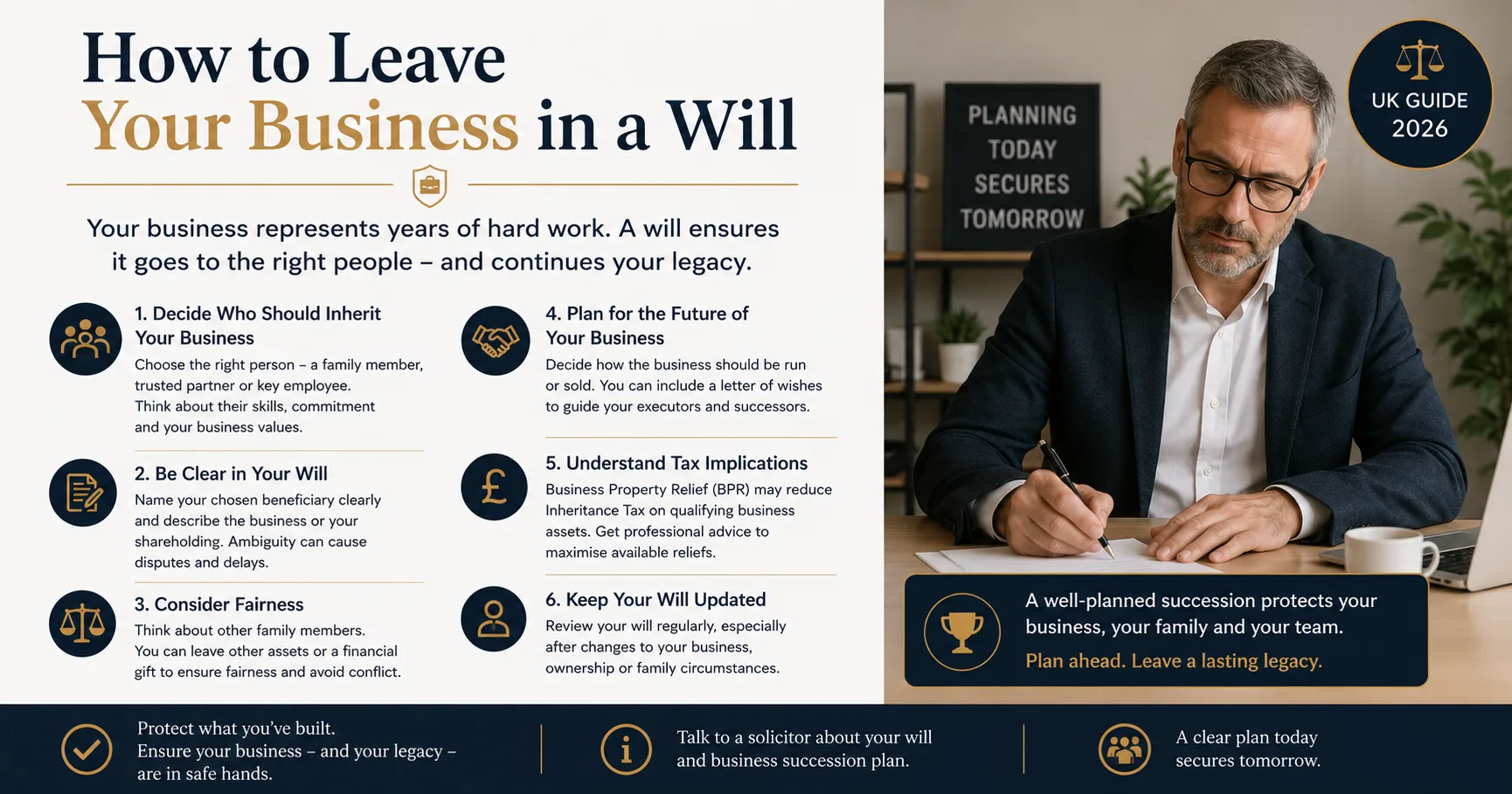
A business is rarely just an asset. It's the years you put in, the staff who depend on it, the customers who rely on it, and — for a lot of UK families — a meaningful share of the household wealth. Leaving it well in a will takes more thought than leaving a house or a savings account.
This guide walks through the practical decisions: who can inherit, what the inheritance tax position looks like, and what you can do now to make sure your wishes are followed.
What counts as "the business" in your will?
The first thing to be clear about is what you actually own. Different structures pass through wills in different ways:
- Sole trader — the business is you. The trading activity ends on death; what passes through your will is the assets (stock, equipment, goodwill, debtor book) and the liabilities.
- Partnership — your share in the partnership passes through your will, but the partnership agreement (or default rules under the Partnership Act 1890) controls whether the business continues.
- Limited company — you own shares, not the business itself. The shares pass through your will. The company keeps trading; the shareholders change.
- Limited liability partnership (LLP) — you own a member's interest, governed by the LLP agreement.
The will deals with your interest — the underlying business carries on (or doesn't) according to its own constitution. That's why the will and the partnership/shareholder agreement need to talk to each other.
Who can you leave the business to?
In principle, anyone — but practically, it's worth thinking about three things:
- Will they want it? Inheriting a working business means inheriting responsibility. Talk to anyone you're considering. A surprised, reluctant heir is the worst outcome for the business.
- Can they run it? A trading business with no competent owner is a liability that depreciates fast. If your obvious heir (often a spouse) isn't equipped to take over, your will should anticipate that.
- Are there restrictions? Many shareholder agreements include pre-emption rights — surviving shareholders can require your shares to be offered to them at a fair value before they can pass to family. The will can't override that contract.
Common patterns:
- Leave to a spouse or partner — straightforward; usually inheritance-tax-exempt
- Leave to children active in the business — often the natural successor route
- Leave shares into a trust — useful where children are too young, or where you want to balance control between active and inactive heirs
- Direct executors to sell — and distribute the proceeds among family
These are the kinds of decisions the Trusted Hands will builder walks you through one at a time.
Inheritance tax: Business Property Relief
For UK business owners, this is the section that matters most.
Business Property Relief (BPR) can reduce the inheritance tax value of qualifying business assets by 50% or 100%. The relief is set out in sections 103-114 of the Inheritance Tax Act 1984 and is one of the most generous reliefs in the tax code.
In broad strokes:
- 100% relief — sole trader business, partnership share, unquoted trading company shares (including AIM-listed)
- 50% relief — quoted controlling shareholdings, certain land/buildings used by the business
Conditions:
- The business must have been owned for at least 2 years before death
- It must be a trading business — investment businesses (property letting, share dealing) generally don't qualify
- The asset must still be owned at death (with some replacement-asset rules)
A few practical points worth knowing:
- BPR is one reason holding family business shares directly can be more tax-efficient than holding cash
- If you sell the business shortly before death, the relief is lost — sometimes deliberate gifting earlier in life makes more sense
- The 2024 Autumn Budget proposed changes to BPR for deaths from April 2026, capping 100% relief at £1 million of combined business and agricultural assets, with 50% relief above that. As of writing in 2026, the legislation reflects those caps. For complex estates, we recommend you seek assistance from a Trusted Hands Advisor or your own legal advice.
This sits alongside the standard £325,000 nil-rate band and £175,000 residence nil-rate band, both frozen until April 2030. You can read more in our guide to inheritance tax in the UK.
Lifetime gifts and the seven-year rule
Many business owners don't wait until death — they pass the business gradually through lifetime gifts. The mechanics:
- A gift of business assets is a potentially exempt transfer (PET)
- If you survive 7 years, it's exempt from inheritance tax entirely
- If you die within 7 years, it's added back to the estate (with taper relief between years 3 and 7)
- BPR can also apply to lifetime gifts in some circumstances
The full mechanics are in our guide to the seven-year rule.
What about partnership and shareholder agreements?
Two contracts you need to look at before drafting the will:
- Partnership agreement — does it provide for the partnership to continue on a partner's death? Does it require the deceased's share to be bought out? At what valuation?
- Shareholders' agreement — does it have pre-emption rights on death? Cross-option agreements? Tag-along clauses?
A will that says "leave my shares to my daughter" is meaningless if the shareholders' agreement requires those shares to be sold back to the company at par. The will and the agreement need to be consistent.
A common arrangement — cross-option agreements with life insurance — lets remaining shareholders buy out the deceased's shares at fair value, with the family receiving cash and the business retaining unified control. These are powerful but technical, and for complex estates, we recommend you seek assistance from a Trusted Hands Advisor or your own legal advice.
Building an estate plan that protects your business? Trusted Hands turns these decisions into a 15-30 minute guided builder. Start free → — only pay when you download.
Practical steps to take now
If you own a business, here's a useful checklist:
- Locate and read your current shareholders' agreement / partnership agreement
- Note any pre-emption or buy-out clauses
- Get a sense of current valuation (a formal valuation isn't needed yet, but a rough number helps)
- Decide who you'd want to inherit and who you'd want to run it (these can be different people)
- Consider whether 2-year BPR ownership is satisfied for all your business assets
- Make sure your will mentions the business specifically, even if just to confirm it falls into the residuary estate
- Review the will whenever the business changes structure — a sole trader who incorporates needs a new will
Frequently asked questions
Should I leave my business to my spouse, even if they don't run it?
It depends. Spouse transfers are inheritance-tax-exempt regardless of BPR, so they're tax-efficient. But they can also "waste" BPR — once your spouse owns the shares, the relief depends on their surviving 2 years of ownership before passing them on. Some couples leave the business directly to the next generation (or into trust) and use other assets to provide for the spouse. For complex estates, we recommend you seek assistance from a Trusted Hands Advisor or your own legal advice.
What if my children don't want the business?
That's a perfectly common and reasonable position. Your will can direct the executors to sell the business and distribute the proceeds. A pre-arranged buyer (typically existing co-owners or senior staff) makes that much smoother — usually documented in a cross-option or buy-sell agreement.
Does the business need to keep running through probate?
Yes, ideally. Trading businesses depreciate fast if they pause. Your executors will need authority to keep things going — choosing executors who understand the business (or at least respect a nominated business manager) is important. Our guide on choosing your executors covers this.
What happens to business debts when I die?
Sole trader debts are personal debts and form part of your estate. Limited company debts stay with the company — the shares pass to your beneficiaries but the personal liability does not (unless you signed personal guarantees). Partnership liability depends on the partnership type and the agreement.
Can I use a trust to control the business after my death?
Yes, and many family businesses do. A trust can hold shares for the long term, with trustees making distributions to beneficiaries while preserving family control. Trusts add complexity and have their own tax regime — useful but not lightweight. For complex estates, we recommend you seek assistance from a Trusted Hands Advisor or your own legal advice.
Ready to write your will?
Trusted Hands is a guided, plain-English will builder. You answer simple questions, see your draft as you go, and only pay when you're ready to download.
- Free to start — no card details to begin
- Smart Will Engine — only asks what's relevant to your situation
- Fixed price — no hourly bills, no surprises
- Annual updates option — keep your will editable as life changes