
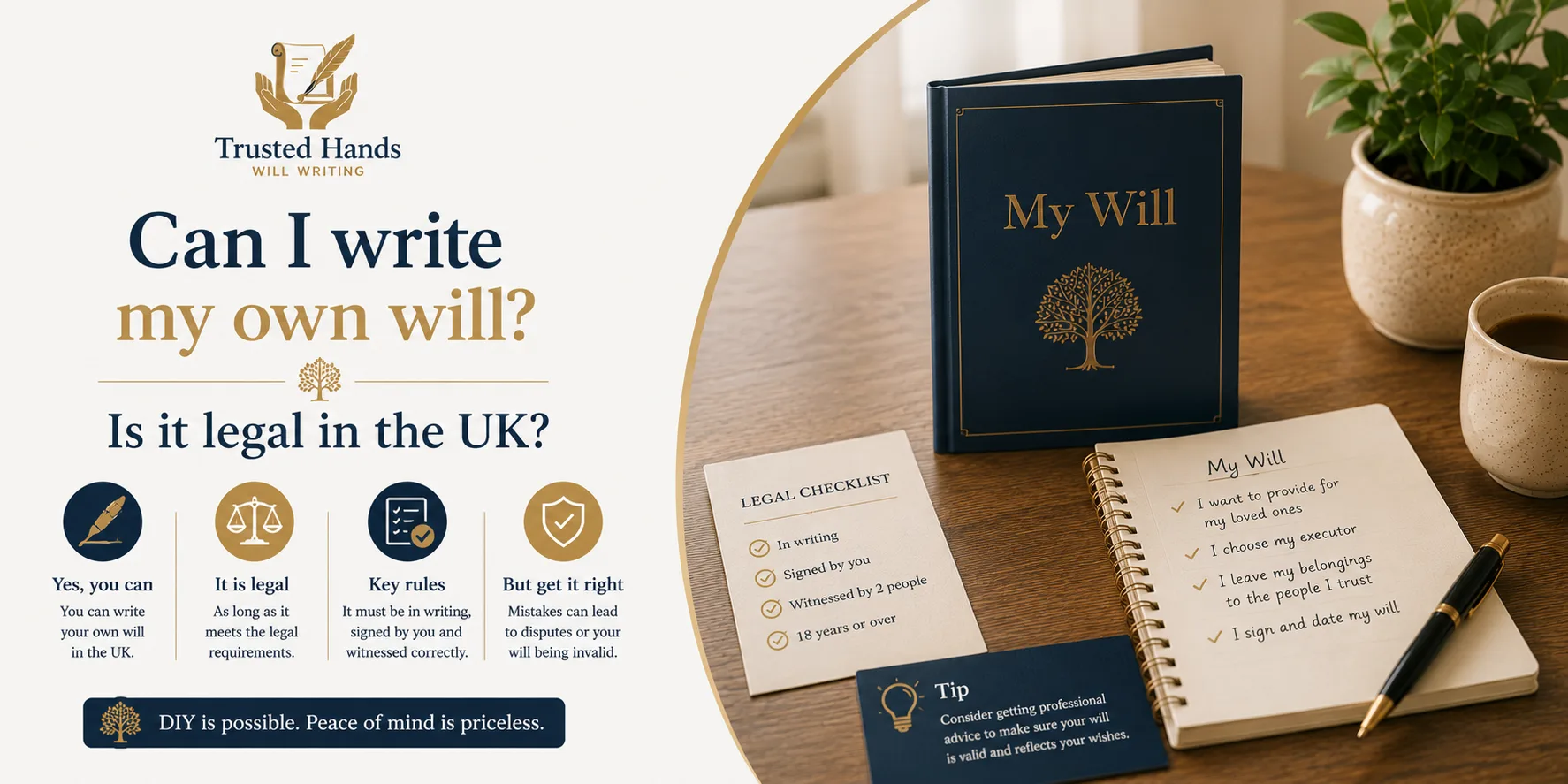
Yes - in England and Wales it is entirely legal to write your own will. There is no requirement to use a solicitor, an online service, or anyone else. The law sets out a list of formalities a will must satisfy, and any document that meets them is valid, regardless of who drafted it. The harder question is whether you should write your own from scratch. This guide covers the law, the practical risks, and where the realistic line is between "fine to do yourself" and "get help."
The legal position
Under the Wills Act 1837 section 9, a will is valid if:
- It is in writing.
- It is signed by the testator (you), or by someone else in your presence and at your direction.
- The signing happens in the simultaneous presence of two adult witnesses.
- Each witness then signs in your presence.
That is the entire legal test. The Act says nothing about who drafted the document, the language used, or the format. A will written by hand on a sheet of paper, witnessed correctly, is just as legal as one prepared by a top City firm.
There is also no requirement that a will be notarised, lodged with anyone, or registered. The signed paper original is the legal document; everything else is admin.
So the answer to "can I write my own will?" is yes, absolutely. The follow-up question - "should I?" - depends on your situation.
What "writing your own" actually means
People usually mean one of three things when they say "DIY will":
- A handwritten will from scratch. Sometimes called a holographic will. Legal in England and Wales, but unusual.
- A fill-in-the-blanks will kit from a stationer or post office.
- A guided online will builder like Trusted Hands.
The first two are what people normally have in mind. The third is something different - it's still you writing the will, but with software and prompts to make sure nothing important is missed.
The risks attached to each are very different.
Why fully DIY wills go wrong so often
The reason solicitors and online services exist is not that the law is hard to satisfy - it's that the drafting is harder than it looks. The most common DIY mistakes are mundane and avoidable, but they break wills:
- No residual estate clause. People list specific gifts and forget to say what happens to everything else. The "everything else" then falls into a partial intestacy, which is usually not what they wanted.
- Ambiguous beneficiary descriptions. "My nephew Tom" - which Tom? "My friend at work" - which friend?
- Vague or impossible gifts. "My car" when you've sold and replaced the car. "My share portfolio" when the portfolio has been wound up.
- Beneficiary witnesses. A beneficiary or their spouse signing as a witness invalidates the gift to them. The rest of the will normally stands, but it's an entirely needless loss.
- Unsigned amendments. Someone strikes a beneficiary out with a pen years later. Not witnessed. Not legal. Now there's a question over the original will too.
- Conditional gifts the will doesn't follow up on. "£10,000 to my daughter if she completes university" - and no fallback if she doesn't.
These aren't theoretical problems. Probate practitioners see them every week. We have a common will mistakes guide with more detail.
Cheap will kits - the worst of both worlds
Will kits - the £10-£25 fill-in-the-blanks booklets sold at large stationers - are responsible for a disproportionate share of disputed estates. They give the appearance of structure while leaving every drafting decision to someone with no training to make it.
The same kit that asks "who do you leave your estate to?" gives no prompt to consider what happens if that person predeceases you, no prompt to deal with stepchildren, no prompt to think about the residence nil-rate band, no prompt to appoint substitute executors. The result looks like a will and behaves like a will - until it gets to probate and falls apart.
If you'd rather just get on with it, our guided will builder is free to start and walks you through these decisions in plain English. The cost difference compared with a kit is small; the safety difference is enormous.
The genuine "you can do it yourself" cases
There are a small number of estates where a fully DIY will is realistic, usually because the situation is genuinely simple:
- A single adult with no children, no property, modest savings, leaving everything to one named person who is clearly identified.
- A married couple with adult independent children, leaving everything to each other and then equally to the children, with no blended-family issues, no business interests, and no IHT concerns.
Even in those cases, a guided service is usually a better idea than a blank sheet of paper, because it forces you to consider scenarios you hadn't thought about (substitute executors, predeceased beneficiaries, the digital legacy).
When you should not draft your own
If any of the following apply, drafting your own will from scratch is risky:
- You're in a blended family - stepchildren, second marriage, ex-partner.
- You're cohabiting but not married.
- Your estate is approaching or above the inheritance tax thresholds (£325,000 nil-rate band plus £175,000 residence nil-rate band, both frozen until April 2030).
- You own a business or business shares.
- You have foreign assets or live partly abroad.
- You want to leave anything in trust - for children, for someone with additional needs, or for tax planning.
- You have a vulnerable beneficiary (someone on means-tested benefits, for instance) where a direct gift could cause problems.
For complex estates, we recommend you seek assistance from a Trusted Hands Advisor or your own legal advice.
What about online will services?
Online will builders are a middle path. You're still the one making the decisions, but the software handles the drafting, the structure, and the formalities. A good one:
- Asks plain-English questions and rewrites them as proper legal clauses.
- Flags scenarios you might not have considered.
- Produces a printable will compliant with the Wills Act 1837.
- Provides clear witnessing instructions.
We compare the routes in detail in solicitor vs online will. For most estates the legal outcome is the same; the cost difference is significant.
Want a guided drafting flow that catches the easy mistakes? Trusted Hands turns these decisions into a 15-30 minute walkthrough. Start free → - only pay when you download.
Frequently asked questions
Is a handwritten will legal in the UK?
Yes - a handwritten will is legal in England and Wales, provided it is signed by you and witnessed by two adults present at the same time. The handwriting itself is irrelevant; the formalities are what matter. That said, handwritten wills are more often disputed because of ambiguity in the wording.
Do I need a solicitor for a will to be valid?
No. There is no legal requirement to involve a solicitor. A will is judged by the document and the way it was signed, not by who drafted it.
Can a typed will I print at home be valid?
Yes - typed and printed wills are valid as long as you sign and witness them correctly. Most modern wills are typed.
What if I make a mistake on a DIY will?
Small mistakes can sometimes be fixed by a witnessed codicil. Larger mistakes - especially around beneficiary descriptions or witnessing - can mean the will fails or needs to be rewritten. Rewriting is usually cleaner than patching.
Can witnesses be family members?
They can be relatives, but they cannot be beneficiaries of the will (or married to a beneficiary). A non-beneficiary family member is fine, but to be safe many people use neighbours or colleagues.
Ready to write your will?
Trusted Hands is a guided, plain-English will builder. You answer simple questions, see your draft as you go, and only pay when you're ready to download.
- Free to start - no card details to begin
- Smart Will Engine - only asks what's relevant to your situation
- Fixed price - no hourly bills, no surprises
- Annual updates option - keep your will editable as life changes