
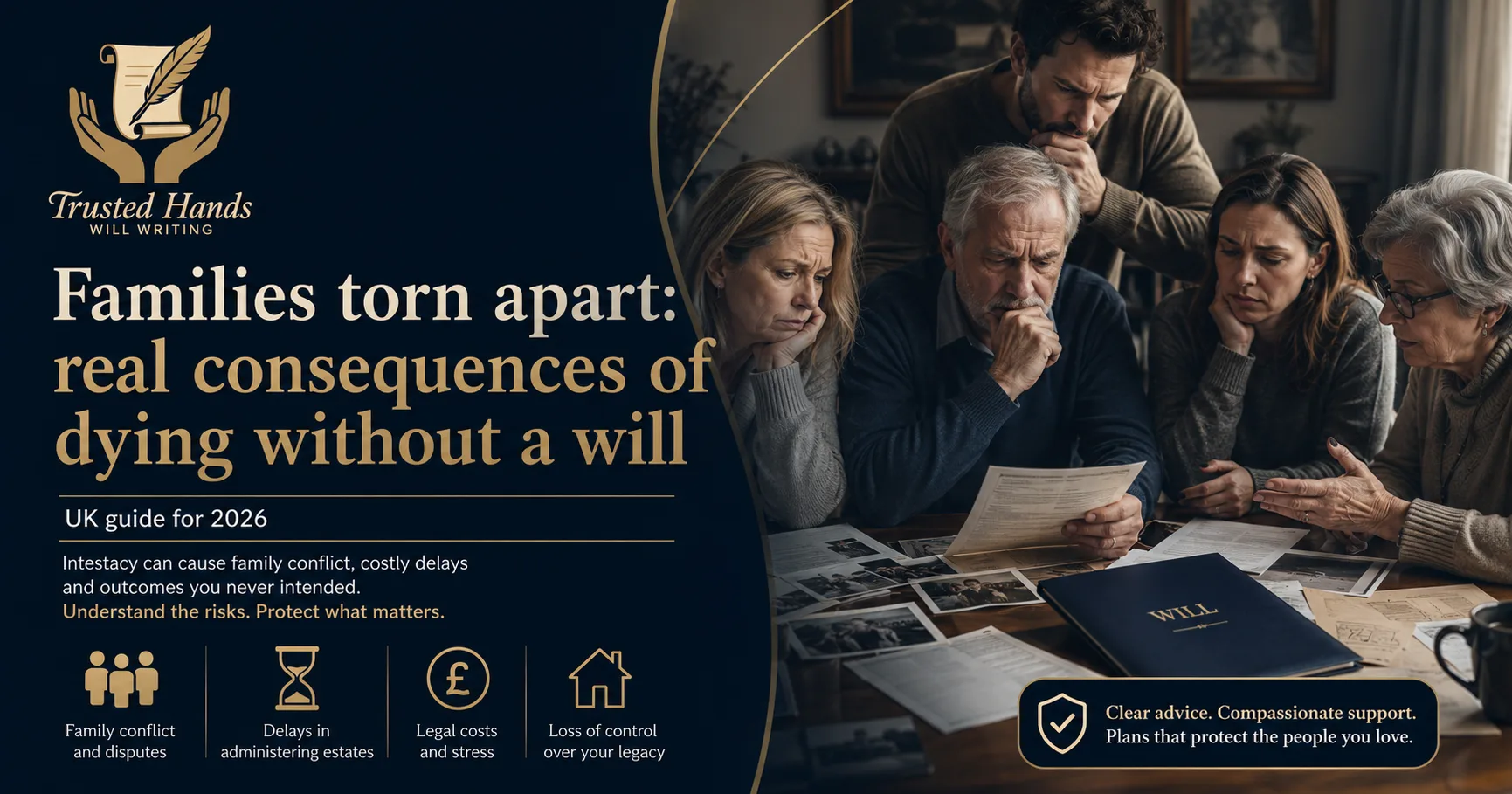
When someone dies without a will, the law decides what happens to their estate. The rules of intestacy are mechanical, fixed, and indifferent to context. They don't know that the deceased had told everyone the house should go to one particular child. They don't know that the long-term partner of fifteen years had no right to anything. They don't know that the estranged spouse was already in a new relationship. They just apply the formula.
For most families, that's at best a frustrating inconvenience. For a meaningful minority, it's the start of years of conflict, legal costs, and broken relationships that never recover. This article walks through the kinds of situations that arise — composite, illustrative scenarios rather than specific named cases — so you can see what's actually at stake when the will doesn't get written.
Why "no will" causes more than just paperwork
The rules of intestacy are set out in the Administration of Estates Act 1925 (as amended). They give priority to:
- The surviving spouse or civil partner (if any), with statutory legacies that have been adjusted upwards over the years
- Children (and their descendants if a child has died)
- Parents
- Siblings (and their children)
- More distant relatives
- The Crown, if no qualifying relatives exist
There's no slot for unmarried partners, no matter how long they've been together. No slot for stepchildren who weren't legally adopted. No slot for close friends, carers, or chosen family. No discretion to favour one child over another. No mechanism to honour what the deceased said they wanted.
The formula is the formula. And that's where the trouble starts.
The kind of situations that arise
These are composite, illustrative scenarios — they reflect the patterns we see again and again, not specific cases or named individuals. None of these stories are about real people; they're the shape of how things go wrong.
The unmarried partner left with nothing
A couple lives together for twenty-two years. They share a home — but it's in his name. They have no children together; she has two from a previous relationship. They never marry, partly out of inertia, partly out of a vague feeling that "common law marriage" gives some kind of protection. He dies suddenly of a heart attack, intestate.
Under the rules of intestacy, she inherits nothing. The house passes to his children from a much earlier marriage, with whom he hadn't been close in years. She has weeks to vacate. Her best route is a claim under the Inheritance (Provision for Family and Dependants) Act 1975 — possible because she lived with him for the requisite two years — but it's contested, expensive, and takes eighteen months to resolve. By the time it's done, the family is permanently fractured.
The fix would have been a will — and arguably marriage, but at minimum, a will. We cover this pattern in detail in cohabiting couples UK will.
The blended family that splits in half
A man in his 60s remarries after the death of his first wife. He has two adult children from the first marriage, his new wife has none. He always tells his children that the house — bought with money from his first marriage — will eventually come to them, and that his wife will be looked after financially in other ways. He never writes this down.
He dies five years into the new marriage. Under the rules of intestacy, the surviving spouse takes the statutory legacy plus half of anything above it; his children share the other half. The house is in his sole name, so it falls into the estate. There's no mechanism to ring-fence it for the children of the first marriage.
The new wife wants to stay in the house; the children want their share, which they can only get by selling. The dispute runs for two years, costs more in legal fees than anyone wants to think about, and ends with the house sold and three people who used to be a family no longer speaking. Our guide on blended families and wills covers the planning options that would have prevented this.
The siblings who turn on each other
Three adult siblings. One has lived with their elderly mother for the last decade as her carer, giving up her own career to do so. The other two visit at Christmas. Mother always says — to anyone who'll listen — that the carer should keep the house, "because she's earned it." But mother never makes a will.
Mother dies. Under intestacy, the estate passes equally between the three siblings. The carer has nowhere to go and no compensation for ten years of unpaid work. The other two siblings, who'd vaguely agreed that "we'll work something out," now find themselves disagreeing about what's fair. Resentments that simmered for years break into the open. The relationships don't survive.
A will, or a deed of variation that all three siblings could have agreed to, would have honoured what the mother actually wanted. Without one, the siblings were forced into a position where being fair to each other meant being unfair to one of them.
The estranged spouse who inherits everything
A husband and wife separate after a long marriage but never finalise a divorce. Both move on; he forms a new long-term relationship; she does too. Neither writes a will. He dies a few years later.
Under the rules of intestacy, the legal spouse — the one he's been separated from for years — inherits as if the marriage were intact. The new partner, who shared his life for the last seven years, inherits nothing. There's no concept of "we'd basically agreed to divorce, we just never got round to it." Either you're divorced or you're not.
The estranged spouse may give up some or all of the inheritance voluntarily; she may not. The new partner has a 1975 Act claim, but the legal cost burns through a chunk of the estate and the outcome is uncertain.
The grandchild who falls between the cracks
A widower has three children — but one of them, the eldest, died in their 40s before their parent did. That deceased child had two children of their own (the grandchildren). The widower also has an adult son and an adult daughter who are still alive.
Under the rules of intestacy, the deceased child's share passes to their own children — the grandchildren — by representation. So far, so straightforward. But the widower had spoken many times about wanting to leave a specific painting to his eldest grandchild, and a specific sum to a charity that helped him after his wife's death.
Neither the painting nor the charity gets anything. The painting passes with the rest of the estate; the charity gets nothing because intestacy has no mechanism for charitable giving. Specific wishes the widower had repeated for years simply evaporate.
If you'd like to spare your own family these situations, start your will online — most people finish in well under an hour.
What's common across all of these
Look across the scenarios and the same threads keep appearing:
- People assumed something was true that wasn't. "Common law marriage" doesn't exist. "Everyone knows what I'd want" isn't legally enforceable. "We'll sort it out" is an aspiration, not a plan.
- Talking about wishes isn't the same as writing them down. The law doesn't act on conversations.
- The cost of fixing it after death is always higher than the cost of writing a will. Often by a factor of ten or a hundred.
- The damage isn't just financial. Family relationships that took decades to build can be destroyed in months.
For a more systematic walk-through of how the rules of intestacy actually work, see dying without a will UK.
Don't let your family figure it out the hard way. Trusted Hands turns these decisions into a 15-30 minute guided builder. Start free → — only pay when you download.
What a will actually changes
Writing a will is the simplest way to ensure your wishes are followed and to spare your family the kinds of conflicts described above. A valid will lets you:
- Name your executors — people you trust to administer the estate
- Specify exactly who gets what, with substitution clauses if a beneficiary dies before you
- Provide for unmarried partners, stepchildren, friends, carers, charities — anyone who matters to you, regardless of whether the rules of intestacy would recognise them
- Appoint guardians for minor children
- Reduce inheritance tax through structuring — gifts, exemptions, the residence nil-rate band
- Leave a letter of wishes alongside the will, explaining your reasoning
It doesn't take long. It doesn't cost much. And it works.
For complex estates, we recommend you seek assistance from a Trusted Hands Advisor or your own legal advice — particularly for blended families, business assets, overseas property, or where you're knowingly making provision that some relatives might dispute.
Frequently asked questions
Doesn't common law marriage protect long-term partners?
No. There's no such thing as common law marriage in England and Wales. No matter how long an unmarried couple have lived together, the surviving partner inherits nothing automatically under the rules of intestacy.
What if everyone in the family agrees to do something different from intestacy?
If all the beneficiaries agree, they can use a deed of variation to redistribute the estate within two years of the death. It works — but it requires unanimous agreement. One holdout breaks the deal.
Can my long-term partner make a claim if I die without a will?
Possibly, under the Inheritance (Provision for Family and Dependants) Act 1975, if they lived with you for at least two years immediately before your death. But it's a contested claim, takes time, and costs money — much more than a will would have.
What about my pension and life insurance?
These often pass outside the estate, under nomination forms held by the provider. They're not affected by intestacy. But everything else — house, savings, possessions — goes through the rules of intestacy if there's no will.
How quickly can I get a will written?
Quickly. A guided online will builder typically takes 15-30 minutes for a straightforward situation. More complex estates take longer — but even then, days rather than weeks. The single biggest delay is the decision to start.
Ready to write your will?
Trusted Hands is a guided, plain-English will builder. You answer simple questions, see your draft as you go, and only pay when you're ready to download.
- Free to start — no card details to begin
- Smart Will Engine — only asks what's relevant to your situation
- Fixed price — no hourly bills, no surprises
- Annual updates option — keep your will editable as life changes