A trust is a legal arrangement where one or more people (the trustees) hold and manage assets for the benefit of one or more other people (the beneficiaries). When a trust is created inside your will, it doesn't come into existence until you die - which is why it's called a testamentary trust. Trusts add a layer of control and flexibility that a simple "give everything to X" gift cannot. They are not just for the wealthy; many ordinary families use them to protect children, support a vulnerable beneficiary, or ringfence a share of the estate for a particular branch of the family.
This guide covers the most common trust types used in UK wills, when each makes sense, the tax implications, and the practical questions every will-maker should ask before using one.
Key takeaways:
- A trust separates legal ownership (the trustees) from beneficial ownership (the people who get the benefit). It's a way of saying "look after this for someone else".
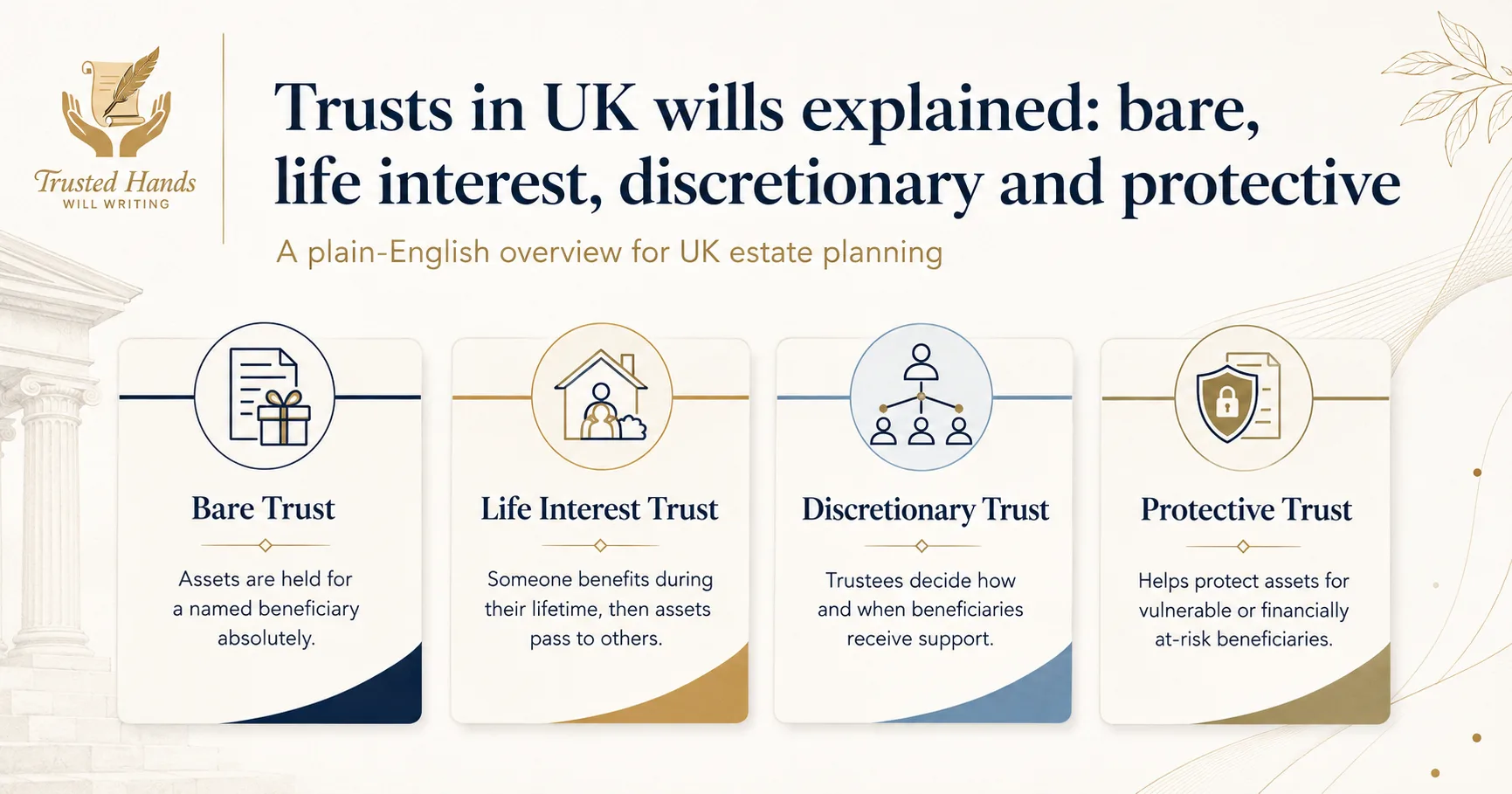
- The most common UK will trusts are: bare trusts (simplest, child reaches 18, gets the assets), life interest trusts (one person gets the income for life, the capital passes on later), and discretionary trusts (trustees decide who gets what, when).
- Trusts have tax consequences - income tax, capital gains tax, and (for discretionary trusts) periodic IHT charges. A trust solves one problem but adds tax admin.
- For most families, trusts are useful for children under 18, vulnerable beneficiaries, blended families, and protecting a property share. They are usually overkill for straightforward "leave it to my spouse and children" wishes.
- Trusts should be drafted with legal advice if there is any complexity. The wrong trust in the wrong situation is worse than no trust at all.
What a trust does
A simple gift in a will - "I leave £50,000 to my daughter Emma" - means Emma owns the money outright the moment probate completes. She can spend it tomorrow, lend it to her boyfriend, lose it in a divorce, or have it factored into a means-tested benefit assessment.
A trust says instead: "I leave £50,000 to my trustees, to hold for Emma on these terms." The trustees are the legal owners; Emma is the beneficiary. The terms can be tight ("pay her the income only") or loose ("distribute as the trustees see fit") or anything in between.
The trustees have a legal duty - a fiduciary duty - to act in the beneficiaries' best interests, follow the terms of the trust, and keep accurate accounts. They can be family members, friends, professionals, or a mixture.
The four common UK will trusts
1. Bare trust
The simplest. The trustees hold the asset for a single beneficiary who is absolutely entitled to it. The beneficiary can demand the asset at age 18 (16 in Scotland).
Used for: Children under 18 receiving money or property. The trust is essentially a holding mechanism until they're old enough to receive the gift directly.
Tax: The income and gains are treated as the beneficiary's, not the trust's, for tax purposes. Simple.
2. Life interest trust (also called an interest-in-possession trust or IPDI)
One person (the life tenant) is entitled to the income of the trust or the use of the asset (typically the right to live in a house) for their lifetime. After they die, the underlying capital passes to the remainder beneficiaries.
Used for: Blended families. Classic example: you leave your share of the family home in trust to give your second spouse the right to live there for life, with the property passing to your children from your first marriage after your spouse dies. Without the trust, you'd have to choose between protecting your spouse and protecting your children.
Tax: Treated as if the life tenant owns the trust assets for IHT purposes (which means the asset is in their estate when they die - but it doesn't affect their nil-rate band thresholds because of "immediate post-death interest" rules).
See our blended families guide for the most common scenario.
3. Discretionary trust
The trustees have discretion over which beneficiaries receive what, when, and how much. The will sets out a class of potential beneficiaries (e.g. "my children and grandchildren and their spouses") and the trustees decide.
Used for: Flexibility. Common in three situations:
- Vulnerable beneficiaries - a beneficiary with addiction, mental health issues, or a disability that affects their ability to manage money. The trustees protect them from themselves.
- Means-tested benefits - assets in a discretionary trust generally don't count for means-tested benefit assessments, because no individual beneficiary has a right to them.
- Family flexibility - your trustees can respond to changing circumstances after your death (one child unexpectedly wealthy, another struggling) in ways you couldn't anticipate when writing the will.
Tax: Trickier. Discretionary trusts face their own IHT regime: a 10-year periodic charge (currently up to 6% of value over the nil-rate band) and exit charges when assets leave the trust. Plus the trust pays income tax at the higher rates (45%) on undistributed income. Income tax is reclaimable by lower-rate beneficiaries via Form R40.
The complexity here means discretionary trusts almost always need a solicitor's drafting. Get it wrong and the tax bill alone can eat the trust.
4. Protective property trust (a type of life interest)
A specific use of the life-interest trust focused on the family home. You leave your share of the home in trust so that:
- Your surviving spouse (or partner) can live there for life.
- Your children eventually inherit your share.
- If your surviving spouse needs care, the local authority cannot count your share of the home in the means assessment.
This is often oversold by unregulated "asset protection" firms as a way to avoid care fees entirely. The reality is more limited: a properly drafted PPT can protect your share, but the surviving spouse's share is still assessable, and HMRC and local authorities will challenge clumsy arrangements. Take regulated legal advice before using one.
When trusts make sense
The honest answer is: less often than you'd think. For a typical estate plan - "leave it to my spouse, then to my children equally" - trusts add complexity, cost, and tax overhead without adding much benefit. The Wills Act 1837, the spouse exemption, and clean residuary gifts already handle the standard cases.
Trusts earn their complexity when:
- You have children under 18 - bare trusts for any gift over a few thousand pounds.
- You're in a second marriage - life interest trust to protect both your spouse and your children from a previous relationship.
- A beneficiary is vulnerable - discretionary trust so the trustees can act protectively.
- A beneficiary is on means-tested benefits - discretionary trust avoids accidentally disqualifying them.
- Your estate is large enough that IHT planning matters - properly structured trusts can defer or reduce IHT across generations.
- You own a family business - trust structures can pass shares without forcing a sale.
For all the other cases, a clean simple will is better. Resist anyone selling you a trust as a one-size-fits-all solution.
Trusted Hands handles bare trusts for under-18 beneficiaries automatically. Our guided builder asks the right questions about children and recommends straightforward trust language without overcomplicating it. For life-interest or discretionary trust planning, we partner with regulated solicitors. Start your will →
Who can be a trustee
Trustees can be:
- Family members (most common). Spouse, adult children, siblings.
- Friends you trust to act objectively.
- Professionals (solicitors, accountants, trust corporations). They charge from the trust assets.
- A mix - one family member and one professional is a popular combination.
Choose trustees with three qualities: honesty, administrative competence (or willingness to instruct help), and availability for the long term. A trust for a 3-year-old beneficiary might run for 15 years before distribution; the trustees need to still be around and able to act.
You can name up to four trustees in a will. Always name at least one substitute in case a trustee dies, refuses to act, or loses capacity.
Frequently asked questions
Are trusts only for rich people?
No. Bare trusts for any meaningful gift to a child under 18 are essentially universal - any will leaving money to grandchildren is using a trust, usually without the will-maker realising. Trusts only become "rich people" tools when you start using discretionary or life-interest trusts for IHT planning at the top end.
Can my spouse and I be trustees together?
Yes, very commonly. For a will trust for your children, naming both spouses as trustees (or one spouse plus a substitute) is standard. Just remember that a single trustee should ideally not also be the sole beneficiary of the same trust fund - it defeats the point.
Do trusts avoid inheritance tax?
Some trust structures defer or reduce IHT; others incur their own IHT charges. There is no general "trusts = no IHT" rule. The classic IHT-efficient trust uses are: putting life insurance "in trust" so the payout falls outside the estate, and structured generational trusts for large estates. Both need regulated advice.
What happens if a trustee dies?
The surviving trustees continue. If the will named substitutes, they step in. If no substitutes are named and all trustees are gone, the court can appoint replacements - costly and slow. Always name substitutes.
Can trustees do whatever they want?
No. Trustees are bound by the terms of the trust and by the general law of trusts (the Trustee Act 2000 and case law). They must act in the beneficiaries' best interests, keep accurate accounts, avoid conflicts of interest, and follow any specific instructions in the will or letter of wishes. They can be sued for breach of trust.
How long can a trust last?
Most UK trusts can last up to 125 years (the perpetuity period under the Perpetuities and Accumulations Act 2009). In practice, most family trusts wind up within 18-30 years of being created.
Can I change my mind about a trust I've put in my will?
Yes. The trust doesn't exist until you die. While you're alive, you can rewrite the will (and the trust within it) at any time. Some testamentary trusts can also be unwound after death by deed of variation if all beneficiaries agree - see our codicil guide.
Trusted Hands is a UK will-writing service, not a firm of solicitors and not a tax adviser. Bare trusts for minor children are handled within our guided builder; life-interest and discretionary trust structures benefit from regulated legal advice and we strongly recommend you speak to a solicitor before including them in your will.
Need a will that handles trusts properly?
For straightforward estates, Trusted Hands builds a clean will with sensible bare trusts for any minor beneficiaries automatically. For more complex trust needs, we'll flag the complexity during the build and point you to a regulated solicitor partner.
- Start free - only pay when you download
- Smart Will Engine flags trust scenarios automatically
- Bare trusts for under-18 beneficiaries built in
- Solicitor partnership for complex trust planning