
Estate planning is the umbrella term for everything you put in place during your lifetime to make sure your money, property, possessions and dependants are looked after if you become unable to manage things yourself - or after you die. It is far bigger than just writing a will. A proper estate plan in 2026 covers your will, your Lasting Powers of Attorney, your pension nominations, your life insurance, the way you own your home, and the conversations you have with your family about what you've decided.
This guide is the pillar overview: what estate planning includes, what people typically miss, and how to put a sensible plan in place without getting lost in jargon.
Key takeaways:
- Estate planning is not just a will. A complete UK plan covers your will, your LPAs, your pension and life insurance nominations, property ownership, and (sometimes) trusts.
- Most adults need at least three documents: a will, a Property & Financial LPA, and a Health & Welfare LPA.
- Pensions and life insurance often sit outside your will - they pay to the named beneficiary, regardless of what the will says. Check your nominations are current.
- Inheritance tax affects only about 4% of UK estates but can be reduced significantly with planning. The 2026 nil-rate bands give most couples a combined £1 million threshold before any IHT.
- Estate planning is iterative: review every 3-5 years and after major life events. It is not a one-and-done.
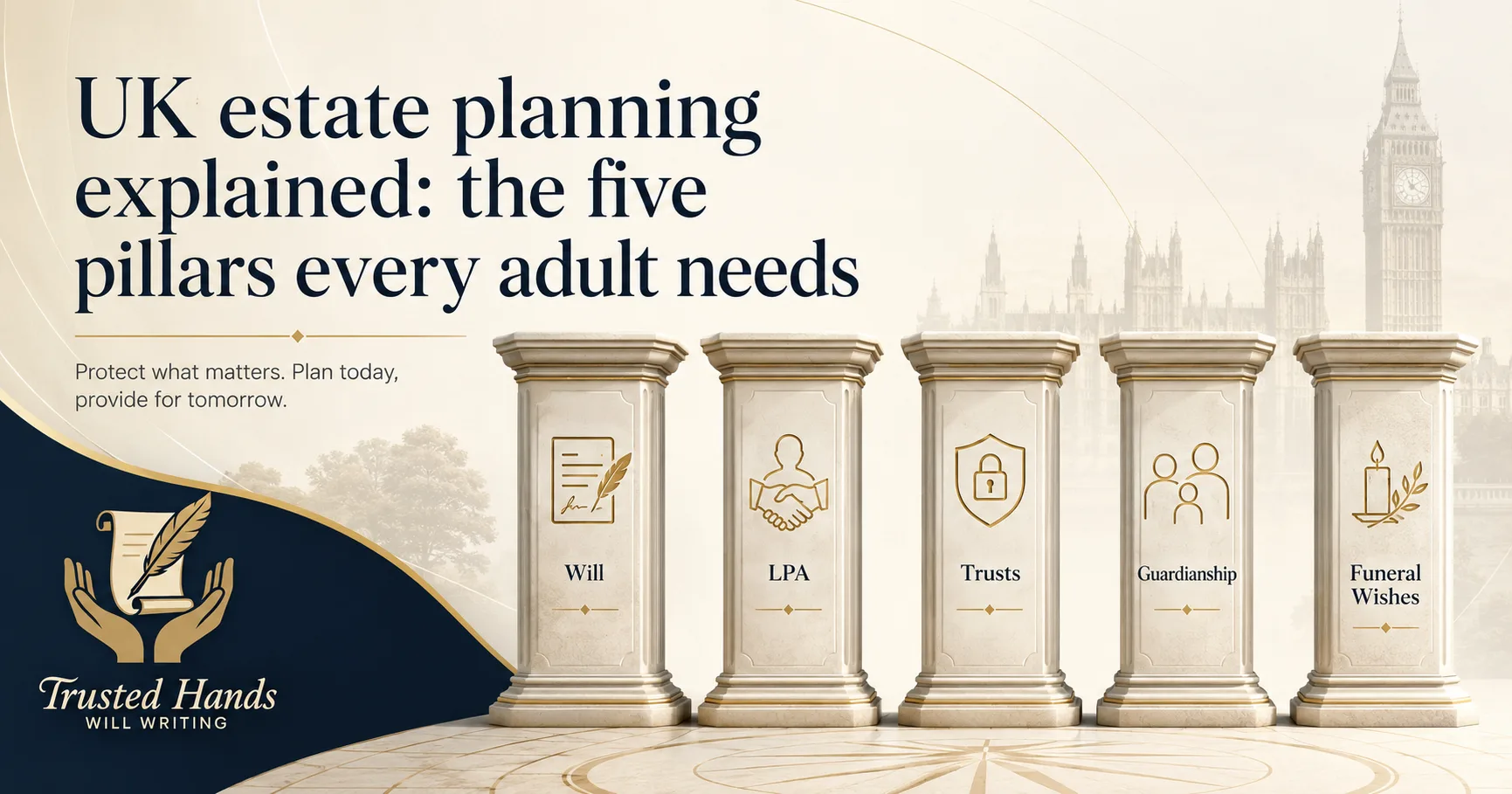
The five pillars of a UK estate plan
A complete estate plan in England and Wales rests on five separate decisions:
1. Your will
Your will controls everything that forms part of your estate: assets held in your sole name, your share of jointly-owned property held as tenants in common, and any cash, possessions or investments not otherwise designated. It is the only document that lets you choose:
- Who inherits what
- Who acts as executor
- Who looks after your children under 18
- Specific gifts, charity bequests, funeral wishes
Without a will, the intestacy rules decide - and they don't know about your unmarried partner, your stepchildren, your favourite charities, or which of your children needs the most help. See what happens if you die without a will and what is a will for the foundations.
2. Your Lasting Powers of Attorney
A will deals with what happens after you die. LPAs deal with what happens if you lose mental capacity while you're alive - through illness, an accident, a stroke or dementia. Without an LPA, your family has to apply to the Court of Protection for a deputyship order: slow, expensive, intrusive, and limited.
Most adults need both:
- Property & Financial Affairs LPA - paying bills, managing investments, selling property
- Health & Welfare LPA - medical decisions, care home choices, life-sustaining treatment
You can only make LPAs while you have capacity. Once it's lost, the option is gone.
3. Your pension and life insurance nominations
This is the pillar most people forget. Pensions and life insurance usually sit outside the will. They pay to whoever is named on the beneficiary nomination form held by the provider, regardless of what the will says.
- Workplace and personal pensions - check the nomination form with each provider. Many people nominate an ex-spouse and never update it.
- Life insurance - if not "written in trust", it pays into the estate (and counts for IHT). If written in trust, it pays direct to beneficiaries (faster, no IHT).
- State pension - dies with you, nothing to nominate.
- ISAs - mostly form part of the estate, but a spouse can inherit the ISA allowance (the "additional permitted subscription").
Check these every couple of years. They are free to update and the consequences of an out-of-date nomination can be much larger than any will issue.
4. Your property ownership
How you own your home determines what happens to it. Two options exist for jointly-owned property:
- Joint tenants - the property passes automatically to the surviving owner by survivorship, outside the will. Common for married couples who want the simplicity.
- Tenants in common - each owner has a defined share. Your share passes under your will (or intestacy rules). Common for unmarried couples, second marriages, or anyone wanting to protect their share for their own children.
See our tenants in common vs joint tenants guide for the implications. Switching between the two is straightforward and is often the missing piece of a blended-family estate plan.
5. The conversation
The document nobody talks about. Telling your family what you've decided - who the executors are, where the will is stored, what your funeral preferences are, whether you've made LPAs - is what makes the documents actually work. The most carefully drafted plan can stall for months if your executors don't know it exists.
Trusted Hands includes a free Executor Pack you can share or print so the people you've named know what they're being asked to do.
How the pieces fit together
A typical estate plan for a married couple in their 50s with two adult children might look like:
| Document | Purpose |
|---|---|
| Mirror wills (one each) | Leave everything to surviving spouse; on second death, split between children. Name children as executors. |
| Property & Financial LPA each | Each spouse acts as the other's primary attorney; adult children as substitutes. |
| Health & Welfare LPA each | Same attorneys, with preferences about end-of-life care recorded. |
| Pension nominations | Updated to name spouse (then children equally as backup). |
| Life insurance | Written in trust to the children. |
| Property ownership | Joint tenants (default for most spouses). |
For an unmarried couple with one child from a previous relationship the picture is different: probably tenants-in-common ownership, separate wills with carefully drafted trusts, and conversations about which assets pass to which side of the family. See our cohabiting couples guide and blended families guide for the variations.
Trusted Hands bundles the will and both LPAs together for a 25% discount. Build everything in one guided journey, save your draft as you go, and only pay when you finalise. Start your will →
Inheritance tax planning
UK inheritance tax (IHT) only applies to estates above the threshold. In 2026 the headline figures are:
- Nil-rate band: £325,000 per person
- Residence nil-rate band: up to £175,000 per person, if the home passes to direct descendants
- Spouse exemption: anything left to a spouse or civil partner passes IHT-free, and any unused nil-rate band transfers to the survivor
For most married couples this gives a combined threshold of up to £1,000,000 before any IHT is due. Only about 4% of UK estates pay any IHT at all.
For larger estates, planning can reduce or eliminate the bill:
- Lifetime gifts - the 7-year rule means gifts you survive by seven years fall outside your estate entirely. See our 7-year rule guide.
- Charitable bequests - gifts to registered charities are IHT-free, and leaving 10%+ of the net estate to charity reduces the IHT rate from 40% to 36% on the rest. See charity gifts in a will.
- Trusts - more complex but can ringfence assets for future generations. See trusts in wills.
- Pension structuring - some pensions sit outside the estate entirely, making them an IHT-efficient inheritance vehicle.
For complex estates, take advice from a regulated financial planner. Our inheritance tax guide and IHT reduction guide cover the main strategies.
When to start estate planning
Now. The two most common regrets we hear are:
- "We meant to update the will after the divorce" - and then the ex-spouse inherited.
- "Mum said she'd do her LPA next year" - and then capacity was lost and the family spent £3,000 on a Court of Protection application.
There is no minimum age or estate size that triggers the need. The triggers are life events:
- Marriage, civil partnership, divorce, separation
- Birth or adoption of a child
- Death of an existing executor or beneficiary
- Moving house, buying a second property, inheriting a property
- Starting or selling a business
- Significant change in income or savings
- Diagnosis affecting capacity (do it immediately)
- Every 3-5 years as a check-up regardless
Frequently asked questions
Do I need a solicitor for estate planning?
Not for most situations. A guided online service like Trusted Hands handles wills and LPAs for the majority of UK adults. Take advice from a regulated solicitor if you have: business interests, foreign property, an estate over £1 million, a complex family situation, or are considering trust structures. For the rest of us, guided online plus a financial adviser for tax planning is plenty.
How much should a complete estate plan cost?
A simple plan (will + both LPAs) typically costs £200-£500 online or £800-£1,500 through a solicitor. Add an annual subscription to keep things current and the total is modest compared to the cost of getting it wrong. Trusted Hands bundles will + LPAs at a 25% discount.
How often should I review my plan?
Every 3-5 years and after every major life event. The most common stale element is the pension nomination - check it whenever you change job.
What's the difference between a will and an estate plan?
A will is one document within an estate plan. An estate plan also includes your LPAs, pension and insurance nominations, property ownership choices, and any tax planning. A will alone is necessary but not sufficient.
Can I do estate planning if I have very little?
Yes. Estate planning isn't about wealth - it's about choice. Even with modest assets you have choices to make about who inherits, who acts as your attorney if you lose capacity, and who looks after children. A free pension nomination update and a £49 will is a complete starter plan.
Will my LPAs still work after I die?
No. An LPA ends on the death of the donor (the person who made it). After death, the executors named in the will take over.
Should I put my house in trust?
Be very cautious of "asset protection trust" sales pitches. For most families, putting a home in trust during your lifetime creates more problems than it solves: capital gains tax, IHT consequences, and potential challenges if it looks like deliberate deprivation of capital for care fees. Take regulated independent advice before considering it. See our trusts in wills guide for trust structures that do make sense.
Trusted Hands is a UK will-writing and LPA preparation service, not a firm of solicitors and not a regulated financial adviser. The guidance above is general; tax and trust planning specifically benefit from advice from a regulated solicitor or financial planner appropriate to your circumstances.
Start your estate plan today
Trusted Hands brings the three core documents together in one guided online journey:
- Will from £49
- LPA preparation pack from £99
- Will + both LPAs bundle - save 25%
- Annual Subscription with Family Vault - unlimited updates, encrypted document storage for the whole family
- Free Executor Pack included with every will