
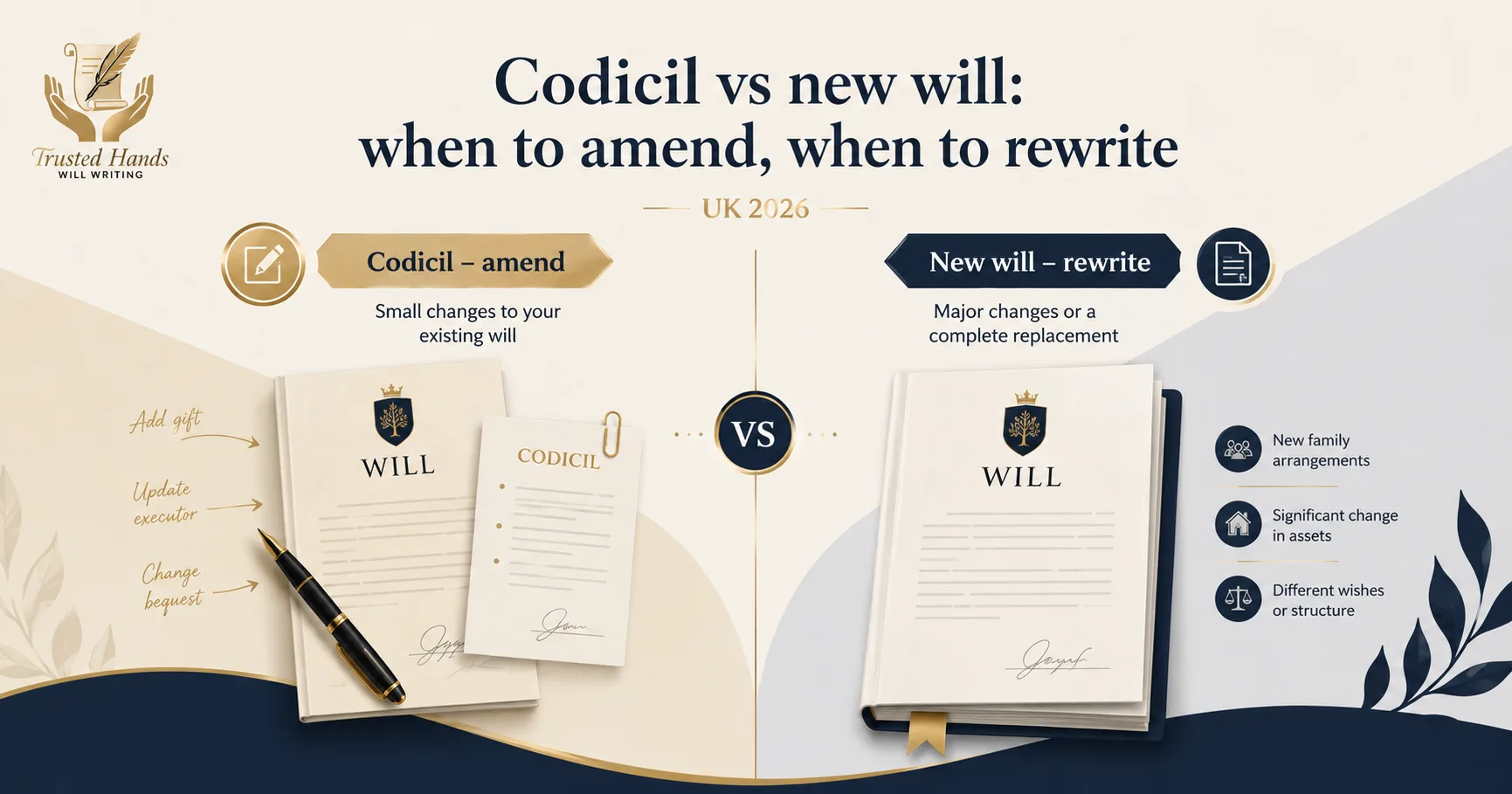
A codicil is a short legal document that amends an existing will without replacing it. It is the traditional way to make small changes - update an executor, add a beneficiary, change a specific gift - without going through the full process of drafting and signing a brand new will. Codicils are simple in concept and ancient in origin, but in 2026 they are usually the wrong choice. This guide covers what a codicil is, the strict rules it has to follow, and why most modern will-writers should just write a fresh will instead.
Key takeaways:
- A codicil is a separate document that amends a specific clause in an existing will. The will and the codicil are read together.
- Codicils must follow the exact same formalities as a will: in writing, signed by the testator, witnessed by two adults present at the same time.
- If a beneficiary witnesses a codicil, their gift in the original will can be voided. The rules of the Wills Act 1837 apply to every codicil.
- For most situations a new will is better than a codicil: clearer, no risk of contradiction between documents, and the cost difference is negligible with modern online services.
- The one case where a codicil still makes sense is a single, very small change to an otherwise unchanged will - and even then, a fresh will rarely costs more.
What a codicil actually does
A codicil is an "addendum" to a will. It identifies the original will (by date and testator name), specifies the change being made, and is signed and witnessed in exactly the same way as the will itself. When the testator dies, the executors present both documents to the Probate Registry. The original will and any codicils are treated as a single combined document for probate purposes.
A codicil can:
- Replace an executor (someone has died, moved abroad, or fallen out of contact)
- Add or remove a specific gift
- Change the amount of a money gift
- Update a beneficiary's name (e.g. a daughter has married and changed her name)
- Add a new beneficiary to the existing list
- Revoke a specific clause without replacing it
What a codicil cannot do is rewrite the residue of the estate or make sweeping changes - the document gets unwieldy fast, and the risk of conflict between the will and the codicil grows.
The strict legal formalities
A codicil is a will-equivalent document. The Wills Act 1837 section 9 applies in full:
- It must be in writing.
- It must be signed by the testator (or by someone in the testator's presence and at their direction).
- The testator must sign in the presence of two adult witnesses present at the same time.
- Both witnesses must then sign in the testator's presence.
- Witnesses must be 18 or over and not beneficiaries of the will or any codicil (and not married to anyone who is).
The witnessing rules are particularly important. Many people assume that because a codicil is "just a small change", the formalities can be more relaxed. They cannot. A codicil witnessed by a beneficiary of the original will voids that beneficiary's gift - even though the gift is in the will, not in the codicil. See our will mistakes guide for how often this catches people out.
When a codicil still makes sense
There is a narrow case where a codicil is genuinely the better choice:
- The change is single and trivial (e.g. swapping one executor for another, or changing a charity's registered name).
- The original will is otherwise still correct.
- You want to avoid resetting the dates on a complex will that has already been through estate planning advice.
- The will is held in storage with the Probate Service or a solicitor and you want to add a small change rather than withdraw and replace.
In these specific situations, a properly executed codicil is fine. The risk is small and the change is auditable.
Why a fresh will is almost always better
For most other amendments, a fresh will beats a codicil in every dimension:
- Clarity at probate. One document, one set of wishes. Executors don't have to cross-reference the will against one or more codicils to work out what the current position is.
- No contradiction risk. A codicil that amends one clause but accidentally conflicts with another can cause expensive disputes. A fresh will starts clean.
- Automatic revocation of older documents. A new will containing the standard revocation clause ("I revoke all previous wills and testamentary dispositions") wipes out the old will and any codicils in one stroke.
- Modern guided builders make it easy. When a Trusted Hands will costs from £49, the marginal saving of a codicil is essentially zero. Even traditional solicitors will quote similar fees for a codicil and a simple new will.
- Future-proofing. If your circumstances are changing enough to warrant any change, they probably warrant a full review.
Saving £49 isn't worth the legal complexity of stacking codicils on top of a will. A guided fresh will from Trusted Hands takes 15-30 minutes and includes a clean revocation clause - your executors deal with one document, not three. Start a fresh will →
What happens if you stack codicils
The legal position is that a will and all subsequent codicils are read together. In practice, that gets messy fast:
- Codicil 1 changes the residual beneficiary.
- Codicil 2 (added two years later) changes one of the specific legacies.
- The original will appoints an executor who has now moved to Australia and never been replaced.
- A fourth document - a "letter of wishes" that the testator thought was binding - is found in the safe.
At probate, the executors and beneficiaries have to make sense of four documents at once. Disputes are more likely. Costs go up. Family members are more likely to fall out over interpretation.
A fresh will avoids the whole mess. The revocation clause in the new will sweeps away the old will and every codicil; your wishes are in one place; and the document is signed and witnessed in a single sitting.
How codicils interact with marriage and divorce
Marriage automatically revokes a will under section 18 of the Wills Act 1837 - unless the will was specifically drafted "in expectation of" that marriage. The same rule applies to codicils made before the marriage: they fall with the will. Any codicil signed before a marriage is gone.
Divorce does not revoke the will, but section 18A treats your ex-spouse as if they had died before you for the purpose of any gift or executor appointment. Again, any codicil that refers to the ex-spouse is read the same way. If you've divorced and want to keep some gifts but remove others to your ex, a fresh will is far cleaner than trying to amend with codicils.
See our updating your will after divorce and when to update your will guides for the trigger events.
Frequently asked questions
How much does a codicil cost?
A solicitor typically charges £100-£250 for a simple codicil. Online services often don't offer codicils as a separate product because a fresh will from £49 is cheaper and cleaner. There's no Probate Registry fee for adding a codicil during your lifetime - the cost is just the drafting and witnessing.
Can I just hand-write a change into my will?
No. Any hand-written change to a signed will is presumed invalid unless it was separately signed and witnessed under the Wills Act formalities. If you cross something out or scribble a new amount, the original wording stands. See our will mistakes guide for how this typically plays out.
Can a witness to my will also witness my codicil?
Yes, provided they are not a beneficiary (or married to one) at the time the codicil is signed. The witnessing rules in section 9 apply to each document independently.
Does a codicil need to be stored with the will?
It should be. The original signed will and any original signed codicils all need to be presented to the Probate Registry. Keep them together in the same safe location and tell your executors that more than one document exists. A codicil tucked into a separate drawer that no one knows about can be missed entirely.
Is there a limit to how many codicils I can have?
There's no legal limit, but practical guidance is: more than one or two codicils per will is a red flag. At that point, the document is hard to read and the chance of error or contradiction has grown enough to warrant a fresh will.
What if I lose the original will but still have the codicil?
This is a probate nightmare. A codicil can only operate as an amendment to a known will. If the will itself is lost, the codicil hangs in the air without context. The courts may rebuild the will from copies and the codicil, but the process is slow and contested. Keep originals safe together - our will storage guide covers the best options.
Can a codicil be made online?
The drafting can happen online or anywhere. What matters is the signing: paper, wet-ink signature, two adult non-beneficiary witnesses present at the same time. The same rules that apply to a will apply to a codicil.
Trusted Hands is a UK will-writing service, not a firm of solicitors. For most amendments to an existing will, we recommend writing a fresh will rather than adding a codicil - it's cheaper, clearer, and removes risk. For genuinely complex situations (existing tax planning, trust arrangements, ongoing litigation), take advice from a regulated solicitor before changing your will.
Time to refresh your will instead?
If you're thinking about a codicil, you probably need a fresh will. Trusted Hands makes it easy:
- From £49 for a fresh single will
- Automatic revocation of your old will built into the new one
- 15-30 minutes to complete
- Guided Witness Mode so the signing is done right
- Annual updates available - never need a codicil again