
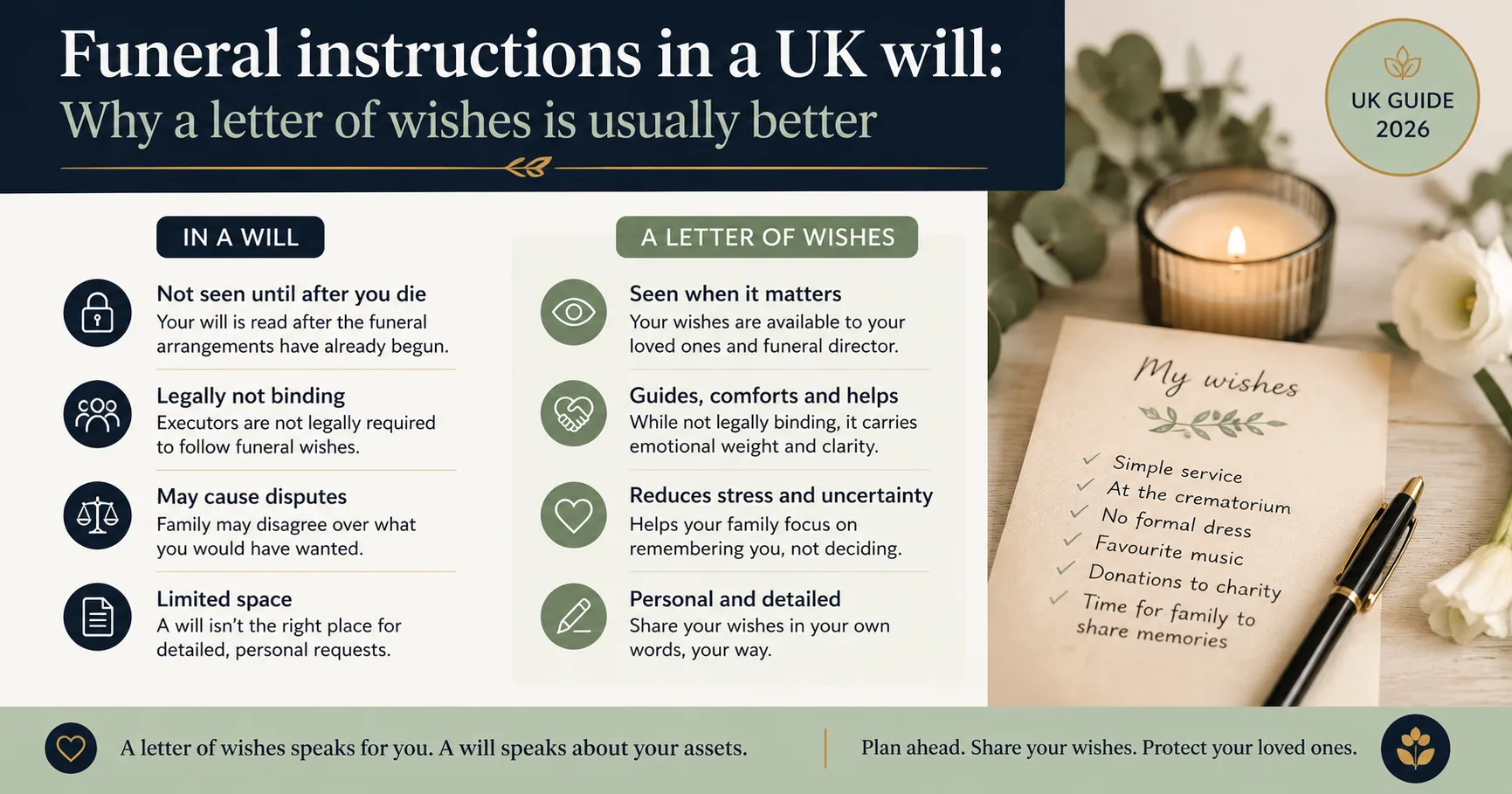
Most people assume their will is the right place for funeral instructions. It usually isn't. By the time the will is found, read and acted on, your funeral has often already happened. And even when the will is read in time, funeral wishes in a will are not legally binding in England and Wales - the executors decide, with no legal duty to follow what the will says. This guide covers how funeral wishes actually work in the UK, where to put them so they're found in time, and the small handful of arrangements that do bind your executors.
Key takeaways:
- Funeral instructions in a will are not legally binding in England and Wales. Your executors have full discretion over the funeral arrangements and ultimate possession of the body.
- A will is also often too slow - it may not be read until after the funeral has taken place.
- Funeral wishes are better recorded in a letter of wishes kept with the will, a funeral plan taken out during your lifetime, or a conversation with your executors and family in advance.
- A prepaid funeral plan is the closest you can get to binding your funeral arrangements - the funeral director is contractually obliged to deliver the agreed plan.
- Organ donation is governed separately under the Human Tissue Act 2004 and is opt-out in England since 2020 - the will is not the place for that decision either.
Why a will is the wrong place for funeral wishes
There are two problems with putting funeral instructions in the body of a will.
Problem 1: timing
A will is typically found, read and acted on days or weeks after death:
- The family notifies the funeral director and registers the death within five days.
- The funeral usually happens 1-3 weeks after death.
- The will is often not found until the executors start probate preparation - sometimes weeks or months after death.
By the time anyone reads the will, the funeral has often already taken place. Whatever the will says about cremation, burial, ceremony or music is moot.
Problem 2: legal status
Even when the will is read in time, the courts have repeatedly held that funeral wishes in a will are not legally binding in England and Wales. The leading authority is the case of Williams v Williams (1882): the testator's executors are responsible for arranging the disposal of the body, and they are free to follow or ignore the deceased's stated wishes as they see fit.
This is counter-intuitive but settled law. In practice, executors usually try to honour a clearly stated wish - especially one as significant as burial vs cremation - but legally they don't have to. Where executors disagree among themselves, or with the family, the court resolves the dispute by reference to the executors' decision, not the deceased's will.
The position is different in some other countries (notably parts of Australia and the US) where funeral wishes carry more legal weight.
Where to record funeral wishes instead
Three options, in order of strength:
1. A prepaid funeral plan (strongest)
A prepaid funeral plan is a contract between you and a funeral director (or a plan provider) under which you pay for your funeral in advance and the funeral director commits to delivering a specified plan when the time comes.
This is the closest you can get to legally binding your funeral. The contract is enforceable - the funeral director is obliged to deliver the agreed plan, and your family has the protection of the contract terms.
Funeral plans are regulated by the Financial Conduct Authority since July 2022. Only FCA-authorised providers can sell new plans. Always check the FCA register before signing up.
Costs in 2026 typically run from £3,500-£5,000 for a standard funeral, payable in a lump sum or in instalments. The plan locks in today's prices against future inflation - which is the financial appeal.
Tell your executors that a plan exists and which provider holds it. A plan no one knows about is no use to anyone.
2. A letter of wishes (next best)
A short letter, kept with the will (or in a more accessible place), setting out:
- Burial or cremation preference
- Religious or secular ceremony
- Specific funeral director, if you have a preference
- Location of any pre-purchased grave plot
- Music, readings, charity for donations
- People to be told (or specifically not told)
- Any cultural or religious requirements (kosher, halal, eco-burial, woodland burial, sea burial)
- Whether a body is to be donated to medical science (separate documentation also needed)
A letter of wishes is not legally binding on the executors either, but it is far more practical than a will:
- Easy to update without re-signing or re-witnessing
- Can be found quickly by family or executors
- Can be detailed without cluttering the will
- Read carefully by sensible executors who want to honour the deceased's wishes
See our letter of wishes guide for the general format.
3. The conversation
The most underrated step. Tell the people closest to you what you want. A clear conversation with your executors, your spouse, your adult children leaves no doubt about your preferences and removes any need to "find" instructions at the worst possible time.
This is especially important for non-default choices: if you want a humanist ceremony in a family with strong religious tradition, or a woodland burial in a family that expects a church service, or an open coffin in a family that finds the idea distressing. The conversation while you're well is the only way to make sure your preferences are understood and accepted.
What about organ donation?
Organ donation is completely separate from your will. It is governed by the Human Tissue Act 2004 and the relevant regulations in each UK nation.
Since May 2020 in England (and earlier in Wales and Scotland), the law operates on opt-out ("deemed consent"): unless you have specifically opted out, or you are in an excluded group, you are deemed to consent to donation of suitable organs after death.
To make your wishes clearer:
- Opt in: register on the NHS Organ Donor Register at organdonation.nhs.uk. Tell your family you've done so - family objections can override deemed consent in practice even though the law gives weight to the donor's registered position.
- Opt out: register on the same register to record an opt-out.
- Both: tell your family. Family confirmation is the practical step at the moment of death; the register supports your stated position.
Putting organ donation instructions in a will is essentially useless - the decision is made within hours of death, long before any will is read.
What about body donation to medical science?
Different from organ donation. Whole-body donation is arranged through the Human Tissue Authority and requires specific signed paperwork during your lifetime - not just a will clause. Contact a medical school in your region (the HTA website lists them) and complete their consent forms. Tell your executors that this paperwork exists and where to find it.
A clause in your will saying "I would like my body donated to medical science" does not, on its own, achieve donation. The medical school will only accept a body if their specific paperwork has been completed and signed.
Trusted Hands stores funeral wishes in your Digital Vault. Update them any time, attach a copy of any prepaid funeral plan or organ donor confirmation, and your executors find everything in one place. Start your will →
Who has the right to decide the funeral
Where there is no clear set of wishes - or where the wishes are unclear or disputed - the legal hierarchy of who decides is:
- The executors named in the will, if any.
- The administrators (closest relatives under the intestacy rules) if there is no will.
- The local authority, if no one steps forward to take responsibility.
The body is not, legally, "owned" by anyone - but the executors have the legal duty to dispose of it, and that duty carries the practical right to decide how.
Disputes between family members about funeral arrangements are unfortunately not rare. The most common source is religious or cultural difference between branches of the family. The executor's word is final - and if there are multiple executors who disagree, they must reach a decision among themselves or, in the worst case, ask the court to decide.
Frequently asked questions
If I write detailed funeral wishes in my will, will my executors follow them?
Usually yes, in practice. Most executors take wishes seriously and try to honour them. Legally, however, they aren't obliged to - and the courts have consistently held that the body is the executor's responsibility and the funeral is theirs to arrange. A letter of wishes or a prepaid plan is more practical.
What if I want a specific funeral director?
Name them in your letter of wishes, or take out a prepaid plan with them. The will is too slow.
Can I be cremated against my family's wishes?
If you're cremated under instructions in a prepaid plan, yes - the funeral director will deliver what the plan specifies. Without a prepaid plan, your family (through the executors) can in principle override your stated wish for cremation in favour of burial, or vice versa. In practice this rarely happens for clearly stated wishes.
Where should I keep my funeral wishes?
In as many accessible places as practical: a letter of wishes with the will, a copy with your spouse or executor, in your Digital Vault if you have one, and in conversation with your family.
Can I have a "green" or woodland burial?
Yes. Many UK woodland burial sites operate under more flexible rules than traditional cemeteries - no embalming, biodegradable coffins or shrouds, sometimes specific tree planting. Note that some woodland sites require advance registration and may charge a "reservation" fee. Best handled via a prepaid plan or pre-arrangement with the site.
How much does the average UK funeral cost?
About £4,200 for a standard funeral in 2026, according to industry surveys (cremation typically £3,000-£3,800, burial £4,500-£5,500). London and the South East run higher. A direct cremation (no ceremony) can be done for under £1,000. A traditional church burial with a wake can exceed £7,000. The variation is enormous - shopping around is worthwhile.
Will my executors be reimbursed for funeral costs?
Yes. Reasonable funeral expenses are a priority debt of the estate, paid before any beneficiaries. Banks will typically release funds from the deceased's accounts to pay funeral bills even before probate. The executors are not personally liable.
Should I prepay my funeral?
Often yes, especially for older adults who can fix the cost at today's price and spare the family the immediate financial pressure. Always use an FCA-authorised provider, check the contract carefully for what's included and what's extra, and tell the family the plan exists. Avoid providers offering unrealistically low prices - they may not cover the full cost when the time comes.
Trusted Hands is a UK will-writing service, not a funeral director. We help you record funeral wishes alongside your will but the will itself is not the place to make binding funeral arrangements. For genuinely binding pre-arrangement, take out an FCA-authorised prepaid funeral plan during your lifetime.
Get the planning sorted in one place
Trusted Hands keeps your will, letter of wishes, funeral preferences and key documents in the encrypted Family Vault.
- From £49 for a single will
- Letter of wishes storage in the Digital Vault
- Annual Subscription with Family Vault unlocks vault for funeral plans, insurance, deeds, identity documents
- Free Executor Pack with first-week guidance