
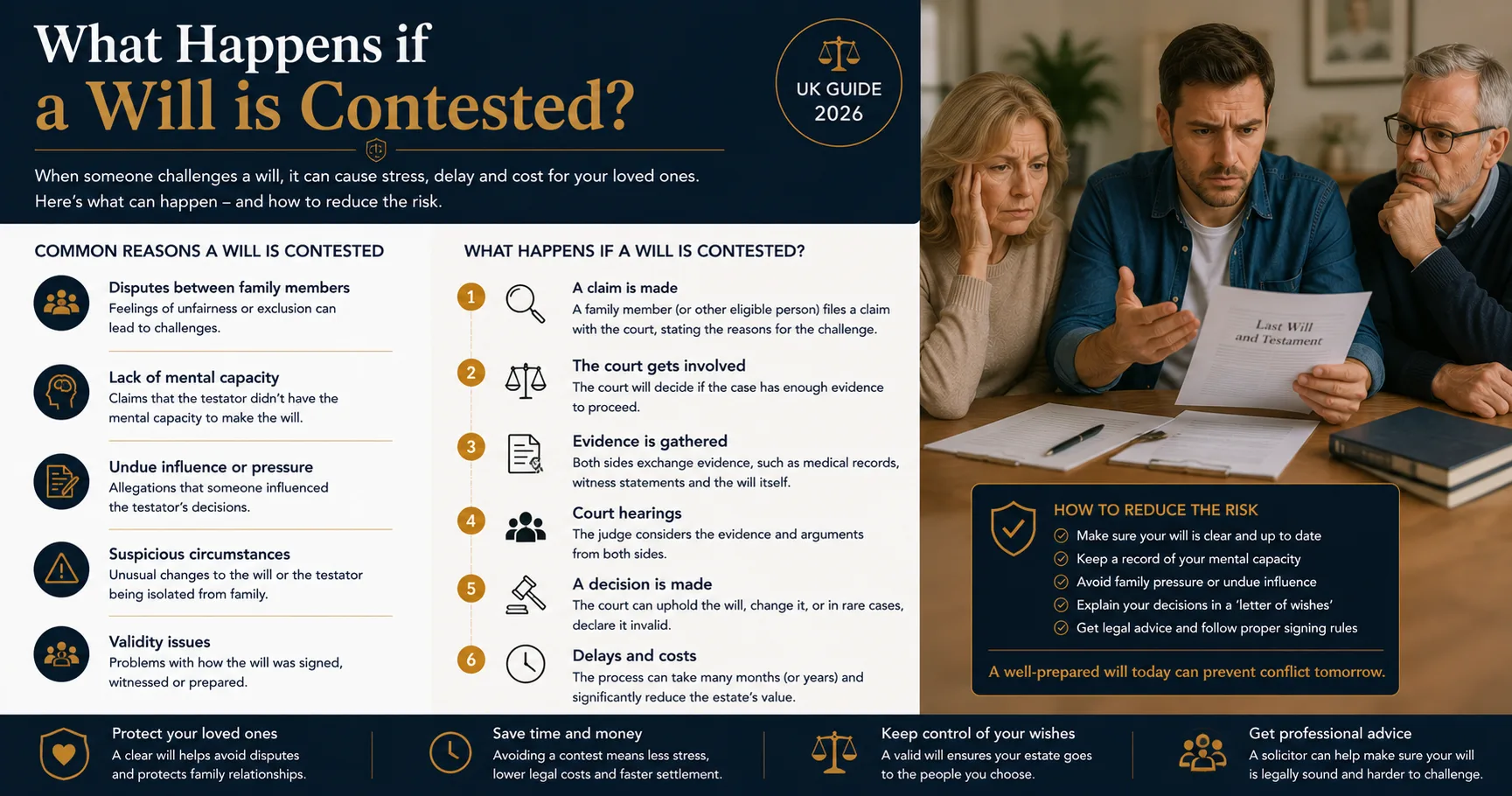
Most wills in England and Wales pass through probate without anyone challenging anything. But a small minority are contested - where someone affected by the will goes to court and asks for it to be set aside, modified or supplemented. Contested probate is one of the fastest-growing areas of UK legal work, and the reasons behind it - bigger estates, more blended families, more home-drafted wills - aren't going away.
This guide explains the main grounds for contesting a will, who can bring a claim, what the process looks like, and (most importantly) how to write a will that minimises the chance it'll happen to your family.
What "contesting a will" actually means
The term covers two distinct legal routes, and they're often mixed up.
- Challenging the validity of the will - arguing it isn't legally binding at all, so the estate should be distributed as if there were no will (or as if an earlier will applied).
- Claiming under the Inheritance (Provision for Family and Dependants) Act 1975 - accepting the will is valid, but asking the court to award additional provision because the will didn't make "reasonable financial provision" for the claimant.
Both end up at court, but the legal questions are completely different.
Grounds for challenging the validity of a will
There are five main grounds. A claim will usually rest on one or two; serious claims often try several at once.
1. The will wasn't properly executed
The Wills Act 1837 section 9 requires the will to be in writing, signed by the testator, with the signing witnessed by two adult witnesses both present at the same time. Any breach of those requirements can invalidate the will - and home-drafted wills get this wrong far more often than people realise.
Typical execution failures:
- One witness, not two.
- Witnesses signed at different times, not in each other's and the testator's presence.
- The testator's signature was added later, after the witnesses had already signed.
Our guide on how many witnesses a will needs goes through the rule in detail.
2. The testator lacked mental capacity
To make a valid will, the testator must have understood, at the time of signing:
- That they were making a will and what that meant.
- The extent of their estate.
- Who might reasonably expect to be considered.
- That no mental disorder was distorting those judgments.
This is the test in the old case of Banks v Goodfellow, still applied today. Capacity claims are common where the testator made the will in old age, in poor health, or in the early stages of dementia.
3. The testator didn't know and approve the contents
Separate from capacity. Even a mentally capable testator must have actually understood and approved what was in the will at the time of signing. Suspicion arises when someone who benefits substantially from the will was also involved in arranging or drafting it, or when the testator was visually impaired or unable to read it.
4. Undue influence
A claim that someone (typically a beneficiary, often a carer or family member) coerced the testator into making the will - going beyond persuasion to overriding the testator's free will. Undue influence is hard to prove because the standard is high and the evidence is often dead, but it does succeed in egregious cases.
5. Forgery or fraud
Outright forgery (the signature isn't really the testator's) or fraud (the testator was tricked into signing something they didn't realise was a will, or signing a will they thought said something different). Rare but serious - and these claims can lead to criminal prosecution as well.
Who can bring a 1975 Act claim?
The Inheritance (Provision for Family and Dependants) Act 1975 is the second main route. It accepts the will is valid but argues that "reasonable financial provision" wasn't made for the claimant. The Act limits who can claim:
- Spouses or civil partners of the deceased.
- Former spouses or civil partners who haven't remarried.
- A cohabiting partner who lived with the deceased as if married for at least two years immediately before death.
- Children of the deceased (including adult children).
- Anyone treated as a child of the family - including stepchildren raised by the deceased.
- Anyone being financially maintained by the deceased immediately before death.
The court considers a long list of factors, including the size of the estate, the financial resources and needs of the claimant, the financial resources and needs of the beneficiaries, and the deceased's reasons for the dispositions made.
For cohabiting couples, the 1975 Act is often the only fallback if the deceased's will (or the absence of a will) didn't provide for them. But it's expensive and stressful and not a substitute for being properly named in a will.
Time limits
There are strict deadlines.
- 1975 Act claims must be issued within six months of the grant of probate.
- Validity challenges have no fixed deadline as such, but can become impossible in practice once the estate has been distributed and the assets dispersed. The smart route is to lodge a "caveat" at the Probate Registry as soon as concerns arise - this stops probate being granted while the issue is investigated.
If you think you may need to challenge a will, do not wait. The clock starts running fast.
Worried about disputes after you go? A clearly drafted, properly executed will is the single biggest defence. Trusted Hands bakes the section 9 rules into the signing process. Start free → - only pay when you download.
What does contesting a will actually cost?
A lot. Even straightforward cases that settle without trial can run to tens of thousands of pounds in legal fees - typically paid out of the estate (so beneficiaries see less). Cases that go to trial regularly run into six figures. The judges have, in recent years, become more openly impatient with families who let estate disputes spiral.
Three rules of thumb:
- Most contested probate disputes settle before trial, because the costs of fighting are too high relative to the size of the estate.
- The losing side often pays a chunk of the winning side's costs, but not all.
- The estate itself can end up bearing significant costs even if the claim fails.
How to write a will that's harder to contest
You can't make a will contest-proof. You can make it much harder to contest successfully.
- Use a proper guided process, not a stationery-shop kit, so the section 9 execution requirements are followed correctly. Our will mistakes guide covers the common drafting errors.
- Keep witnesses neutral - no beneficiaries, no spouses of beneficiaries.
- Get medical evidence of capacity if you're elderly, ill, or making big changes to a long-standing will. A short letter from your GP at the time of signing is gold-dust if capacity is later questioned.
- Avoid arrangements where the main beneficiary organised the will. If your daughter is the main beneficiary and she also booked the appointment, drove you to it, paid for it and helped pick the wording, you've created a textbook "want of knowledge and approval" claim.
- Provide reasonably for those the law expects you to provide for - especially spouses, dependents and children for whom you have an obvious responsibility. If you choose to leave one out, explain why in a separate letter of wishes. The letter doesn't bind the court, but it's powerful evidence of your reasoning.
- Don't keep the will a complete secret from family. Surprises after death drive disputes more than almost anything else. A short, calm conversation - or even a letter explaining the broad shape of your decisions - defuses a lot of future conflict.
For complex estates, we recommend you seek assistance from a Trusted Hands Advisor or your own legal advice.
What happens if a contest succeeds?
It depends which type.
- A successful validity challenge sets the will aside. The estate is then distributed under the previous valid will (if there was one) or under the intestacy rules.
- A successful 1975 Act claim awards the claimant a sum from the estate - either an immediate payment, a regular payment, or a transfer of an asset. The will isn't invalidated; it's effectively topped up for the claimant.
Either outcome reduces what the named beneficiaries actually receive.
Frequently asked questions
Who can challenge a will?
For a validity challenge, anyone with "standing" - usually meaning anyone who would inherit if the will were set aside, or anyone named in an earlier will. For a 1975 Act claim, only the categories listed above (spouse, ex-spouse, cohabiting partner, child, child of the family, financial dependent).
How long do I have to contest a will?
Six months from the grant of probate for a 1975 Act claim. For a validity challenge, you should lodge a caveat at the Probate Registry as soon as possible. Don't wait.
Will I have to pay if I lose?
Probably some of the other side's costs, yes. The exact share depends on the case, but losing a contested probate claim is expensive. Speak to a probate solicitor before issuing.
Can I contest a will if I was completely cut out?
You can try - the most common route is a 1975 Act claim if you're in one of the eligible categories. Whether it'll succeed depends on whether you were a dependent and whether the estate could reasonably be expected to make provision for you.
Can I avoid all of this with a "no contest" clause?
Some wills include a forfeiture clause - "anyone challenging this will loses their inheritance". They have some deterrent effect, but the courts retain the power to make 1975 Act awards regardless. They're a partial measure, not a complete shield.
Ready to write your will?
Trusted Hands is a guided, plain-English will builder. You answer simple questions, see your draft as you go, and only pay when you're ready to download.
- Free to start - no card details to begin
- Smart Will Engine - only asks what's relevant to your situation
- Fixed price - no hourly bills, no surprises
- Annual updates option - keep your will editable as life changes