
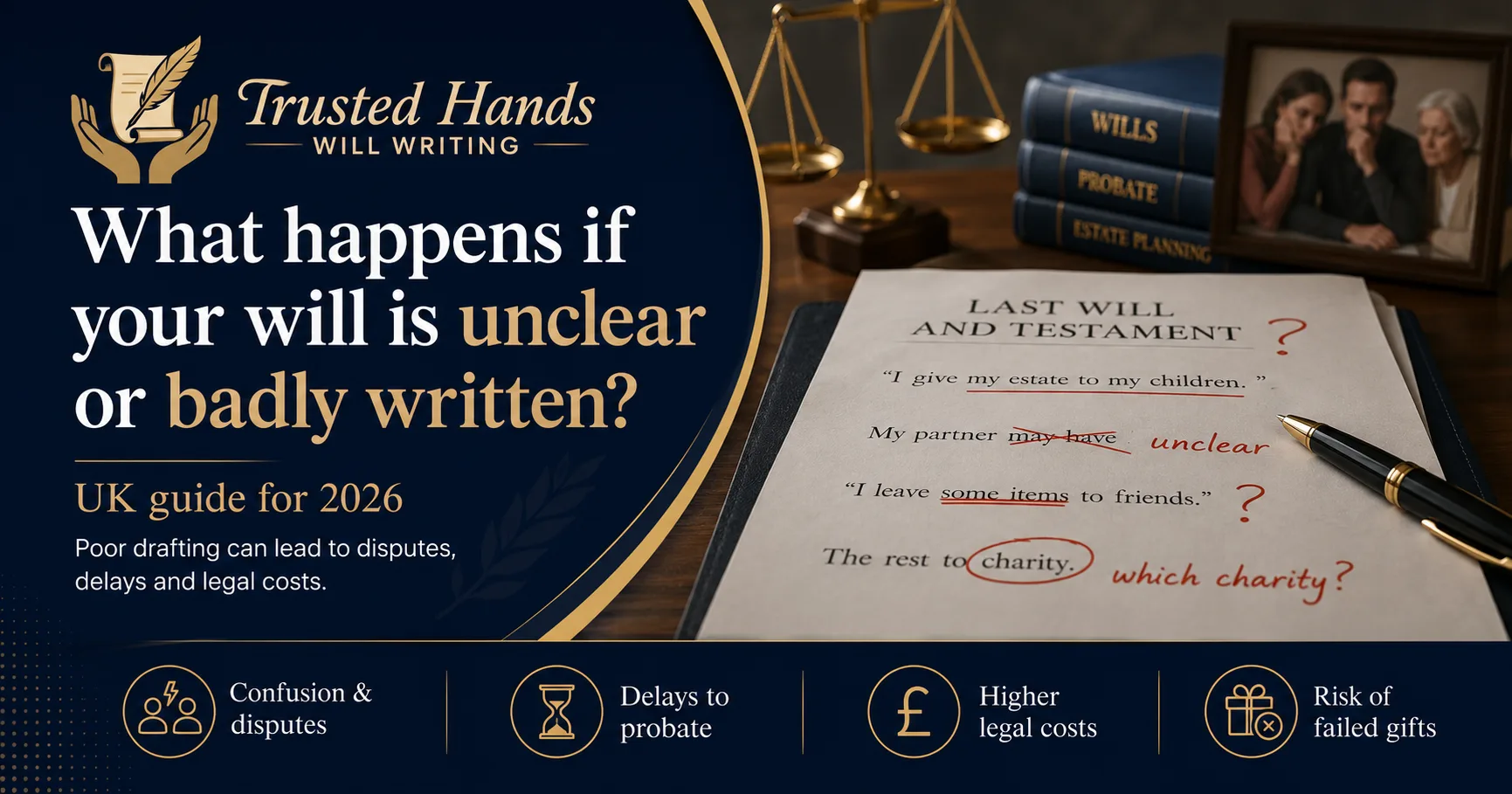
A will is a legal instruction. It tells your executors who gets what, who looks after children, and how your estate should be wound up after you die. When the wording is clear, that instruction works the way you intended. When it's vague, contradictory, or badly drafted, things can go wrong in ways most people never anticipate — and you're no longer around to clarify what you meant.
Unclear wills don't just cause inconvenience. They cause delay, family conflict, legal costs, and sometimes a result that is the opposite of what you actually wanted. This guide walks through what "unclear" really means in a will, what executors and the courts do when faced with one, and how to avoid the common drafting traps.
What counts as an unclear or badly written will?
A will can be technically valid — properly signed and witnessed under section 9 of the Wills Act 1837 — and still be a mess to administer. The most common problems fall into a few buckets:
- Ambiguous wording. "I leave my house to my children" sounds simple. But which house? The one you owned when you wrote the will, or the one you owned when you died? And which children — biological only, or stepchildren too?
- Internal contradictions. Clause 4 says the residue goes to your sister. Clause 9 says it goes equally between your nieces and nephews. Both can't be right.
- Missing fallbacks. You leave everything to your spouse. Your spouse dies before you. Now what? Without a substitute beneficiary, that gift may pass under intestacy rules or the residuary clause — possibly to people you barely know.
- Vague identification. "My nephew Tom" is fine if you have one nephew called Tom. If you have two, or your sister had a son named Tom and a stepson named Tom, your executors have a problem.
- Outdated references. A gift to "the cottage in Cornwall" — sold ten years ago. A gift "to my husband John" — divorced in 2019. The will doesn't update itself.
- Home-made language. Phrases like "I want my children to be looked after" or "my family should share fairly" are wishes, not instructions. They're not legally enforceable in the way a properly drafted gift is.
What executors do when wording is unclear
Executors have a legal duty to administer the estate according to the terms of the will. If they genuinely can't tell what those terms mean, they have a few options.
First, they look at the will as a whole. Courts apply what's called the "armchair principle" — they put themselves in the position the testator was in when the will was written, looking at the surrounding circumstances. Did you have one nephew Tom or two when you signed it? Did you own one house or three?
If that doesn't resolve things, executors can apply to the court for what's called a construction summons — essentially asking a judge to interpret the disputed clause. That costs money (usually paid out of the estate) and adds months to the process. For a smaller estate, the legal fees can swallow a meaningful chunk of what beneficiaries would have received.
If you'd rather avoid the gamble, our guided will builder prompts you through the wording as you go, with plain-English questions designed to surface ambiguities before they become problems.
When the courts have to step in
There's a body of case law going back well over a century on how to interpret unclear wills. The general approach is:
- Read the will in plain English first. If the meaning is clear on the face of it, that's the meaning.
- Look at extrinsic evidence (under section 21 of the Administration of Justice Act 1982) only if the wording is ambiguous on its face, or ambiguous in light of surrounding circumstances. That can include drafting notes, earlier wills, or evidence of what the testator told a solicitor.
- Apply the rules of construction — for example, the rule that a will is read as if executed immediately before death (so "my house" usually means whatever house you owned at death, not when you wrote the will).
Courts try hard to give effect to what the testator intended. But "intent" has to be reconstructable from the document and admissible evidence. If two people each have a credible claim under the wording, a judge will pick one — and the loser walks away with nothing.
Common drafting traps people fall into
Most unclear wills aren't written by lawyers. They're written by people using free templates, old will kits from a stationery shop, or hand-written drafts copied from the internet. The traps are predictable:
- "My estate" vs. "my residuary estate." These mean different things. Get the term wrong and a specific gift can swallow the residue or vice versa.
- Per stirpes vs. per capita. "Equally between my children" — what if one of them dies before you? Does their share go to their children, or get redistributed among your surviving children? Saying nothing leaves it to the rules of intestacy and section 33 of the Wills Act, which may or may not match what you'd want.
- Joint vs. several gifts. "To A and B" can mean different things depending on whether they're joint tenants or take in equal shares.
- Residue not properly disposed of. A will lists specific gifts but never says what happens to everything else. The leftover passes under intestacy — possibly to relatives you'd specifically wanted to exclude.
- Conditional gifts that don't say what happens if the condition fails. "To my son if he reaches 25" — what if he dies at 23? Without a fallback, the gift fails and the money goes back into residue.
We've covered the most frequent failures in detail in our guide to will mistakes UK — worth reading alongside this article if you're drafting your own.
What happens to the estate while the dispute runs?
Probate effectively pauses. Executors can administer the parts of the estate that aren't in dispute, but they can't safely distribute money or property that depends on the unclear clause. That can mean:
- Beneficiaries waiting months or years for their share
- Assets sitting in estate accounts earning very little
- Property left empty, costing council tax and insurance
- Family relationships fraying as months turn into years
For complex estates, we recommend you seek assistance from a Trusted Hands Advisor or your own legal advice. The cost of a properly drafted will is almost always trivial compared to the cost of fixing an unclear one after death.
Worried your existing will might be unclear? Trusted Hands turns these decisions into a 15-30 minute guided builder. Start free → — only pay when you download.
How to make sure your own will is clear
The drafting principles aren't complicated, but they need to be applied consistently:
- Name people in full. "My nephew Thomas James Smith of 14 Acacia Avenue" beats "my nephew Tom" every time.
- Identify property precisely. "My freehold property at 22 Elm Street, Bristol" beats "my house."
- Always include fallbacks. If your first-choice beneficiary dies before you, who takes their share? Spell it out.
- Don't mix wishes and instructions. Use a separate letter of wishes for things like funeral preferences or guidance to your trustees. Keep the will itself focused on legal gifts and appointments.
- Review after major life events. Marriage, divorce, a new child, a property sale, a death in the family. All of these can turn a clear will into a confusing one overnight.
- Use a guided service rather than a blank template. The reason templates fail is that they assume you already know what to write. A guided builder asks the questions for you and surfaces the gaps.
If your situation is straightforward, start your will online — most people finish in under half an hour. If your situation is genuinely complex (overseas property, a business, a vulnerable beneficiary, a blended family with stepchildren), for complex estates, we recommend you seek assistance from a Trusted Hands Advisor or your own legal advice.
Frequently asked questions
Is a slightly ambiguous will still valid?
Usually yes. Validity (was it properly signed and witnessed?) is separate from clarity (does it say what you meant?). An ambiguous will can be perfectly valid and still cause months of dispute over what specific clauses mean.
Can my executors fix mistakes after I die?
Not unilaterally. Executors must administer the will as written. In limited cases, the court can rectify a will under section 20 of the Administration of Justice Act 1982 if there's been a clerical error or the drafter failed to understand instructions. Beyond that, beneficiaries can sometimes vary their entitlements by deed of variation — but that requires their consent.
What if two clauses contradict each other?
Generally, a later clause overrides an earlier one if they can't be reconciled. But courts try to read the whole document together first to see if both can be given some effect.
Should I keep my old will if I write a new one?
No — destroy it once the new one is properly executed. Two wills floating around is a recipe for confusion and disputes about which one is the "real" final version.
Can I add handwritten notes to my typed will?
Risky. Any alteration after signing needs to be re-witnessed under section 21 of the Wills Act 1837 to take effect. Unwitnessed annotations are generally ignored — but they can create doubt about what you intended and prompt disputes.
Ready to write your will?
Trusted Hands is a guided, plain-English will builder. You answer simple questions, see your draft as you go, and only pay when you're ready to download.
- Free to start — no card details to begin
- Smart Will Engine — only asks what's relevant to your situation
- Fixed price — no hourly bills, no surprises
- Annual updates option — keep your will editable as life changes