
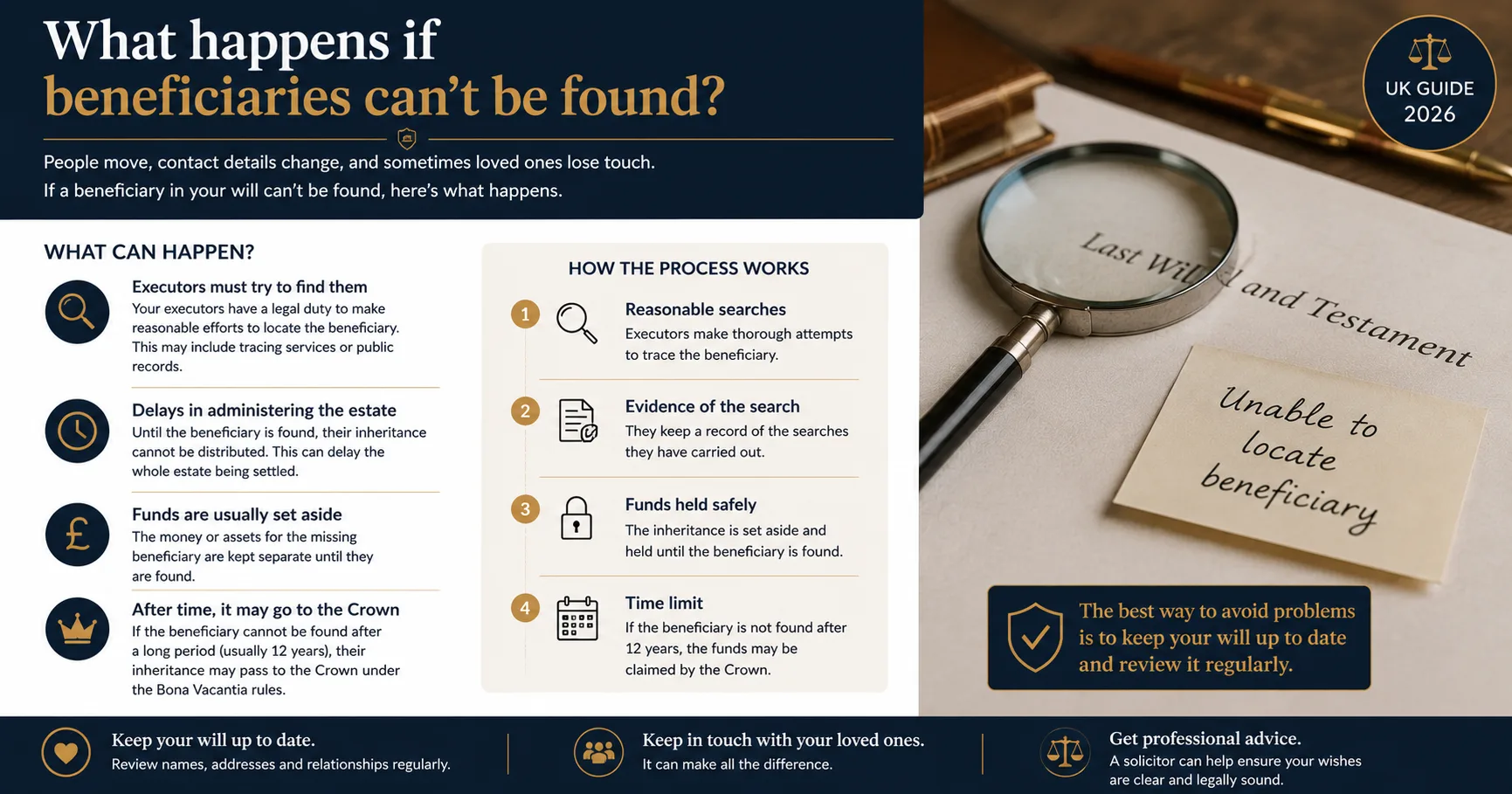
Most wills name people the executors know personally — a spouse, children, a sibling. But quite a few wills include people executors have never met, or haven't seen for decades. An old friend the testator wanted to remember. A cousin who emigrated. A grandchild who's grown up and moved on. When it comes to distributing the estate, executors face a problem they can't ignore: they're legally required to pay the right people, and they can't pay people they can't find.
This guide walks through what executors can and should do when a beneficiary is missing, the formal protections available under English law, and what happens to the share if a beneficiary is never traced.
Why missing beneficiaries are more common than you'd think
People move. They change names through marriage. They emigrate. They fall out of touch with the family. Wills can be twenty or thirty years old by the time they take effect, and a beneficiary who was easy to find when the will was written may be entirely off-grid by the time the testator dies.
Common scenarios:
- A friend named in an old will who has since moved house — possibly several times.
- An adult child or grandchild who broke off contact with the family years ago.
- A relative living abroad whose address in the will is no longer current.
- A charitable beneficiary that has merged with another charity, changed its name, or wound up.
- A class of beneficiaries — "all my grandchildren" — where the testator didn't list current addresses.
In each case, the executor has a clear instruction in the will, and an obligation to give effect to it, but no easy way to do so.
What executors must do — the duty to make reasonable enquiries
Executors are legally responsible for paying the right people. If they distribute the estate without making reasonable efforts to find a beneficiary, and the beneficiary later turns up, they can be personally liable to pay that beneficiary their share — even if the estate has already been distributed and there's no money left.
The standard isn't perfection. It's reasonable enquiries. What that looks like depends on the size of the gift and the size of the estate, but typically includes:
- Checking the address in the will against any more recent records (Christmas card lists, old correspondence, the deceased's address book or phone).
- Contacting other family members who might know where the person is.
- Searching electoral roll records, professional directories, and social media.
- Checking probate records — if the missing beneficiary has died, their share may pass to their estate.
- Engaging a professional tracing agent or "heir hunter" for harder cases.
For smaller gifts, basic enquiries may be enough. For substantial gifts, executors are expected to do significantly more — and to document what they did, in case they need to justify the decisions later.
If you're writing your own will and want to make sure your executors aren't left chasing ghosts, our guided will builder prompts you to record current addresses and identifying details for every beneficiary you name.
Tracing agents — what they actually do
Professional tracing services (sometimes called heir-finders or genealogists) specialise in finding missing beneficiaries. They typically charge in one of two ways:
- A fixed fee — paid by the estate, regardless of outcome.
- A percentage of the share — typically 10-30% of whatever the missing beneficiary inherits, paid by the beneficiary if found.
Reputable tracing firms have access to records executors don't easily have — international electoral rolls, immigration records, marriage and death registers from multiple jurisdictions, professional databases. For gifts over a few thousand pounds, the cost is usually justified. For tiny gifts, it may not be.
Whichever route is used, the executor should keep a record of the steps taken. If a beneficiary later surfaces and complains, that record is what protects the executor.
When the search runs dry — formal protections for executors
If reasonable enquiries don't turn up the beneficiary, the executor can't simply hold onto the money forever. There are two main tools that allow safe distribution:
1. Section 27 notices (Trustee Act 1925)
A notice is published in the London Gazette and a local newspaper where the deceased lived, calling on anyone with a claim against the estate to come forward within a stated period (at least two months). After that period, the executor can distribute the estate based on the claims they've actually received, and is protected against later claims they didn't know about.
Section 27 protects executors against unknown creditors and unknown beneficiaries, but it doesn't help much where the executor knows the beneficiary exists but can't find them.
2. Missing beneficiary indemnity insurance
For known-but-missing beneficiaries, executors can take out an insurance policy that pays the beneficiary's share if they ever turn up. The estate can then be distributed to the other beneficiaries with the missing share covered by the policy.
Premiums vary based on the size of the gift, the strength of the search, and the likelihood of the person being alive. For modest gifts where the search has been thorough, premiums are often low enough to be the cheapest sensible option.
3. A Benjamin order
For more substantial cases, the executor can apply to the court for a Benjamin order — named after a 1902 case. The court authorises distribution on the assumption that the missing beneficiary is dead (or otherwise cannot claim). Beneficiaries get their shares; if the missing person later turns up, they can still claim against the recipients (though not against the executor personally).
Benjamin orders are slower and more expensive than insurance, so they're typically used only where insurance isn't available or where the share is large enough to justify the legal cost.
Want to spare your executors a tracing nightmare? Trusted Hands turns these decisions into a 15-30 minute guided builder. Start free → — only pay when you download.
What happens to the share if a beneficiary genuinely can't be found?
This depends on the will, the search, and the legal route taken.
If the executors have used a section 27 notice and a Benjamin order or insurance, the share is distributed to the other beneficiaries — either to the residuary beneficiaries (if the missing person was a specific gift) or proportionally among the remaining residuary beneficiaries (if the missing person was a residuary beneficiary).
If the will has a clear substitution clause ("if X cannot be found, his share goes to Y"), that provision takes effect. We covered why substitution clauses matter in our guide to will mistakes UK — they're one of the most under-used drafting tools.
If there's no substitution clause and the gift fails entirely, the share usually falls into residue. If a residuary share fails, what's left over may pass under the rules of intestacy — see dying without a will UK for how those rules work — even where there's an otherwise valid will.
How to write a will that's easy to administer
If you're writing a will now, you can save your executors enormous time and cost by:
- Listing full names and current addresses for every beneficiary, not just first names or relationships.
- Including a date of birth for each beneficiary where you reasonably can — it's the single best identifier when names are common.
- Adding contact details for at least one person who knows them. A sister, a parent, an old friend.
- Including substitution clauses for every named beneficiary. "To Sarah Johnson, but if she predeceases me or cannot be found within twelve months of my death, to her children equally."
- Updating the will after major life events — both yours and your beneficiaries'. A change of address is a small thing; if it's the only address in your will, it's not.
- Talking to your executors about who's named so they have context if the trail goes cold.
For complex estates, we recommend you seek assistance from a Trusted Hands Advisor or your own legal advice — particularly if you're naming beneficiaries you've lost touch with, or beneficiaries living abroad.
Frequently asked questions
How long do executors have to search before distributing?
There's no fixed deadline, but the duty is "reasonable enquiries" not "exhaustive ones." For smaller gifts, a few months is typical. For large gifts, executors may keep searching for a year or more, often alongside running a section 27 notice and arranging insurance.
What if a beneficiary turns up after the estate has been distributed?
If the executor took proper protections (section 27 notice, missing beneficiary insurance, Benjamin order), they're generally protected. The beneficiary may still be able to claim against the people who received the money — but the executor isn't personally on the hook.
Can a missing beneficiary be presumed dead?
Under the Presumption of Death Act 2013, a missing person can be formally declared dead after at least seven years of being unheard of (in some circumstances less). That's a different legal route from a Benjamin order — the latter is about distributing the estate as if the person were dead, not about formally declaring it.
Does this apply to charities too?
Yes. If a charity named in a will has wound up, merged, or changed its name, executors need to identify the successor or apply the cy-près doctrine to redirect the gift to a similar cause. It's a different process from missing individuals but the same underlying problem — executors paying the right person.
Should I name very old friends in my will?
You can — but keep the will up to date. A friend named in 1995 may have moved twice and remarried by the time you die. Either update the will when their circumstances change, or include a substitution clause and a fallback if they can't be traced.
Ready to write your will?
Trusted Hands is a guided, plain-English will builder. You answer simple questions, see your draft as you go, and only pay when you're ready to download.
- Free to start — no card details to begin
- Smart Will Engine — only asks what's relevant to your situation
- Fixed price — no hourly bills, no surprises
- Annual updates option — keep your will editable as life changes