
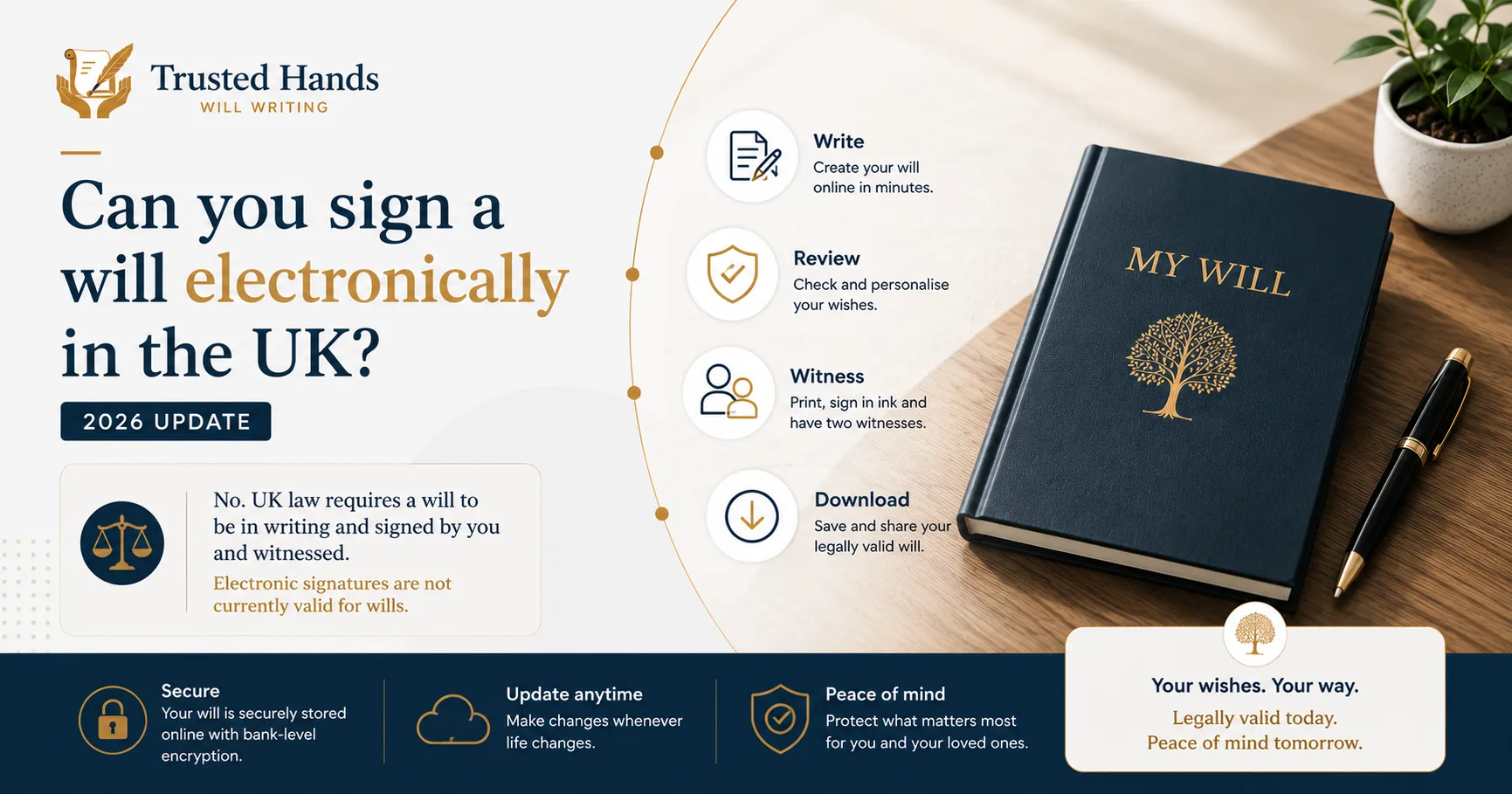
Can you sign a will electronically in the UK? The short answer in 2026: no, not for a normal will. The Wills Act 1837 still requires a wet-ink signature on paper, witnessed by two adults present at the same time. Despite COVID-era temporary changes and an active Law Commission review, the law has not changed. This guide covers what's actually permitted today, the temporary remote-witnessing exception that no longer applies, the Law Commission's 2025 reform proposals, and what to expect over the next few years.
Key takeaways:
- In England and Wales as of 2026, wills must still be signed in wet ink on paper and witnessed by two adults present at the same time.
- Digital signatures (typed names, e-signature platforms like DocuSign) are not valid for wills.
- Remote video witnessing was temporarily allowed during the COVID-19 pandemic (28 September 2020 to 31 January 2024) but has now lapsed.
- The Law Commission's May 2025 report recommended allowing electronic wills under strict conditions. Implementation by Parliament has not yet happened and no firm date is set.
- Until the law changes, every valid will must follow the Wills Act 1837 section 9 formalities: written, signed in wet ink, two witnesses, present at the same time.
What the Wills Act actually requires
Section 9 of the Wills Act 1837 (as amended) requires four things for a valid will:
- The will is in writing (paper)
- Signed by the testator (or by another person in the testator's presence and at their direction)
- Signed in the presence of two or more witnesses, present at the same time
- Each witness then signs in the presence of the testator
There is no provision in section 9 for electronic signature, electronic document, or remote witnessing.
The signature itself can be in any form — full name, initials, even a mark by someone unable to write — but it must be a physical mark made on paper by hand. Typed names, e-signatures and digital marks are not currently accepted.
What about online will services?
Online services like Trusted Hands handle the drafting electronically — you fill in answers in a guided builder, the system generates the will document, and you download it as a PDF. The drafting being online doesn't make the will electronic.
The crucial step is what happens next: you print the will, sign it in wet ink, and have two witnesses sign in your presence. From that moment, the printed signed paper is the legal will. The digital PDF you downloaded is just a draft until it's signed.
This is why every guided online service includes detailed signing instructions and witness guidance. The online builder makes the drafting easier; the signing has to be done the traditional way.
The COVID-era remote witnessing exception
During the COVID-19 pandemic, the UK government temporarily amended the Wills Act to allow remote video witnessing. The Wills Act 1837 (Electronic Communications) (Amendment) (Coronavirus) Order 2020 made it lawful, for a limited period, to witness a will via real-time video link rather than physical presence.
The change applied to wills witnessed between 28 September 2020 and 31 January 2024. Wills witnessed remotely during that window remain valid forever, but the temporary provision has now lapsed.
Since 1 February 2024, the rules reverted: witnesses must be physically present in the same room as the testator at the time of signing. Remote video witnessing for new wills is no longer permitted.
The 2025 Law Commission report
The Law Commission of England and Wales published its long-awaited Wills Project final report in May 2025. The report makes the most significant proposed reforms to UK will-writing law in nearly 200 years. Key recommendations include:
- Electronic wills to become possible under strict authentication and storage requirements
- Lowering the age of testamentary capacity from 18 to 16
- Removing the rule that marriage automatically revokes a will (so existing wills survive a subsequent marriage)
- Changing the rules on undue influence to make challenges easier where appropriate
- Various other technical reforms
Crucially, the recommendations are proposals — they require Parliament to legislate before they take effect. As of mid-2026, no legislation has been introduced. A timeline for implementation has not been set publicly.
If electronic wills are introduced, expect:
- Stringent authentication requirements (likely involving secure identification, e.g. via government verification systems)
- Mandatory secure storage of the electronic will document with verifiable integrity
- Limitations on who can hold the electronic version
- Continued recognition of paper wills alongside electronic ones (no forced migration)
Until then, the law is as it has been since 1837.
Trusted Hands wills are designed for the current law. Your will is generated as a print-ready PDF with a built-in Guided Witness Mode that walks you through the signing ritual step by step. Start your will →
Other countries — different rules
Some other jurisdictions have moved ahead of England and Wales on electronic wills:
- Australia (most states) allows electronic and remotely-witnessed wills, with safeguards
- Several US states (Nevada, Florida, Indiana, Illinois and others) recognise electronic wills
- Canada has limited recognition in some provinces
- Singapore has provided for electronic wills in specific contexts
UK reform tends to lag international moves on this. The Law Commission report draws extensively on international precedent — when reform happens here, it will likely borrow the safeguards proven elsewhere.
What this means for you in 2026
- Use an online builder for drafting — much faster, cheaper, less stressful than a solicitor for typical estates.
- Print, sign in wet ink, witness physically — no exceptions for the actual execution.
- Store the original safely — the wet-ink paper is the will. A scan or PDF copy is not a substitute at probate.
- Watch the news — if Parliament legislates the Law Commission's recommendations, online services will adapt their workflows. Until then, the old rules apply.
Frequently asked questions
Can I sign my will with an e-signature platform like DocuSign?
No. E-signature platforms are designed for contracts that are valid under the Electronic Communications Act 2000, which explicitly excludes wills. A will signed via DocuSign or similar is not a valid UK will.
What about a video-witnessed will signed in 2021?
If it was signed between 28 September 2020 and 31 January 2024 and complied with the temporary regulations (real-time video link, witnesses observing the signing, etc.), it is valid and remains valid. If signed outside that window via video, it is not valid.
Is a typed name at the bottom of a Word document a valid will?
No. The signature must be a wet-ink physical mark by your hand. A typed name is not a signature for Wills Act purposes.
What about wills signed on a tablet with a stylus?
The Law Commission report touches on this but as of 2026 the answer is still no. A stylus mark on a tablet is not currently recognised as a "writing" or "signature" under section 9. Once electronic wills are legislated, this may change.
Is a will I scan and email to my solicitor valid?
The original wet-ink paper is the will. The scan is a copy. At probate, the wet-ink original is required. The scan is useful as evidence the will exists but does not substitute for the original.
What about a will witnessed via FaceTime or Zoom today?
Not valid under current rules. The temporary COVID provision lapsed on 31 January 2024. Witnesses must be physically present in the same room as the testator from that date forward.
When will electronic wills be legal in the UK?
No firm timetable. The Law Commission published its final report in May 2025. Parliament would need to legislate. Realistic timeline: not before 2027, possibly later. Until then, the wet-ink rules apply.
What's the safest way to make a will today?
Use a guided online builder for the drafting (cheaper, faster, accurate). Print the PDF, sign in wet ink in front of two adult non-beneficiary witnesses present at the same time, and store the wet-ink original safely. That's the legally sound route in 2026.
Trusted Hands is a UK will-writing service that produces wills compliant with the Wills Act 1837. We do not offer electronic wills because they are not currently valid in England and Wales. If electronic wills are introduced by Parliament, we will adapt accordingly.
Build a will that's valid today
Trusted Hands generates print-ready, Wills Act-compliant PDFs with step-by-step signing guidance.
- From £49 for a single will
- Smart Will Engine adapts to your situation
- Guided Witness Mode for correct signing ritual
- Digital Vault stores your reference copy alongside scans of your wet-ink original
- Free Executor Pack with every will