
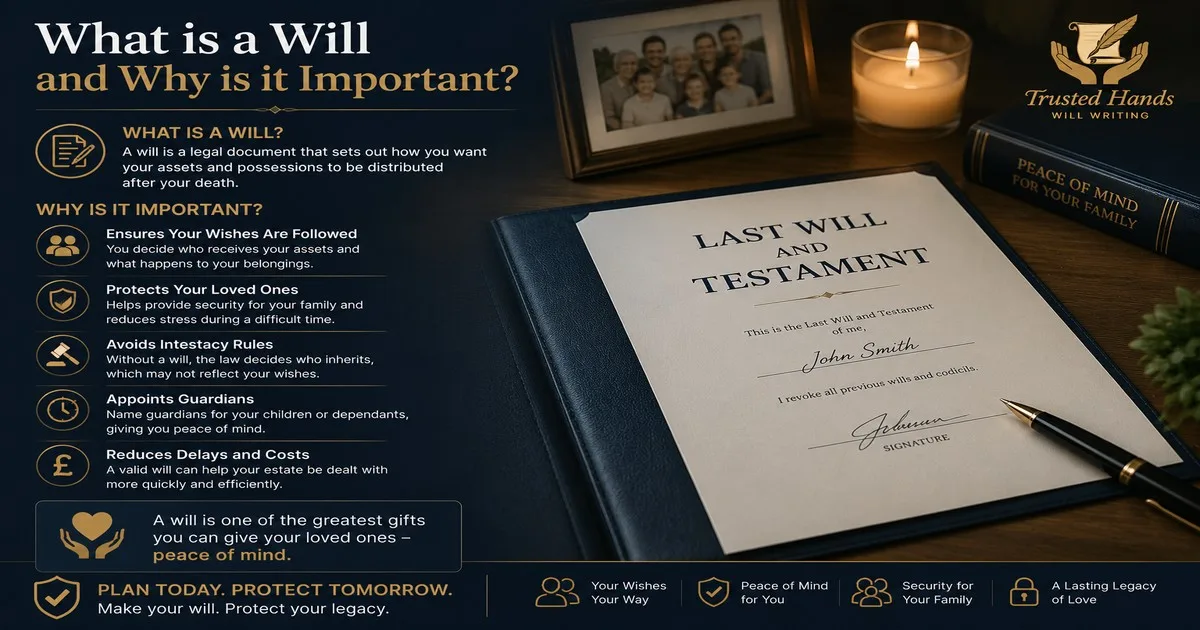
A will is the legal document that says what should happen to your money, your possessions and the people who depend on you when you die. It is the single most important piece of paper most adults will ever sign, and yet around half of UK adults still don't have one. This guide explains what a will is, what it covers, what it cannot do, and the practical reasons every adult in England and Wales should have one in place.
What a will actually is
In legal terms, a will (sometimes called a "last will and testament") is a written declaration of how you want your estate distributed after your death. Your estate is everything you own minus everything you owe: your home, savings, investments, vehicles, possessions, business interests and digital assets, less any debts.
A valid will in England and Wales must comply with the Wills Act 1837 section 9, which requires it to be in writing, signed by you, and witnessed by two adults who are present at the same time. Get those formalities right and your wishes carry the full weight of law. Get them wrong and the document can be worthless.
A will is also where you can:
- Appoint executors - the people who carry out your wishes.
- Appoint guardians for any children under 18.
- Leave specific gifts of money, items or property to named people or charities.
- Divide the residue (everything left after specific gifts and debts) between your chosen beneficiaries.
- Record funeral wishes and other personal instructions.
A will is not the same as a power of attorney (which covers decisions while you're alive but unable to make them) and it is not the same as a trust (which is a separate legal arrangement, although a will can create one).
What happens if you don't have one
If you die without a valid will, the law calls this dying intestate. Your estate is then divided up according to the intestacy rules in the Administration of Estates Act 1925, not by you. The results often surprise people:
- An unmarried partner of decades inherits nothing automatically.
- A spouse you've separated from but never divorced can still inherit a substantial share.
- Stepchildren you raised but didn't adopt receive nothing.
- Your children inherit equal shares regardless of need or circumstance.
- If you have no living relatives at all, the estate goes to the Crown.
The "common-law spouse" who inherits under English law simply does not exist. The only way to override these defaults is to write a will. Our guide to dying without a will goes into the rules in more detail.
If you'd rather just get on with it, our guided will builder is free to start and walks you through every decision in plain English.
Why a will matters more than people think
Most people put a will off because they imagine it is morbid, expensive, or only for the wealthy. None of that is really true any more.
It is for everyone, not the wealthy. A will is not really about money - it's about choice. Who looks after your children. Who manages your affairs. Who gets the things that matter to you. People with very little still have things they care about, and people they want protected.
It saves your family time, money and arguments. Probate is harder, slower and more expensive when there's no will. Disputes are more common. The administrator (the equivalent of an executor in an intestacy) has less authority on day one and has to apply for letters of administration before they can do almost anything.
It protects vulnerable people. If you have a partner you aren't married to, a child with additional needs, an adult relative who depends on you, or a charity that matters to you, the only reliable way to provide for them is through a will.
It can save tax. The Inheritance Tax Act 1984 gives you several legitimate planning options - charitable bequests, life-interest trusts, gifts that fall outside the seven-year rule - that you cannot use without a will. We cover the basics in our inheritance tax guide.
What a will cannot do
It's worth being clear about the limits of a will, because some of the most common questions we get show people don't realise these gaps:
- Pensions usually pay out via a separate beneficiary nomination form held by the pension provider. Whatever your will says about the pension is normally ignored.
- Life insurance behaves the same way - it pays to the policy beneficiary, not under the will (unless you've left it to your estate).
- Jointly owned property held as joint tenants passes to the survivor automatically by survivorship, outside the will.
- Foreign assets may be governed by the law of the country they're in, not by an English will.
For complex estates, we recommend you seek assistance from a Trusted Hands Advisor or your own legal advice. A guided online will is the right answer for most people, but multi-jurisdiction or business succession cases benefit from specialist input.
How a will is made valid
The legal formalities are simple but unforgiving:
- The will must be in writing (paper, signed in wet ink).
- You must sign it, or direct someone else to sign it in your presence.
- You must do so in the simultaneous presence of two adult witnesses.
- Each witness then signs in your presence.
- Witnesses must be over 18 and not beneficiaries (and not married to a beneficiary).
Most invalid wills fail on the witnessing, not the drafting. If a beneficiary witnesses a will, the gift to them fails - the rest normally stands, but it's a needless mistake. We explain the most common errors in our will mistakes guide.
Thinking about getting yours sorted? Trusted Hands turns these decisions into a 15-30 minute guided builder. Start free → - only pay when you download.
Frequently asked questions
Do I need a solicitor to write a will?
No. A will written through a guided online service like Trusted Hands is exactly as legally valid as one drafted by a solicitor, provided it complies with the Wills Act 1837. Solicitors are useful for genuinely complex estates - trusts, business succession, foreign property - but most estates don't need one.
How much does a will cost?
Online services typically £40-£90, traditional solicitors £200-£500 for a standard will, more for complex drafting. See our will pricing guide for a full breakdown.
How often should I update it?
Review every three to five years and after any major life event - marriage, divorce, a new child, buying a house, the death of an executor. Marriage automatically revokes a previous will unless the will was made in expectation of that marriage.
Where should I keep my will?
Sign it in wet ink on paper and store the signed original somewhere safe and findable - a fireproof home safe, the Probate Service's storage facility, or a specialist provider. The original is what counts at probate; a copy is not enough. Always tell your executors where to find it.
Can I change my will later?
Yes. You can replace it with a new will (which revokes all earlier ones) at any time, or add a small change with a witnessed addition called a codicil. Most people find rewriting cleaner than amending.
Ready to write your will?
Trusted Hands is a guided, plain-English will builder. You answer simple questions, see your draft as you go, and only pay when you're ready to download.
- Free to start - no card details to begin
- Smart Will Engine - only asks what's relevant to your situation
- Fixed price - no hourly bills, no surprises
- Annual updates option - keep your will editable as life changes