
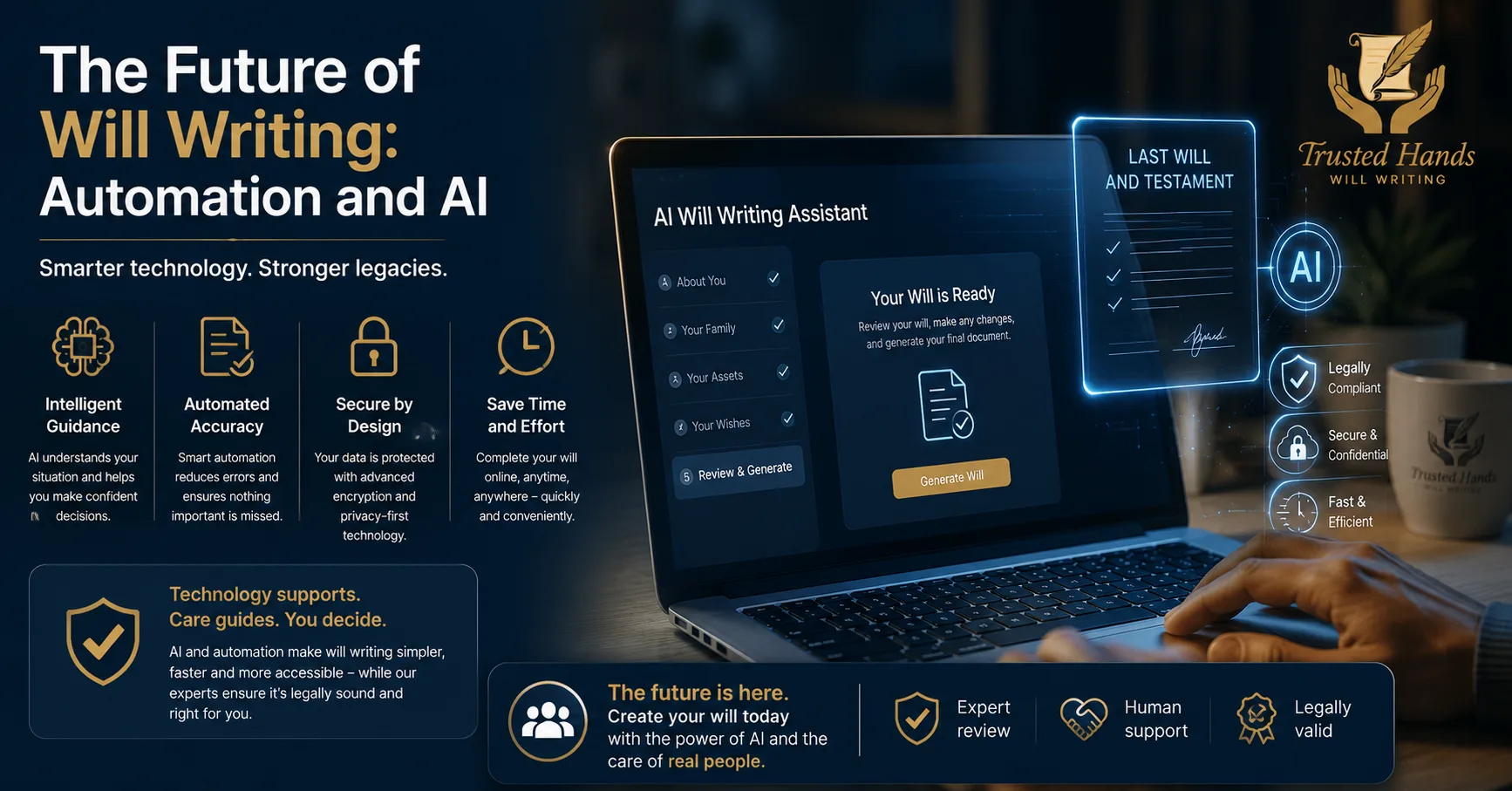
The way wills are written has changed more in the last five years than in the previous fifty. Pen-and-paper stationer kits and £400 high-street appointments still exist, but they're no longer the default. In 2026, most new wills in England and Wales are drafted on a screen, often in under half an hour, and increasingly with help from software that adapts to the person writing it.
This article looks at what that shift actually means - the role of automation, where AI is genuinely useful, where it isn't, and what an "online will" looks like a few years from now.
Where will-writing has come from
For most of the twentieth century the choice was binary: see a solicitor, or use a printed kit from a stationer. The kit was cheap and dangerous - one missed clause or a witness who happened to be a beneficiary could invalidate the document or void a gift. The solicitor was reliable but slow and expensive, often involving a 60-minute meeting and a follow-up appointment.
Online services started appearing in the 2000s, but early versions were really just digital versions of the paper kit - templated forms with little context. The legal mechanics under the Wills Act 1837 section 9 never changed: a will must be in writing, signed by you, and witnessed by two adults present at the same time who are not beneficiaries. What changed was how the drafting happened.
What "automation" actually does in a modern will builder
Automation in will-writing isn't about a robot writing your will. It's about software that:
- Asks the right questions in the right order, skipping ones that don't apply.
- Cross-checks for the obvious failure modes (witness who's also a beneficiary, residual estate left blank, executor under 18, missing substitute).
- Produces a clean, lawyer-reviewed document template populated with your answers.
- Walks you through correct signing and witnessing.
Done well, this catches most of the mistakes that historically invalidated DIY wills. We have a longer piece on the most common will mistakes in the UK - the majority are mechanical, and a guided builder eliminates them by design.
If you'd rather just get on with it, our guided will builder is free to start - you only pay when you're ready to download.
Where AI fits in (and where it doesn't)
There's a lot of breathless writing about AI replacing solicitors. The reality in 2026 is more useful and less dramatic.
What AI is genuinely good at:
- Plain-English explanations. Explaining what a residuary clause is, what survivorship means, or what happens if a beneficiary dies before you - in language a normal person can read.
- Helping you find the right question. "I want to leave my house to my kids but my partner needs to live in it" is a complex instruction. AI assistance can map that to the right will provisions (life-interest trust, occupation right, etc.).
- Catching ambiguity. "My eldest son" is fine until you have two sons from different relationships. Software can flag the ambiguity before it becomes a probate dispute.
What AI shouldn't do:
- Final drafting of contentious or trust-based provisions without human review.
- Tax planning for complex estates above the £325,000 nil-rate band and £175,000 residence nil-rate band thresholds (frozen until April 2030 under current UK government policy).
- Anything requiring regulated legal advice.
For complex estates, we recommend you seek assistance from a Trusted Hands Advisor or your own legal advice. AI is the assistant, not the solicitor.
The legal framework hasn't changed
A will written on a guided online builder is governed by the same rules as a will written by a solicitor. There is no separate "digital will" regime in England and Wales. The signed paper original, witnessed correctly, is the legal instrument.
The Law Commission has been consulting for years on whether to recognise fully electronic wills (signed digitally, witnessed remotely). As of 2026, the requirement remains: wet-ink signature, paper, two adult witnesses present at the same time, none of them beneficiaries. Most reformers expect this to change in the coming decade. Until it does, the "online" part of an online will refers to the drafting and document production - not the signing.
What does the next five years look like?
Three trends are already visible:
- Smart triage. Software increasingly steers people away from itself when their situation needs human help. A guided builder that detects you have a foreign property, a business, or a child with disabilities should flag those issues and route you to professional advice. Trusted Hands is built this way.
- Continuous wills. Instead of writing a will every five years and forgetting about it, more people now keep a "live" will - updated when life changes (marriage, divorce, new child, house move) for a small annual fee. Estate planning becomes a subscription, not a one-off purchase.
- Better integration with the wider estate. Pension nominations, lasting powers of attorney, and digital asset planning are increasingly handled in one place rather than as separate paperwork. We have a piece on crypto and digital assets in your will for the digital side.
Thinking about writing yours? Trusted Hands turns these decisions into a 15-30 minute guided session. Start free - you only pay when you download the document.
What this means if you're writing a will today
You don't need to wait for any of this to mature. The combination of a well-designed guided builder, a clear printable document, and correct signing and witnessing produces a legally valid will under the existing Wills Act 1837 rules. For the majority of UK estates, that's all that's needed.
If your situation is more involved - a trust, a business, a foreign property, an estate likely above the IHT threshold - a guided service should still be your starting point, but be ready to pair it with a private-client solicitor for the bespoke drafting.
What "good automation" looks like in practice
There's a meaningful gap between cheap fillable templates and well-designed guided builders, and the difference matters. A good guided builder, in 2026, does several things at once:
- Branches the conversation. A married parent of three sees different questions from a single homeowner with no children. Each path produces a structurally different will.
- Catches signing errors before they happen. Witness-as-beneficiary is the classic failure - a good builder warns you about it explicitly.
- Explains in plain English. Anything legally significant - residual estate, substitute beneficiaries, executor powers - is described in language a non-lawyer can act on.
- Knows its own limits. When your situation involves a trust, a business, or foreign assets, the builder should tell you and route you to professional advice.
If the software you're using doesn't do these things, it's a template with extra steps - and templates have a much higher failure rate at probate.
Why this matters for ordinary estates
The dramatic AI-replaces-lawyers framing makes for good headlines but misses the real story. The genuine impact of automation in will writing is much more mundane and much more important: hundreds of thousands more UK adults are writing valid wills who otherwise wouldn't have. Inertia is the biggest cause of intestacy, and friction - cost, time, formality - is the biggest cause of inertia.
A guided online will reduces every form of friction. That's why the trend is irreversible: it's not that AI is better than a solicitor at drafting wills (it usually isn't, for complex cases); it's that a guided builder is dramatically better than no will at all, which is where around half of UK adults still are.
Frequently asked questions
Is an AI-written will legally valid?
A will produced by AI-assisted software is no less valid than one drafted by a solicitor, provided it complies with the Wills Act 1837 and is signed and witnessed correctly. The legal requirement is about the document and the signing process, not the drafting tool.
Will I still need a solicitor in five years?
For complex estates, yes. For straightforward ones, almost certainly not. The trend is for software to handle the standard 80% of cases and human professionals to handle the genuinely complex remainder.
Can I sign a will electronically yet?
Not in England and Wales as of 2026. The wet-ink signature in front of two witnesses is still required. Reform is being consulted on but not yet enacted.
What happens if AI gets something wrong in my will?
A reputable guided builder uses AI as an assistant, not as the final drafter. The output is a templated document reviewed by qualified professionals. If you're nervous, choose a service that publishes who reviewed its templates and offers human escalation when needed.
Is the future of wills paperless?
Eventually, probably. Most of the world is moving towards electronic wills with secure digital signatures and remote witnessing. England and Wales is moving more slowly. The drafting is already paperless; the signing isn't.
Ready to write your will?
Trusted Hands is a guided, plain-English will builder. You answer simple questions, see your draft as you go, and only pay when you're ready to download.
- Free to start - no card details to begin
- Smart Will Engine - only asks what's relevant to your situation
- Fixed price - no hourly bills, no surprises
- Annual updates option - keep your will editable as life changes