
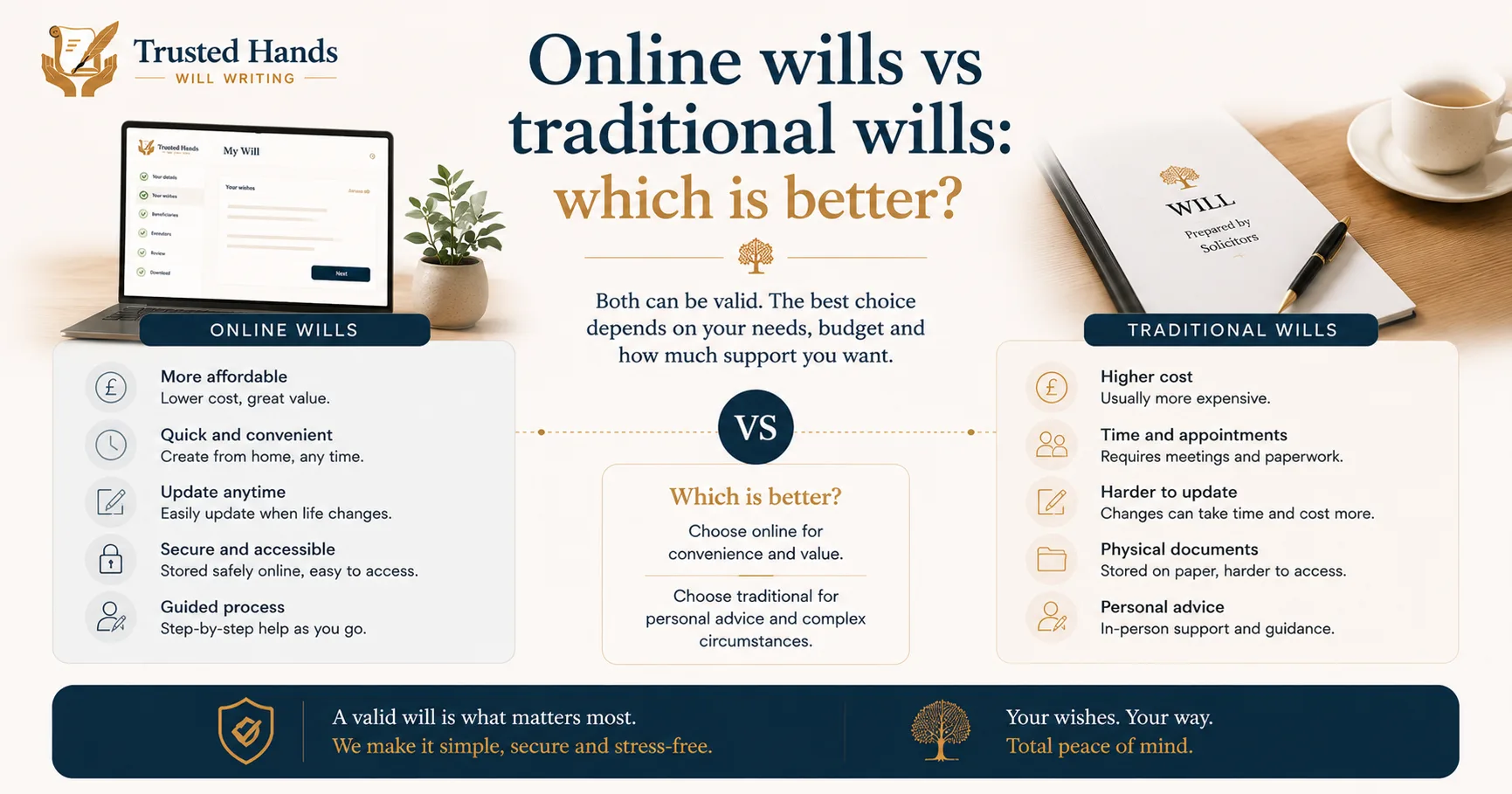
Online wills and traditional solicitor wills both produce the same legal thing: a document that disposes of your estate when you die, valid under the Wills Act 1837 if signed and witnessed correctly. What differs is the journey, the cost, and the experience of writing one. This guide compares the two side-by-side so you can decide which suits you.
We're not going to pretend one is universally better than the other. They suit different people and different estates. But we'll be specific about where each one shines and where each one falls short.
Definitions
For clarity:
- Traditional will — drafted by a solicitor (or sometimes by a regulated will-writer) following a face-to-face or telephone consultation, reviewed in a meeting, signed in the office or at home with the firm's witnesses.
- Online will — drafted using a guided question-and-answer interface that produces a finished document. You print, sign, and arrange your own witnesses.
Both produce a paper will compliant with section 9 of the Wills Act 1837. The legal status of the finished document is identical.
The cost difference
| Route | Single will | Mirror wills (couple) | Updates |
|---|---|---|---|
| Online guided | £40-£90 | £80-£150 | Often included or £10-£20/year |
| Solicitor | £200-£500 | £350-£800 | Per-appointment fee |
| Specialist solicitor (complex) | £600-£1,500+ | £900-£2,000+ | Hourly |
Pricing varies by region — London and the South-East tend to be at the upper end of solicitor ranges. Online pricing is more uniform because the underlying cost structure is software-based. Our will pricing comparison has a fuller breakdown including charity will months and "free" bank wills.
The time difference
A guided online will is typically a single sitting of 15-30 minutes if you have your information ready. You can pause and come back later if you don't.
A traditional solicitor will is a process measured in weeks:
- Booking the initial consultation (often a couple of weeks' wait).
- The consultation itself (45-90 minutes).
- Drafting time (1-3 weeks).
- Review and signing meeting.
Three to six weeks is a realistic end-to-end timeline. It's not slow because solicitors are slow — it's slow because the workflow involves multiple appointments and a person with other clients.
These are the kinds of trade-offs our Smart Will Engine is designed to remove for straightforward estates.
The experience difference
This is the part that often decides things. Some people genuinely prefer a face-to-face meeting; others find it intimidating or simply inconvenient.
Traditional will pros:
- A qualified person physically explains your options.
- Easier to ask "what about my situation specifically?" questions.
- The solicitor's contemporaneous notes can support the will's validity if it's later challenged.
- Some people find the formality reassuring.
Online will pros:
- No travel, no time off work, no waiting room.
- You answer at your own pace, in your own home.
- The questionnaire prompts you for things you might not think of (substitute executors, residual clauses, guardians).
- You can edit and revisit before paying.
- Often cheaper to update later — no per-appointment fees.
If you'd rather skip the appointments and get it done this evening, our guided will builder is free to start.
Which estates suit which route?
Traditional solicitor route is the right call for:
- Trusts (life-interest, discretionary, disabled-person).
- Business succession with shareholdings or partnership interests.
- Foreign property in jurisdictions with their own succession rules.
- High-value estates with serious inheritance tax planning needs (above the combined £1 million threshold).
- Blended families with a meaningful risk of dispute.
- Cases where capacity could later be questioned.
- Any situation where you want a regulated professional's bespoke judgement on a specific risk.
For complex estates, we recommend you seek assistance from a Trusted Hands Advisor or your own legal advice.
Online guided route works well for:
- The classic "everything to my spouse, then to our children equally."
- Single people leaving an estate to siblings, friends, charities.
- Cohabiting couples needing wills (especially urgent given they don't inherit under intestacy — see our cohabiting couples guide).
- Mirror wills for couples with simple wishes.
- Parents of young children needing to appoint guardians.
- Anyone who has put off writing a will for years and wants the bar to be low.
What about quality of drafting?
The fear that online wills are somehow lower-quality is largely a hangover from the early days of the industry. A reputable modern guided builder is designed and maintained by qualified will-writers, uses standardised tested wording, and runs every will through validation rules to prevent the most common errors.
A solicitor will is bespoke, which is both a strength and a weakness. The strength is that unusual situations can be handled with custom drafting. The weakness is that bespoke drafting is also where ambiguity creeps in — every clause is hand-typed, sometimes from a template the firm hasn't reviewed in years, sometimes adapted hastily for a specific case.
Our common will mistakes guide shows the errors that can occur in any drafting route.
What about future updates?
A will isn't a one-time document. It needs updating after marriage (which actually revokes the previous will), divorce, the birth of a child, a death of an executor, the sale of a property, or major changes in finances.
- With a solicitor: each update is normally a fresh appointment and a fresh fee. People often end up living with a will that's five or ten years out of date.
- With a good online builder: log in, change what's changed, re-issue. Many services offer an annual updates option for the price of a takeaway.
What about regulation and recourse?
A frequent worry: "If something goes wrong with an online will, who do I complain to?" The honest answer is that your recourse depends on the provider, not the route.
- Solicitors are regulated by the SRA and complaints go to the Legal Ombudsman.
- Will-writers (online or otherwise) may belong to a self-regulatory body such as the Society of Will Writers or the Institute of Professional Willwriters, which have their own codes of conduct and complaints processes.
- Consumer protection law applies to all paid will services — misrepresentation, unfair contract terms, and the like.
- Data protection is governed by UK GDPR for any provider holding your personal information.
A reputable online provider will list its qualifications, professional memberships, and complaints process clearly. If those are absent, that's a warning sign. See our hidden risks of cheap will services for the warning signs to watch for.
Want a will you can keep up to date as easily as you write it? Trusted Hands lets you re-issue the will whenever you need to. Start free → — only pay when you download.
Frequently asked questions
Is the legal weight of an online will the same as a solicitor will?
Yes. Both routes produce documents that are valid under the Wills Act 1837 if signed and witnessed correctly. There's no legal hierarchy between them.
Can I have an online will reviewed by a solicitor?
Yes — many people use a guided builder to do most of the work, then pay a solicitor for an hour's review. This is often the most cost-effective path for borderline cases.
Are mirror wills cheaper to do online?
Significantly. Most online services charge slightly more for two wills than for one, while solicitor mirror wills are typically £350-£800.
Do online wills handle inheritance tax planning?
For straightforward IHT planning — using both partners' nil-rate bands, the residence nil-rate band, charitable bequests for the lower 36% rate — yes. For complex IHT structures involving lifetime trusts, gifts with reservation, or business reliefs, you'll usually want a specialist solicitor.
Will a solicitor be unhappy if I bring in a will I drafted online?
In our experience, no — most are pragmatic about online wills, and many will happily review one for a fixed fee. The will-writing industry has accepted that guided builders are now a normal part of the market.
Ready to write your will?
Trusted Hands is a guided, plain-English will builder. You answer simple questions, see your draft as you go, and only pay when you're ready to download.
- Free to start — no card details to begin
- Smart Will Engine — only asks what's relevant to your situation
- Fixed price — no hourly bills, no surprises
- Annual updates option — keep your will editable as life changes