
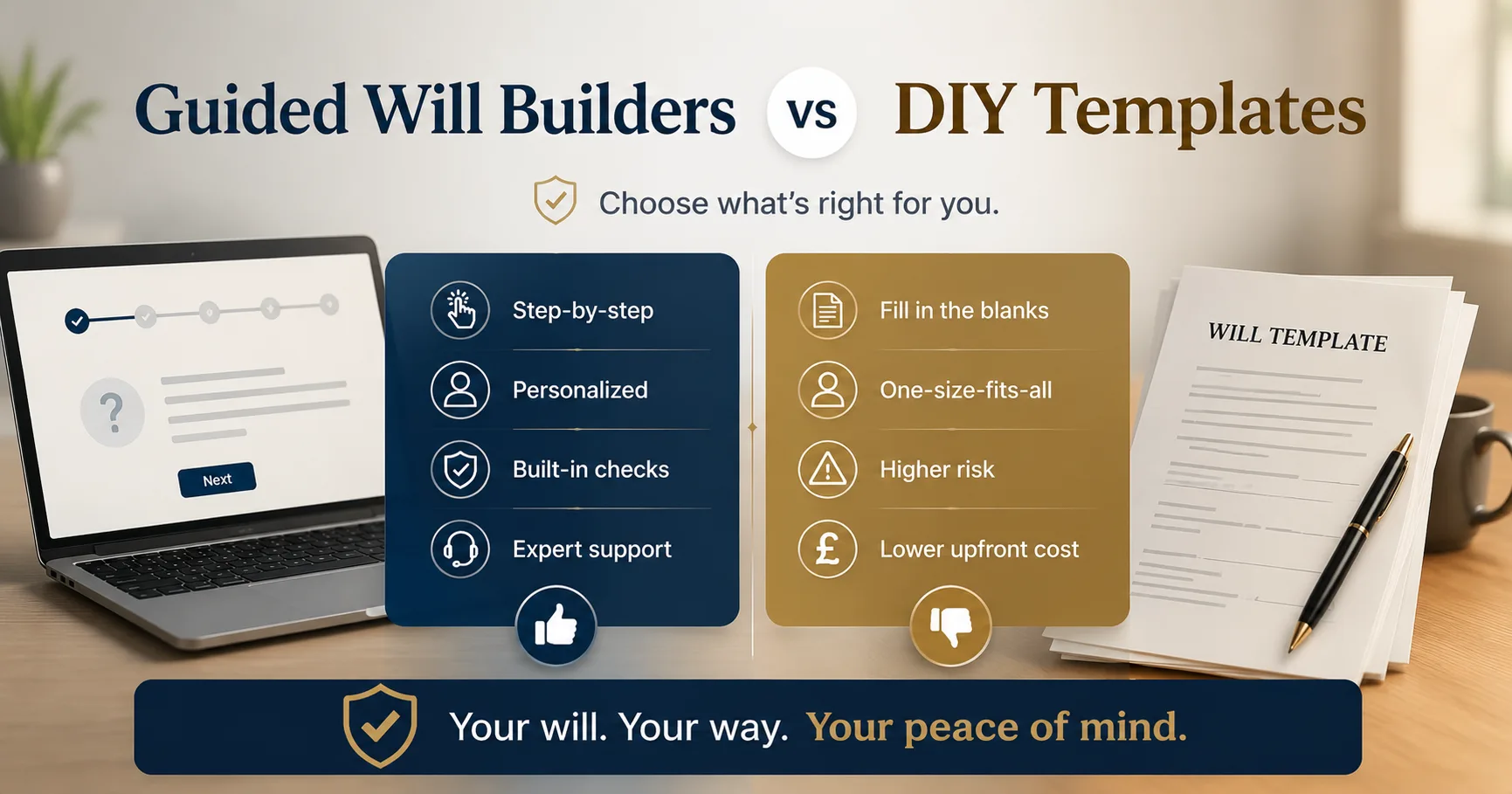
"Online will" gets used as a single category, but it actually covers two very different products: a DIY template that you fill in yourself, and a guided will builder that asks you questions and produces a document based on your answers. They look similar from the outside. They behave very differently when something goes wrong.
This is an honest look at what each one is, where they overlap, and which one is right for whom.
What is a DIY template?
A DIY template is a pre-printed or pre-formatted document with blank spaces for names, beneficiaries, executors, and gifts. You can buy one from a stationer for £10-£25, or download a free PDF template from various websites.
The structure is fixed. You decide which clauses apply, which to delete, which to fill in. The legal language is already written; the personalisation is up to you.
What you get:
- A pre-drafted will form.
- Some written guidance on how to complete it.
- A general signing instruction.
What you don't get:
- Branching logic that adapts to your situation.
- Validation against common mistakes (witnesses who shouldn't witness, missing residual clauses, contradictory gifts).
- Built-in updates when life changes.
- Any human or software review of what you've written.
What is a guided will builder?
A guided will builder is software that asks you a series of questions and uses your answers to produce a personalised will document. The document is not a template you fill in - it's generated specifically for you, with clauses included or omitted based on what you've said.
A modern guided builder (Trusted Hands included) typically:
- Adapts the question flow to your situation - skipping irrelevant questions, asking deeper ones where needed.
- Validates your answers against the Wills Act 1837 section 9 requirements.
- Flags issues like a witness who's also a beneficiary, an executor under 18, a missing residual estate clause.
- Produces a clean printable document you can sign in front of two witnesses.
- Stores your answers so you can update the will easily later.
What you get:
- A bespoke document, not a template.
- Built-in error-checking.
- Plain-English explanations of what each section does.
- Usually an option to keep the will updated for a small annual fee.
The cost difference
A DIY template is £10-£25. A guided will builder is usually £40-£100. Both are dramatically cheaper than a high-street solicitor (typically £200-£500 for a standard will). The price gap between template and guided builder is small in absolute terms - and pays back the moment a guided builder catches a single mistake that would otherwise have invalidated a gift or the entire will.
We have a full will cost comparison covering every option in 2026 if you want to see all the pricing in one place.
If you'd rather just see what a guided builder looks like, the Trusted Hands will builder is free to start.
Where DIY templates go wrong
The classic DIY template failure modes are well-documented in probate practice:
- Witness errors. A beneficiary witnesses the will and their gift fails. Or only one witness is present at the time of signing. Or a witness is under 18.
- Missing residual clause. Specific gifts are listed but the catch-all "everything else" is left blank, so a portion of the estate falls into intestacy.
- Ambiguous beneficiaries. "My eldest son" without a name, when there are two sons from different relationships. "My nephew Tom" when there are two nephews called Tom.
- Contradictory gifts. The same item left to two different people in different clauses.
- Marriage revocation. Writing a DIY will and then getting married, without realising marriage automatically revokes the previous will.
A guided will builder catches most of these by design - either by validating answers, by structuring the question flow, or by prompting you to confirm where things look ambiguous. A template doesn't catch any of them; it just produces what you write.
This is the central difference. A template is a static document. A guided builder is an active drafting partner.
Where guided builders have limits
Honesty matters. Guided builders aren't right for every estate. They're optimised for:
- A clear list of beneficiaries and shares.
- Standard executor and guardian appointments.
- An estate that's mostly in the UK.
- An estate that doesn't need bespoke trust drafting.
For complex estates - life-interest trusts, business succession, foreign property, complex IHT planning above the £325,000 nil-rate band and £175,000 residence nil-rate band (both frozen until April 2030) - a guided builder is a great place to map out the basics, but you should pair it with a private-client solicitor for the trust-based drafting.
For complex estates, we recommend you seek assistance from a Trusted Hands Advisor or your own legal advice.
Ready to start? Trusted Hands turns these decisions into a 15-30 minute guided builder. Start free - only pay when you download.
When a template might be acceptable
Be honest with yourself. A DIY template can produce a valid will if:
- You have a deep understanding of UK will-drafting language.
- Your estate is genuinely simple - one beneficiary, no children, no property, no complications.
- You're rigorous about witnessing.
In practice, very few situations meet that bar. And the price gap between a template and a guided builder is so small that the extra protection is almost always worth it. We have a piece on why DIY wills fail that goes into the specific failure modes in more detail.
What about hybrid options?
Some online services blur the line - a fillable template with light validation. They're usually cheaper than a full guided builder but don't offer the same branching logic or error-checking. Treat them as upgraded templates rather than true guided products.
The test: does the question flow change based on your answers? If a married parent of three sees the same questions as a single homeowner with no children, you're looking at a template. If the questions adapt, you're looking at a guided builder.
Frequently asked questions
Is a DIY template will legally valid?
It can be, if signed and witnessed correctly under the Wills Act 1837. But the failure rate at probate is much higher than for guided builder wills, mostly because nothing checks for the common mistakes.
Why are guided builders more expensive than templates?
Because they're software, not documents. You're paying for the question logic, the validation, the error-checking, and the document generation - all of which catch the mistakes that invalidate templates.
Can I update a template will easily?
Not really. Each update means writing a fresh codicil (with the same witnessing rules as the original will) or producing an entirely new will. Guided builders typically store your answers and let you regenerate the document for a small annual fee.
What about wills produced by AI chatbots?
Treat any will produced by a generic AI chatbot with extreme caution. Without UK-specific validation, structured clause libraries, and human review of the templates, you're effectively using a fancy template - with all the same risks.
Which option do most UK adults use in 2026?
Guided online will builders are now the most common route for new wills in the UK. Templates and DIY kits remain a small minority. Solicitors retain the complex-estate end of the market.
Ready to write your will?
Trusted Hands is a guided, plain-English will builder. You answer simple questions, see your draft as you go, and only pay when you're ready to download.
- Free to start - no card details to begin
- Smart Will Engine - only asks what's relevant to your situation
- Fixed price - no hourly bills, no surprises
- Annual updates option - keep your will editable as life changes