
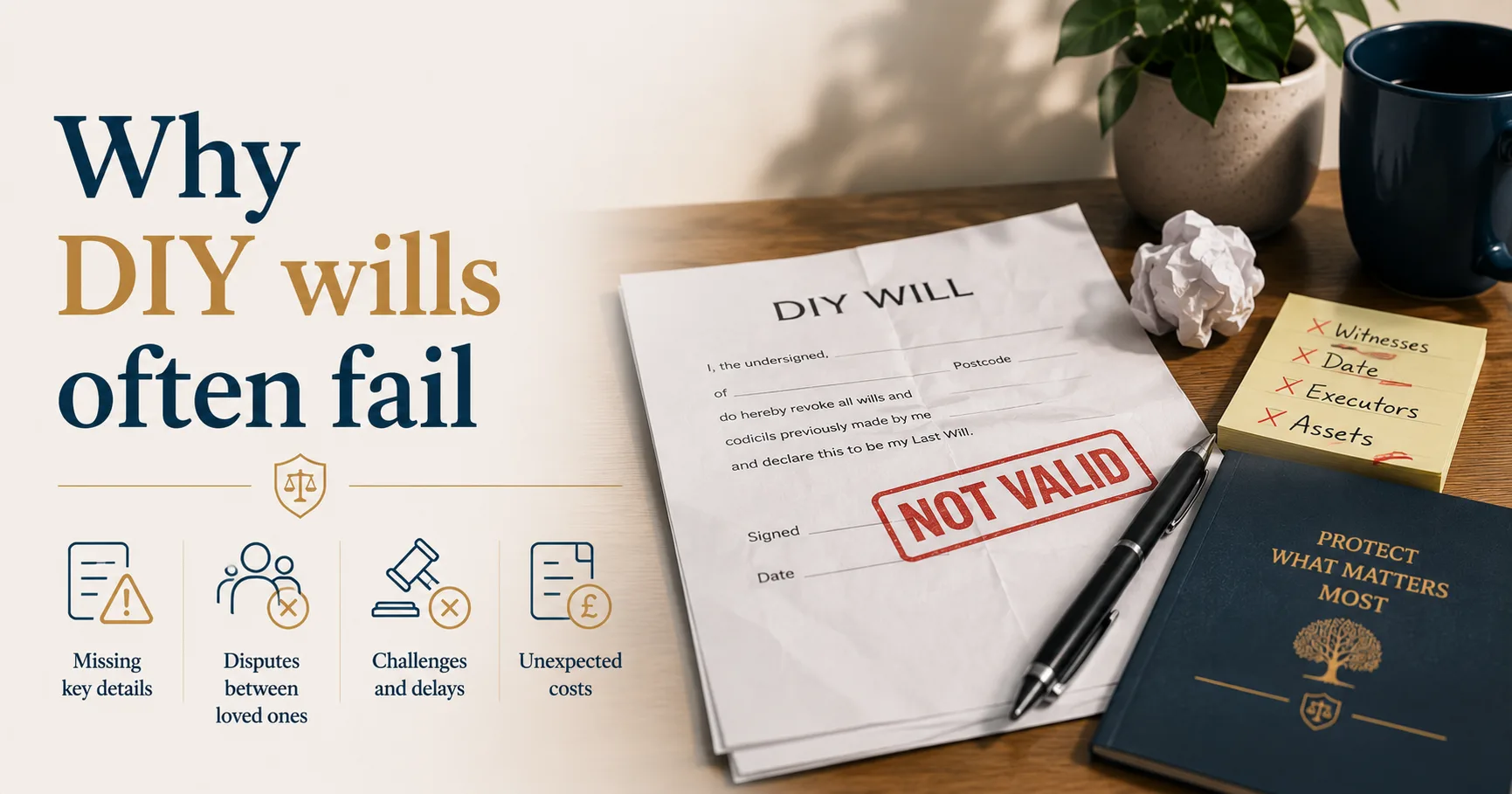
A DIY will kit from a stationer or supermarket costs £10-£25. It feels like a sensible saving over a £40-£90 online service or a £200-£500 solicitor will. In practice, DIY wills are responsible for a disproportionate share of UK probate disputes. This guide explains why — what actually goes wrong with them, what the courts have said about them, and what to use instead.
We're not going to tell you a DIY will is impossible to do well. Legally, you can write your own will from scratch on a sheet of paper, and if it's signed and witnessed correctly it's just as valid as one drafted by anyone else. The problem is that the failure rate is genuinely high, and the failures often only emerge years later when the will is read.
How DIY wills typically fail
There are around half a dozen recurring failure modes. Most DIY wills that go wrong fall into one or more of these:
1. The witnessing is wrong
The single most common failure. The Wills Act 1837 section 9 requires two adult witnesses, both present at the same time, neither of them a beneficiary (or married to / in a civil partnership with a beneficiary). DIY kits often don't make this clear enough. Common errors:
- Witnesses sign at different times, in different rooms, or on different days.
- A beneficiary witnesses the will (the gift to them then fails).
- A spouse of a beneficiary witnesses the will (same effect).
- The testator signs but the witnesses never countersign.
Our common will mistakes guide goes deeper into each of these.
2. The residual clause is missing
A residual clause says what happens to "everything else" — the property and money not specifically allocated. DIY wills often leave specific gifts ("£500 to my niece, my watch to my brother") and assume that's enough. It isn't. Without a residual clause, anything not specifically gifted falls under the intestacy rules — exactly the thing the will was supposed to prevent. See our intestacy explainer for what that means in practice.
3. The gifts are ambiguous
DIY will-writers often use the names they actually call people ("my son David") rather than the names that would identify the person legally ("my son David Charles Smith of 14 Acacia Avenue, born 12 March 1985"). When there are multiple Davids in the family, or when a gift refers to "the house" without specifying which one, ambiguity is the result. Probate disputes frequently turn on a single ambiguous phrase.
4. No substitute beneficiaries
What if the beneficiary dies before you do? DIY wills frequently don't say. The gift may then "lapse" and fall back into the residue, or — for gifts to your own children or grandchildren — be saved by section 33 of the Wills Act and pass to their children. But the result is often not what the testator intended, and it would have taken one extra clause to be explicit.
5. No substitute executors
If your sole executor has died, moved abroad, or simply doesn't want the role, the estate has no clear administrator and the family has to apply for letters of administration. Always name at least one substitute. Our how to choose your executors guide explains how.
6. Marriage revoked the will
DIY will-writers — like everyone else — often forget that marriage revokes a previous will unless the will explicitly says it was made in expectation of that marriage. Someone who wrote a DIY will at 25, married at 30, and never updated it, has effectively no will. The intestacy rules kick in.
If that's hitting close to home, the Trusted Hands will builder is free to start — and it prompts you for every one of these things.
What courts have said
We won't quote case law we can't verify, but the pattern in published probate decisions is consistent:
- Disputes over DIY wills are disproportionately common.
- Ambiguous wording almost always gets read against the family — meaning the person who wrote the will didn't get what they wanted.
- Witnessing failures void the will entirely, sending the estate to intestacy.
- The legal costs of contesting or rectifying a DIY will routinely run into tens of thousands of pounds — many times the cost of a properly drafted will.
The economics of DIY wills are surprisingly bad: a small saving up front, a large gamble at the back end. For complex estates, we recommend you seek assistance from a Trusted Hands Advisor or your own legal advice.
What's different about a guided online builder?
A reputable online will service is designed precisely to prevent the failure modes above:
- The questionnaire prompts you for substitute beneficiaries, substitute executors, and a residual clause every time.
- The document includes the revocation clause automatically, so writing a new will properly cancels the old.
- The witnessing instructions are explicit, with warnings about beneficiary witnesses.
- The wording is tested — every will produced by the service uses the same drafting that's been reviewed by qualified will-writers.
- Validation rules flag combinations that don't make sense (gifts adding up to more than 100% of residue, missing executors, beneficiaries who are also witnesses).
It's the same legal route — paper, signature, two witnesses — but with the trip-hazards removed.
What about software-generated PDFs from generic websites?
This is the bottom of the market and it's worth being explicit. Some websites take a few details and produce a generic PDF will template with no real validation, no human review, and no guidance. That's closer to a DIY will than to a guided builder. Look for:
- A genuine question-and-answer flow that adapts to your situation.
- Validation rules that catch common errors.
- Backing by qualified will-writers (often listed on the team page).
- A clear support route if you have questions.
We've covered this market segment in the hidden risks of cheap will services.
When a DIY will is genuinely fine
In honesty, a DIY will can produce a valid document if:
- The estate is genuinely simple (one beneficiary, no minor children, no property issues, no complex family history).
- The will-writer knows the witnessing rules and follows them precisely.
- The wording is unambiguous and includes a residual clause.
- The will is updated promptly when life changes.
But if you're confident enough to do all of that, you're confident enough to use a guided builder, which is barely more expensive and removes most of the remaining risk.
The cost of getting a will wrong is enormous compared to the cost of getting it right. Trusted Hands is free to start and produces a Wills Act 1837-compliant document in 15-30 minutes. Start your will →
Frequently asked questions
Is a handwritten will valid in the UK?
Yes — a will written by hand on plain paper is valid if it's signed and witnessed correctly. The medium doesn't matter; the formalities do.
Can I just print a will template I found online?
Technically yes, but generic templates have all the failure modes above and none of the validation. If you're going to use software, use software that asks you the right questions.
What's the cheapest safe way to make a will?
A guided online builder. Most are £40-£90 for a single will and £80-£150 for mirror wills, with annual update options. That's only marginally more than a DIY kit and removes the major failure modes.
My DIY will is already signed — do I need to redo it?
If it has any of the issues above, yes. Better to write a new will (which revokes the old) than to leave a flawed document for your executors to wrestle with.
Can a DIY will be partially valid?
In some cases — for instance, if a beneficiary witnesses the will, only the gift to that beneficiary fails and the rest of the will stands. But several failure modes (witnessing failures, lack of capacity, marriage revocation) void the entire will.
Ready to write your will?
Trusted Hands is a guided, plain-English will builder. You answer simple questions, see your draft as you go, and only pay when you're ready to download.
- Free to start — no card details to begin
- Smart Will Engine — only asks what's relevant to your situation
- Fixed price — no hourly bills, no surprises
- Annual updates option — keep your will editable as life changes