
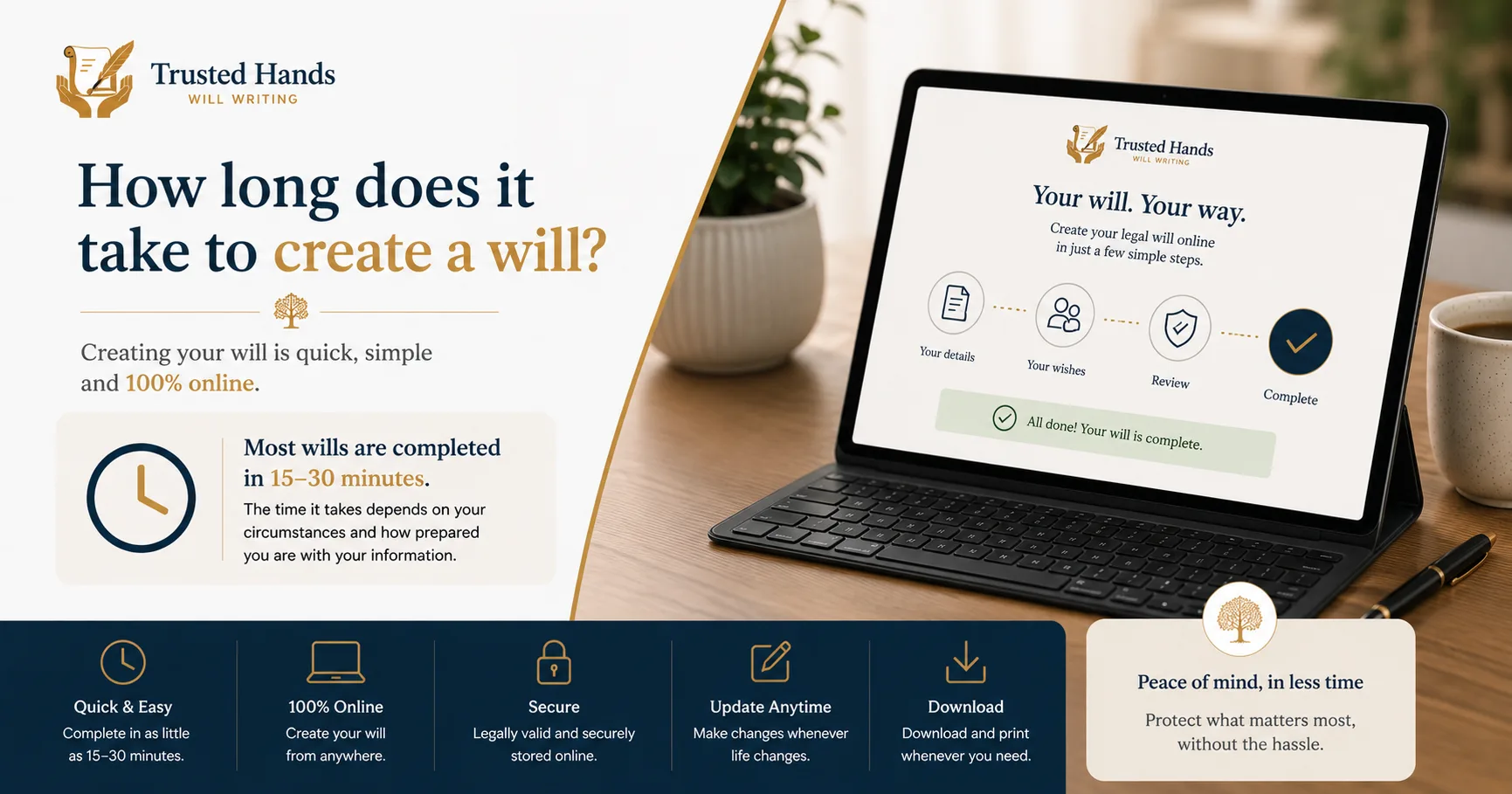
"How long is this actually going to take?" is one of the first questions people ask when they finally decide to sort their will. The answer depends almost entirely on the route you choose. A guided online will can be done in a single sitting between cups of tea. A traditional solicitor route can take weeks. This guide breaks down realistic timeframes for each option, and what tends to slow people down regardless of which path they take.
The short answer
For most estates in England and Wales, here's the rough timing in 2026:
- Online guided will builder: 15-30 minutes start to finish, plus 5-10 minutes to print, sign and witness.
- Traditional solicitor: 2-4 weeks from first call to signed document.
- Will Aid or Free Wills Month appointment: 1-3 weeks during the campaign month.
- Fully DIY (handwritten or kit): 30 minutes to a few hours, but with much higher risk of errors.
The legal validity is identical regardless of route, provided the formalities are met. The differences are in how much hand-holding you get and how much it costs - we cover the cost side in our will price guide.
Online guided will: 15-30 minutes (plus signing)
Modern online will builders work by asking you plain-English questions and turning your answers into proper legal clauses. The Trusted Hands Smart Will Engine, for instance, only asks the questions relevant to your situation - so a single-and-no-children user is asked nothing about guardianship, and a renter isn't asked about jointly owned property.
In a single sitting you'll typically:
- Set up an account (a couple of minutes).
- Answer the guided questions (15-25 minutes).
- Review the draft will on screen.
- Pay only when you choose to download (Trusted Hands is free to start).
- Print, sign and witness in front of two adult non-beneficiary witnesses.
Most people complete the digital part in a single sitting. The only "delay" is finding two witnesses - which is normally same-day or next-day.
These are the kinds of decisions our Smart Will Engine walks you through one at a time.
Traditional solicitor: 2-4 weeks
A solicitor route typically looks like this:
- Initial enquiry - phone or web form. Same day or next-day response.
- Information gathering - they send a questionnaire or arrange a fact-find call. A few days to a week to schedule.
- First consultation - 30-60 minutes, in person or by video. Often a week or two out from first contact.
- Drafting - the solicitor produces a draft will. 3-10 working days.
- Review - you read it and request changes. Could be one round, could be three.
- Signing appointment - in office or with travelling witnesses. A few days to a week to schedule.
Realistic end-to-end: 2-4 weeks for a straightforward will. Longer for complex drafting (trusts, business succession, blended families) where the back-and-forth is more involved.
The advantage is the qualified eyes on the file. The disadvantage is that for most estates the result is the same as a guided online will - the legal output is identical, only the route differs. We compare them in solicitor vs online will.
Will Aid and Free Wills Month: 1-3 weeks during the campaign
Each November (Will Aid) and during October's Free Wills Month, participating solicitors offer a will in exchange for a charitable donation. The structure is the same as a traditional solicitor route - just pre-funded by the donation. Booking is usually constrained because the slots are limited and the campaign month is busy.
If you've already planned to give to charity, these schemes can be good value. If you haven't, the donation is comparable to an online will fee.
DIY from scratch: 30 minutes to several hours
Writing your own will from scratch - on paper or with a £15 will kit - is legal in the UK. We cover the legal position in can I write my own will.
The drafting itself is fast - 30 minutes for a confident person. But this route has by far the highest rate of probate disputes per will written. The time saving over a £40-£90 guided service is real but tiny; the risk of an invalid or partially invalid will is real and not tiny.
Half an hour, no card details to start. Trusted Hands turns the decisions into a 15-30 minute guided builder. Start free → - only pay when you download.
What tends to slow people down
Whichever route you choose, the same handful of things slow people down. Knowing them in advance lets you front-load the work:
Indecision about beneficiaries. Particularly the residual estate - what happens to "everything else." Couples often disagree on the split between children, charities and surviving spouse arrangements.
Choosing executors. People want at least two, and want them to be willing. A quick conversation in advance is a good idea. Our executors guide explains what's involved.
Choosing guardians (if applicable). Like executors, you want to ask first rather than tell. This is the single most common reason wills sit half-finished.
Tracking down information. Pension provider names. Mortgage account numbers. Beneficiary addresses. None of this is required for the will to be valid - the will refers to people and things in general terms - but it's needed if you want a clean letter of wishes alongside.
Finding witnesses. Less of a delay than people fear, but worth thinking about. Two adult non-beneficiary witnesses, both present at the same time. Neighbours and colleagues are common choices.
What you cannot rush
A few things shouldn't be rushed:
Mental capacity at signing. If there's any doubt (illness, medication, dementia), arrange a doctor's note from the day of signing. This protects the will from challenge under the test in Banks v Goodfellow.
Inheritance tax planning. If your estate is near or above the £325,000 nil-rate band plus the £175,000 residence nil-rate band (both frozen until April 2030 per UK government policy as of 2026), tax-aware drafting matters. For complex estates, we recommend you seek assistance from a Trusted Hands Advisor or your own legal advice.
Communicating wishes. A will distributes assets but doesn't explain reasons. A separate letter of wishes is non-binding but often the most-treasured part of an estate plan. It is worth a quiet hour at the kitchen table.
How quickly can it actually be done?
If you're motivated and your situation is straightforward, it is genuinely realistic to:
- Decide today.
- Complete a guided online will tonight.
- Print and witness it tomorrow at work or with neighbours.
- Store the signed original in a fireproof box by Wednesday.
Done in three days, for under £100.
The main barrier most people hit isn't time - it's putting it off. Once you sit down to do it, it's faster than most evening admin.
Frequently asked questions
Is the online process really only 15-30 minutes?
For most estates, yes. The Smart Will Engine only shows questions relevant to your situation, so simple cases finish in 15 minutes and more complex ones in 25-30. Stopping and coming back is supported - your progress is saved.
How long does the witnessing take?
About 5 minutes. You and your two witnesses gather, you sign, they sign, everyone watches each other do it. The only slow part is making sure the witnesses qualify - over 18, not beneficiaries, not married to a beneficiary.
How long until the will is "in force"?
Immediately, as soon as it's correctly signed and witnessed. There is no registration, lodgement, or waiting period. Your will is legally effective from the moment everyone has signed.
Do I have to come back later to finish?
Not unless you want to. Most online services support saving and returning, but there's nothing stopping you finishing in one sitting. Pace yourself by your decisions, not the software.
How long should I take to think about it?
Up to you. Some people prefer to mull beneficiaries over a fortnight; others decide in an evening. The most common mistake isn't deciding too quickly - it's putting it off for years.
Ready to write your will?
Trusted Hands is a guided, plain-English will builder. You answer simple questions, see your draft as you go, and only pay when you're ready to download.
- Free to start - no card details to begin
- Smart Will Engine - only asks what's relevant to your situation
- Fixed price - no hourly bills, no surprises
- Annual updates option - keep your will editable as life changes