
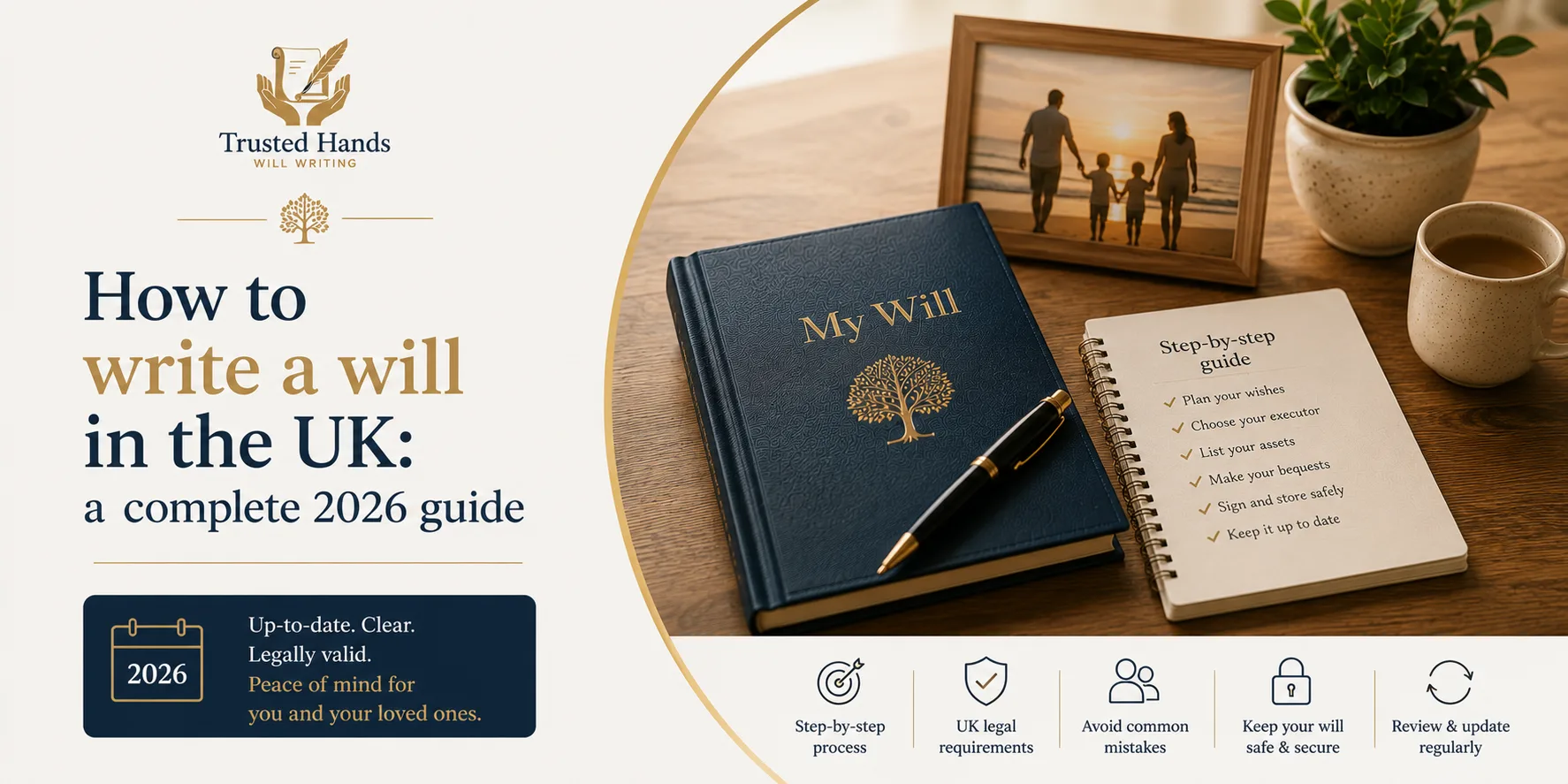
A will is the legal document that decides what happens to your money, possessions and home when you die. Without one, the law does it for you - and rarely in the way you'd have chosen. This guide walks through every step of writing a valid will in England and Wales: what to include, who to appoint, and how to sign it so it stands up in probate.
Why writing a will matters more than people think
If you die without a will (the legal term is "intestate"), your estate is distributed under the intestacy rules set out in the Administration of Estates Act 1925. Those rules can produce surprising outcomes:
- An unmarried partner of 30 years inherits nothing automatically.
- A spouse you're separated from but not divorced from can inherit a substantial share.
- Children inherit equal shares regardless of need.
- Step-children are not recognised at all.
Writing a will is the only way to override the default. It is also where you appoint guardians for your children, leave specific gifts to people or charities, and record your funeral wishes.
Step 1 - List what you own
Start with a rough inventory of your estate: your home (and whether it's owned solely or jointly), savings and investments, pensions, life insurance, vehicles, valuables, and any debts. You don't need exact valuations to write the will, but having the picture helps you allocate it sensibly.
Step 2 - Decide who inherits
Your beneficiaries fall into two main groups:
- Specific gifts - particular items or sums to particular people ("£500 to my niece Sarah", "my piano to my brother John").
- Residual estate - everything else, divided in shares.
Most disputes happen around the residual estate, so be explicit. If you want it split equally between three children, say so as percentages. If one child should receive a larger share for a reason, say that too - and consider recording your reasons in a letter of wishes so it isn't open to misinterpretation later.
Step 3 - Choose your executors
Executors are the people who actually carry out your wishes. They gather the assets, pay debts, apply for probate, and distribute the estate. We have a full guide on choosing executors, but the short version:
- Pick at least two, or one with a substitute.
- Choose people likely to outlive you.
- Make sure they're willing - it's a real job.
Step 4 - Appoint guardians (if you have young children)
If your children are under 18 and both parents die, the guardians named in your will take over. Without that appointment, the courts decide. Speak to whoever you'd like to appoint first - most people are honoured but it's a serious commitment, so it shouldn't be a surprise.
Our guide to appointing guardians covers what to think about.
Step 5 - Write the will
You have three realistic options:
- Online will-writing services like Trusted Hands - guided by software, reviewed for completeness, and produced as a clean printable document. Suitable for the majority of estates.
- A solicitor - usually £200-£500 for a standard will, more for complex or trust-based drafting.
- A "DIY" will kit from a stationer - cheap but easy to invalidate.
We'd avoid option 3 unless you're truly comfortable drafting legal language. The cost saving over a guided will-writing service is small and the risk of an invalid will is real.
Step 6 - Sign and witness it correctly
This is where most invalid wills go wrong. The Wills Act 1837 section 9 requires:
- The will is in writing.
- The testator (you) signs it (or someone signs on your behalf in your presence and at your direction).
- The signing happens in the presence of two witnesses, both present at the same time.
- Each witness then signs in your presence.
Witnesses must be 18 or over and not beneficiaries of the will (and not married to or in a civil partnership with a beneficiary). If a beneficiary witnesses your will, the gift to them fails - the rest of the will normally still stands, but it's an avoidable disaster.
See our common mistakes guide for the other ways wills get invalidated.
Step 7 - Store it safely and tell people where it is
Sign and witness the will in wet ink on paper. The signed paper original is what counts at probate. Common storage options:
- A fireproof home safe.
- The Probate Service's wills storage facility (a one-off government fee).
- With a solicitor or specialist storage provider.
Always tell your executors where the original is - a will no one can find is no help.
How often should you update your will?
A useful rule of thumb: review it every three to five years, or sooner if you have a major life event:
- Marriage (note: marriage revokes a previous will unless the will says it was made in expectation of that marriage).
- Divorce (your ex-spouse is treated as having predeceased you for the purposes of the will).
- Birth or adoption of a child.
- Buying property.
- Significant change in finances.
- Death of an executor or main beneficiary.
For complex estates, we recommend you seek assistance from a Trusted Hands Advisor or your own legal advice.
Ready to start your will? Trusted Hands turns these decisions into a 15-30 minute guided builder. Start free → — only pay when you download.
Frequently asked questions
How much does it cost to write a will in the UK?
Online services typically £40-£90, traditional solicitors £200-£500 for a standard will, more for complex drafting. See our will pricing comparison for a full breakdown.
Is an online will legally valid?
Yes - provided it complies with the Wills Act 1837 and is signed and witnessed correctly. The legal requirement is about the document and the signing process, not whether it was drafted on paper, in a solicitor's office, or via online software.
Can I write my own will from scratch?
Legally yes, but practically it's risky. Small drafting errors - ambiguous gifts, undefined beneficiaries, missing residual clauses - regularly cause expensive probate disputes. A guided service prevents most of these.
What's a "letter of wishes"?
A non-binding personal letter that sits alongside your will. It can explain reasons for choices, leave personal messages, or record where to find documents. It carries no legal force but is often the most-treasured part of an estate plan.
Does a will cover my pension?
Usually no. Most pensions pay out to a nominated beneficiary (a separate form filed with the pension provider), bypassing your will entirely. Check and update your nomination forms regularly.
Ready to start? Begin your will online - the Smart Will Engine adapts as you go, so you only answer questions relevant to your situation. Most people complete a self-service will in 15-30 minutes.
Ready to write your will?
Trusted Hands is a guided, plain-English will builder. You answer simple questions, see your draft as you go, and only pay when you're ready to download.
- Free to start — no card details to begin
- Smart Will Engine — only asks what's relevant to your situation
- Fixed price — no hourly bills, no surprises
- Annual updates option — keep your will editable as life changes