
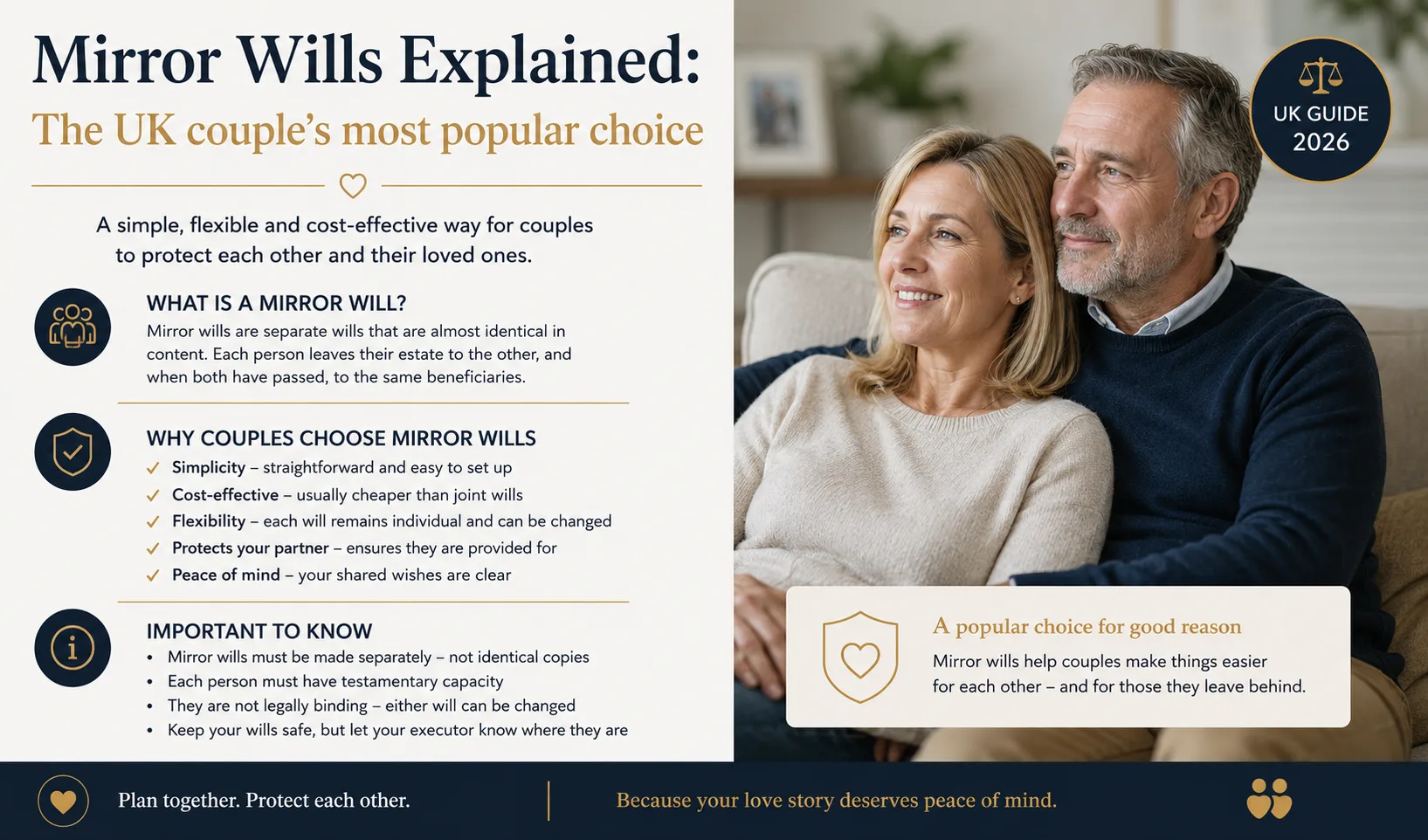
Mirror wills are the most popular type of will for UK couples. They are two separate but almost identical wills, made together, that "mirror" each other — typically leaving everything to the surviving partner and then on to the same chosen beneficiaries. Around 60% of couples who write wills choose mirror wills because they balance simplicity, fairness and flexibility better than the alternatives. This guide explains what mirror wills are, when they're the right choice, and the common misconceptions that catch couples out.
Key takeaways:
- Mirror wills are two separate wills — one for each partner — that contain matching wishes. They are not a single joint document.
- Each partner can change their own will independently at any time, including after the first partner dies. This is the key difference from mutual wills.
- Mirror wills are ideal for couples with aligned wishes: same beneficiaries, same executors, same guardian choices for children.
- They are cheaper per person than two separate single wills because much of the drafting is shared (Trusted Hands mirror wills are £179 total — £89.50 per partner).
- Marriage, divorce or remarriage revokes a mirror will the same as any other will. Update after any major life change.
What mirror wills actually are
A mirror will is not one document. It is two documents, signed separately by each partner, that say nearly identical things. The wills typically:
- Leave everything to the surviving partner first
- On the death of the second partner, distribute the combined estate to the same chosen beneficiaries (usually children, equally)
- Name the same executors (often the children, or a trusted friend)
- Appoint the same guardians for any children under 18
- Contain the same specific gifts, charitable bequests and funeral wishes
The "mirror" describes the matched contents — not the legal mechanism. Each will stands on its own and goes through probate independently.
Why couples choose mirror wills
The honest answer is that mirror wills hit the sweet spot of cost, control and flexibility:
- Cheaper than two single wills. Drafting two largely-identical wills together is far less work than drafting two unrelated ones. Trusted Hands prices mirror wills at £179 (vs £49 × 2 = £98 for two truly independent single wills — but in practice nobody does this if the wishes match).
- More flexible than mutual wills. Mutual wills bind the surviving partner — they cannot change their will after the first death. Mirror wills do not.
- Simpler than a joint will. A joint will is one document signed by two people; rare in modern UK practice because of probate complications after the first death.
- Match the most common life situation. Most couples genuinely do want the same outcome: protect the survivor, then share with the children.
When mirror wills are the wrong choice
Mirror wills assume your wishes will substantially match your partner's. If they don't, you need separate single wills (which still cost about the same in total and avoid the implication that you've agreed when you haven't). Cases where single wills are better:
- Significantly different beneficiaries — different children from previous relationships you don't want pooled, or one partner wants to leave a major gift to a cause the other doesn't share
- Wildly different estates — one partner has a business or large investments, the other doesn't
- One partner has complex needs — assets in trust, foreign property, business interests that need their own drafting
For blended families in particular, mirror wills are often not the right answer — the surviving partner could rewrite their mirror will to disinherit the first partner's children. Mutual wills or carefully drafted trusts are usually the better fit.
The "can change later" reality
Here is the single most-misunderstood thing about mirror wills: the surviving partner can change their mirror will at any time, including the day after the first partner dies. Nothing in a mirror will prevents this.
In practice, most surviving partners honour the original agreement — but the law doesn't require them to. If the survivor remarries, the new marriage automatically revokes their mirror will (see will mistakes guide). The estate then passes to the new spouse under intestacy unless a fresh will is signed.
This is why blended families often prefer mutual wills, which legally bind the survivor. Mirror wills trust the survivor to do the right thing; mutual wills make it a legal obligation.
Trusted Hands mirror wills include a free Executor Pack and Digital Vault storage. Build both partners' wills in one guided session, with the spouse invited via email once you've finished. Start mirror wills →
How the building process works
With Trusted Hands, mirror wills are built like this:
- One partner pays once for both wills (£179 total).
- That partner completes their will in the guided builder — beneficiaries, executors, guardians, specific gifts.
- The dashboard shows an "Invite your spouse" panel. You enter their email.
- They click the invite, log in or create an account with that email, and their tied will is added to the household at £0.
- They can copy across most of the answers (since wills mirror) or edit anything that differs.
- Each partner downloads, prints and signs their own will — separately — in front of two adult witnesses present at the same time.
Each partner's signed will is legally independent. If one partner loses theirs, the other partner's will is still valid.
Witnesses and signing
The witnessing rules for each mirror will are exactly the same as any other UK will (Wills Act 1837 section 9):
- Both witnesses must be present at the same time when you sign
- Both witnesses must be 18 or over
- Neither witness can be a beneficiary of your will (or married to one)
- The witnesses can be the same people for both partners' wills
In practice, couples often sign both wills in the same room, in the same sitting, with the same two witnesses. That's fine — but each signing must follow the formalities for each will independently.
Frequently asked questions
Are mirror wills automatically valid for both partners?
No. Each will must be signed and witnessed independently. There is no "mirror wills" legal concept in English law — there are just two wills that happen to contain matching wishes. Each goes through the Wills Act 1837 process separately.
Can my spouse and I have different executors in our mirror wills?
Yes. The wills are independent. Most couples name each other plus the same substitute (often an adult child), but you can name different substitutes if that suits your circumstances.
What if we separate but don't divorce?
Separation does not affect either will. Both wills remain in force exactly as written. If you want to remove your separated partner as a beneficiary or executor, you must write a new will — separation alone does nothing automatically. See our updating your will after divorce guide.
What happens to the second mirror will if one of us dies?
Nothing automatically. The deceased partner's will goes through probate. The surviving partner's mirror will remains in force and unchanged. The surviving partner can choose to update their will, write a new one, or leave it as is. They are under no legal obligation to honour the original mirror agreement.
Are mirror wills different from "couples wills"?
"Couples wills" isn't a legal term — it's a marketing label that usually means mirror wills. Some providers also use "spouse wills" or "partner wills" to mean the same thing.
Can mirror wills cover unmarried partners?
Yes. Mirror wills work for any couple — married, civil partners, or cohabiting couples. For unmarried couples especially, mirror wills are essential because there is no spouse-inheritance default to fall back on.
Do we have to use the same witnesses?
No. Each will needs its own two witnesses, but they can be different people. In practice using the same two witnesses for both signings (in the same sitting) is simpler.
Trusted Hands is a UK will-writing service, not a firm of solicitors. Mirror wills are well-suited to the majority of UK couples; for blended families, business succession, or estates over £1 million, take advice from a regulated solicitor before signing.
Ready to build your mirror wills?
Trusted Hands mirror wills are guided, online, and finished in 15-30 minutes per partner.
- £179 total for both wills (£89.50 per partner)
- Spouse invite system — your partner's tied will is automatically £0 after you pay
- Free Executor Pack for both partners
- Digital Vault storage included
- Guided Witness Mode for the signing