
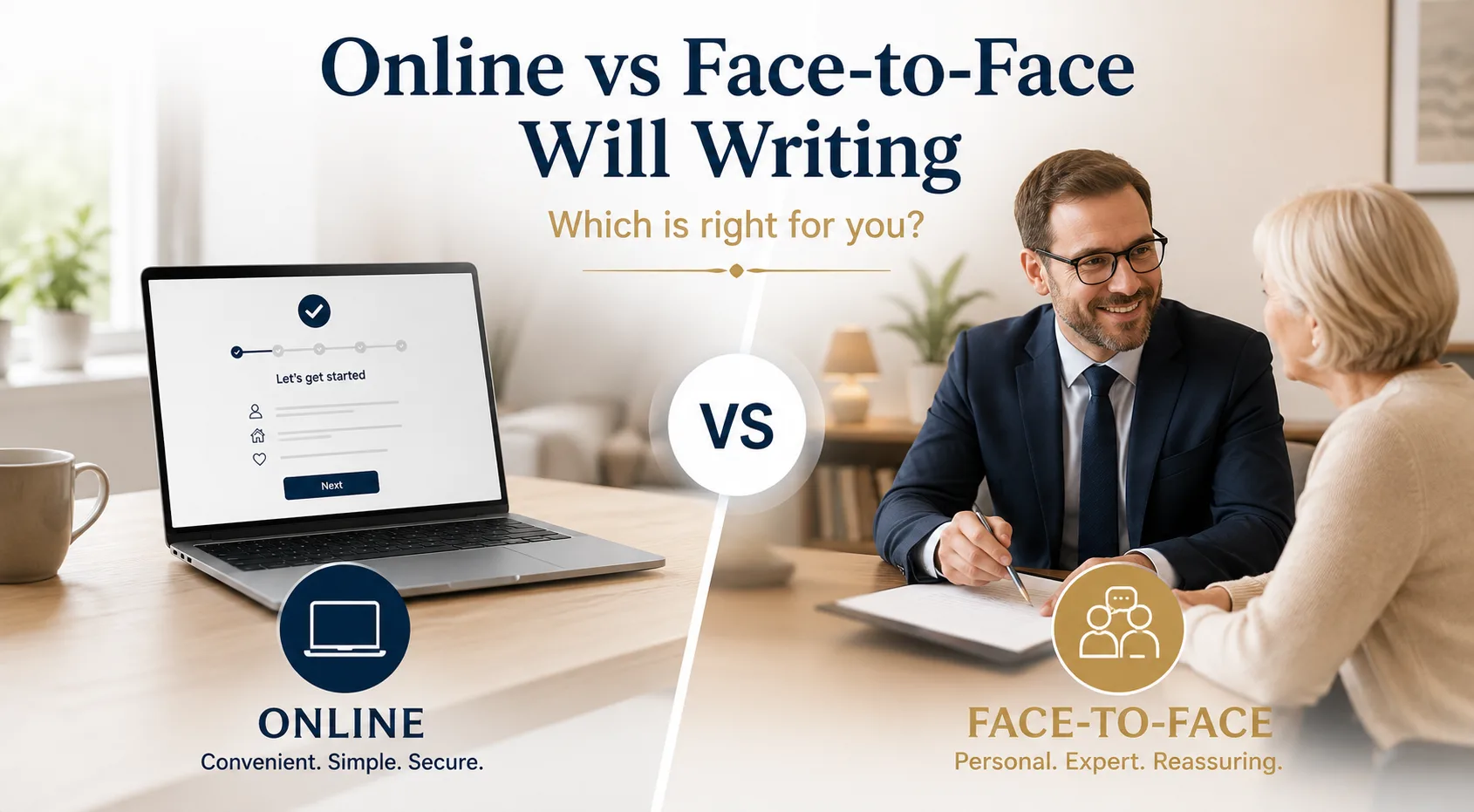
Should you write your will online or sit down with a solicitor in person? It's the question most people pause on before they write a will at all - and the honest answer is that the right route depends on your situation. For most UK estates in 2026, online wins on cost, speed, and flexibility. For some, a solicitor's office is still the right choice.
Here's an honest comparison.
What an online will actually looks like
A modern online will (the kind Trusted Hands produces) is a guided, software-driven flow. You answer questions on a screen, the software adapts based on your answers, and at the end you get a printable document drafted to comply with the Wills Act 1837 section 9.
You then print it on plain paper and sign it in front of two adult witnesses.
Typical cost: £40-£100. Typical time: 15-30 minutes. Most people do it from home in a single sitting.
What a face-to-face will looks like
A traditional solicitor will involves:
- Booking a consultation (typically a 30-60 minute appointment).
- Attending the meeting, usually at the firm's office.
- Receiving a draft a few days later by email or post.
- Reviewing and requesting changes.
- A second appointment to sign in the firm's office, with their staff acting as witnesses.
Typical cost: £200-£500 for a standard will, more for mirror wills or trust-based drafting. Typical time: two to four weeks calendar time, with one to two hours of actual meeting time.
Cost compared
This one is straightforward. A simple online will is roughly a fifth of the cost of a simple solicitor will. Mirror wills for a couple are usually 50-100% more than a single online will, vs typically £350-£800 for solicitor mirror wills.
What you're paying for at a solicitor:
- Their time in the meeting.
- Drafting time and document review.
- Office overheads.
- Storage of the original (some firms charge separately for this).
What you're paying for online:
- The software platform.
- Lawyer-reviewed document templates.
- Validation logic against common mistakes.
- Often, an annual updates option.
If your estate is straightforward, the cost premium for face-to-face is hard to justify. We've broken down every will cost option in the UK in more detail.
Speed compared
Online wins decisively here. A guided online will is usually finished in one sitting. A solicitor will involves at least two appointments scheduled around their availability and yours - typically two to four weeks elapsed.
For people who've been meaning to write a will for years, this matters. Inertia is the biggest reason wills don't get written. The faster the process, the more likely it actually happens.
If you'd rather just get on with it, the Trusted Hands will builder is free to start - you only pay when you download.
Validity compared
This is where many people assume the solicitor will is "more legal." It isn't. The legal requirements under the Wills Act 1837 are identical regardless of how the document was drafted:
- The will must be in writing.
- You sign it.
- Two adult witnesses, both present at the same time, see you sign.
- The witnesses sign in your presence.
- Neither witness is a beneficiary or married/in a civil partnership to one.
A correctly signed online will is just as binding as a correctly signed solicitor will. The validity comes from the signing, not the drafter. We have a longer piece on whether online wills are legally binding if you want a deeper dive.
Where face-to-face genuinely wins
In honesty, there are situations where a solicitor in the room is the right call:
- Trust-based drafting. Life-interest trusts (for example, letting a partner live in the house for life with the children inheriting afterwards) need bespoke drafting that goes beyond what most guided builders produce.
- Business succession. Leaving a stake in a business, especially one with multiple shareholders or a partnership agreement, often needs a coordinated approach with the business's other documents.
- Foreign property or assets. Cross-jurisdiction estates need someone who understands both UK and the relevant other country's rules.
- Complex blended-family situations where you're trying to provide for a current partner and protect inheritance for children from a previous relationship. This can be done online but is one of the cases where bespoke advice is often worth it.
- Estates likely to face IHT planning. If your estate is well above the £325,000 nil-rate band and £175,000 residence nil-rate band (both frozen until April 2030), tax planning may be worth the solicitor's fee.
- Capacity concerns. If there's any chance someone might later challenge the will on the basis that you weren't of sound mind, having a solicitor as a witness who can attest to your capacity is valuable.
For complex estates, we recommend you seek assistance from a Trusted Hands Advisor or your own legal advice.
Not sure which route is right for you? Trusted Hands' guided builder flags the situations where you should consider professional advice. Start free - the questions tell you what your situation needs.
Where online wins
For everyone else, online is the better choice in 2026:
- You save several hundred pounds on a will that achieves exactly the same legal outcome.
- You finish in 30 minutes instead of two appointments over a month.
- You can review your draft as you go.
- You can update it cheaply (or free, with some annual updates options) as life changes.
- You don't take an afternoon off work.
The "most UK estates" group is large. If you have a clear list of who you want to inherit, no business succession concerns, no foreign property, and you're not setting up a trust - online is almost certainly the right choice.
What about hybrid options?
Some online services offer a phone or video review with a qualified will writer for an extra fee. This is a sensible middle ground if you want online's speed and price but want a human to look the will over before you sign.
It's not the same as a full solicitor relationship, but it covers the "I just want someone to confirm I haven't missed anything" anxiety that stops some people choosing online.
Frequently asked questions
Is a face-to-face will more legally robust than an online one?
No. Both are governed by the Wills Act 1837. A correctly signed online will is just as binding as a correctly signed solicitor will. Robustness depends on the drafting and the signing, not the venue.
What if I have a complex situation - is online still possible?
Often yes for the bulk of the document, but you should pair it with professional advice for the complex parts. A guided builder that flags complexity (like Trusted Hands) is designed to identify these cases.
Can a solicitor write the will and then I sign it at home?
Some solicitors will post drafts for at-home signing, though many prefer in-office signing because they can witness it themselves. Ask the firm before you book.
Do I need to use a solicitor for probate even if I used a solicitor for the will?
No. Probate is a separate process and can be handled by your executors directly, by an online probate service, or by any solicitor - it doesn't have to be the firm that drafted the will.
Which is better for couples - online or solicitor mirror wills?
For straightforward situations, online mirror wills are dramatically cheaper and equally valid. For blended families or complex estate-splitting between current partner and previous-relationship children, a solicitor is often worth the cost.
Ready to write your will?
Trusted Hands is a guided, plain-English will builder. You answer simple questions, see your draft as you go, and only pay when you're ready to download.
- Free to start - no card details to begin
- Smart Will Engine - only asks what's relevant to your situation
- Fixed price - no hourly bills, no surprises
- Annual updates option - keep your will editable as life changes