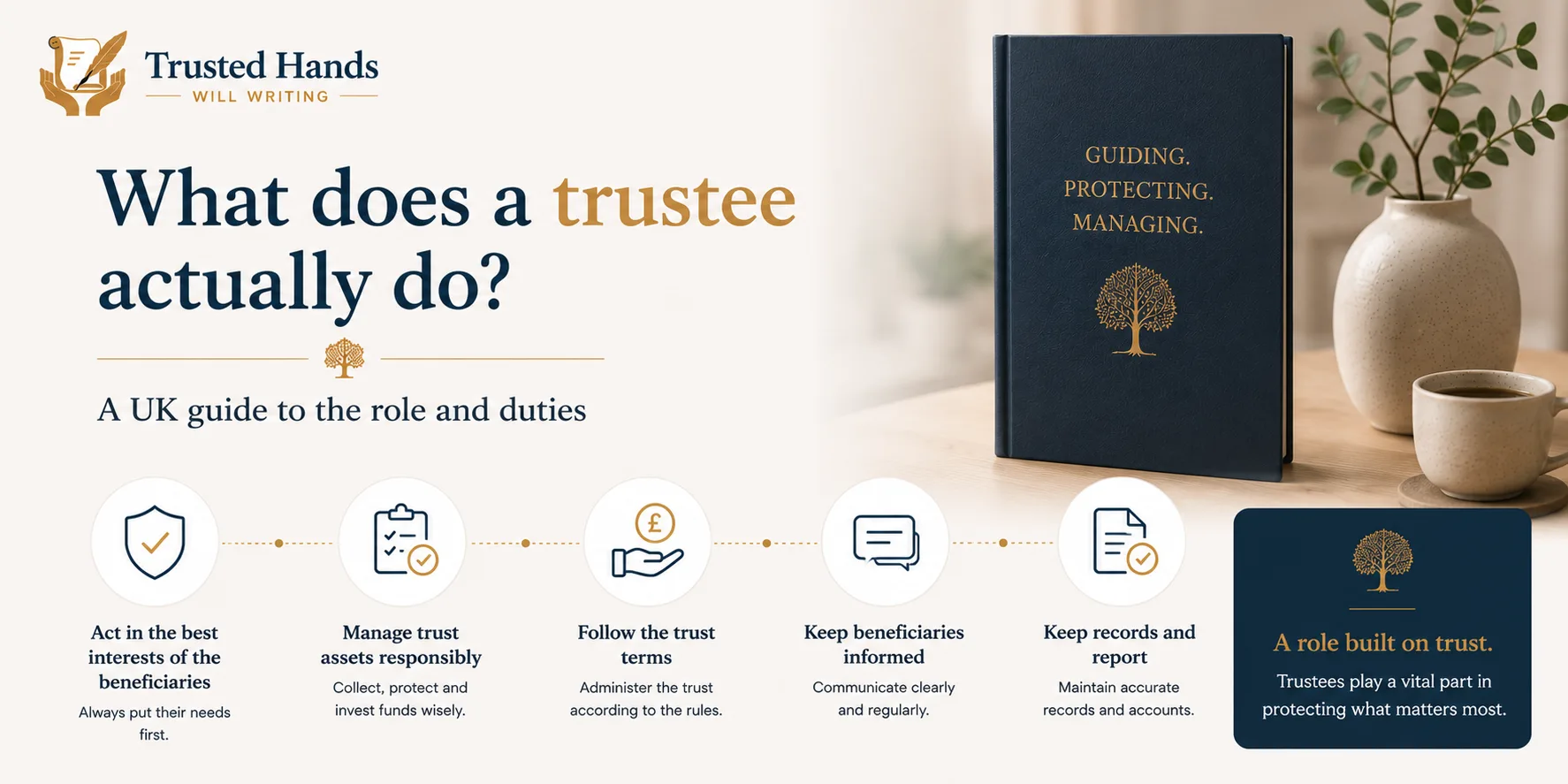
Being asked to be a trustee is a significant responsibility. Trustees hold legal title to trust assets, owe a fiduciary duty to the beneficiaries, and can be personally liable for breaches of trust. Done well it's a long-term commitment of real value to a family; done badly it can lead to lawsuits and personal financial loss. This guide explains what a UK trustee actually does, the legal duties involved, the limits of trustee discretion, and the practical questions every prospective trustee should ask before saying yes.
Key takeaways:
- Trustees are the legal owners of trust assets. They hold the assets for the benefit of the beneficiaries named in the trust.
- Trustees owe a fiduciary duty to the beneficiaries — to act in their best interests, avoid conflicts, follow the trust terms, and account for what they do.
- Trustees can be personally liable for breaches of trust, including losses from poor investment decisions, unauthorised distributions, or failure to follow the trust terms.
- The role can last decades for a will trust set up for young children or grandchildren.
- Most trustees are unpaid family members or friends; professional trustees (solicitors, trust corporations) can be appointed and charge from the trust.
What a trustee actually does
A trustee's role depends on the type of trust and what assets it holds, but core duties include:
- Holding legal title to the trust assets (bank accounts, property, investments, etc. in the trustees' names, not the beneficiaries' or the deceased's)
- Administering the trust in accordance with the terms set out in the will or trust deed
- Investing trust assets prudently and in line with the standard investment criteria
- Keeping accounts of all trust income, capital, distributions and expenses
- Making distributions to beneficiaries when authorised or required
- Communicating with beneficiaries about the trust's existence, purpose and progress
- Filing tax returns if the trust has income or gains
- Registering the trust with HMRC's Trust Registration Service where required
For a simple bare trust holding £10,000 for a child until they turn 18, this is straightforward. For a £500,000 discretionary trust with property, investments and multiple beneficiaries, it's a substantial part-time job.
The legal duties of a trustee
The Trustee Act 2000 and centuries of case law set out specific duties:
### Duty to follow the trust terms
The trust document — the relevant clauses in the will, or the trust deed — is the trustees' primary instruction set. They must follow what it says. Deviating without legal authority is a breach of trust.
### Duty to act in the beneficiaries' best interests
Trustees act for the beneficiaries, not themselves. Where there's a choice, they must choose what's best for the beneficiaries collectively.
### Duty of care
Trustees must act with the care and skill reasonable in the circumstances. The standard is higher for professional trustees (who hold themselves out as having expertise) than for lay family-member trustees.
### Duty to avoid conflicts of interest
A trustee must not put themselves in a position where their personal interests could conflict with their duty to the beneficiaries. This is one reason naming a beneficiary as the sole trustee is poor practice for substantial trusts.
### Duty to act unanimously (where there are multiple trustees)
Unless the trust deed says otherwise, all trustees must agree on decisions. Disagreement can deadlock a trust.
### Duty to keep accounts
Trustees must keep accurate records of trust income, expenditure, distributions and capital. Beneficiaries have the right to see these accounts.
### Duty to invest prudently
Trustees must apply the "standard investment criteria" — the suitability of the investment to the trust, and the need for diversification. Holding everything in cash is no longer a safe default; trustees must actively consider whether the investment mix is appropriate.
Personal liability
A trustee who breaches their duties can be personally liable for any loss caused. This is the part that prospective trustees don't always appreciate.
If a trustee:
- Makes an unauthorised distribution → may have to repay it personally
- Invests negligently and loses money → may have to make good the loss personally
- Fails to file required tax returns → may face HMRC penalties personally
- Acts in a conflict of interest without proper disclosure → may have to disgorge any profit
Trustees can sometimes get exoneration via:
- Trust exoneration clauses in the trust deed (most modern trust documents include them, but they don't excuse fraud or wilful default)
- Court permission for difficult decisions in advance
- Insurance (trustee liability insurance is available, paid from the trust assets in most cases)
Most lay trustees acting honestly and reasonably are fine. The risk is meaningful but manageable.
How many trustees, and who?
A trust can have between one and four trustees (some specialised structures allow more). Most family trusts have two or three.
Common choices:
- Family members — adult children, siblings, spouse
- Friends — long-term close friends with relevant skills
- Professional trustees — solicitors, accountants, trust corporations (charge from trust assets, often 0.5-1% per year)
For substantial or long-running trusts, a mix is often best: one family member who understands the personalities, plus one professional who handles the administration.
What a trustee can pay themselves
Lay trustees (family/friends) generally cannot charge for their time. They can only recover out-of-pocket expenses (travel to meetings, postage, professional fees they've paid).
Professional trustees (solicitors, accountants, trust corporations) can charge, usually under a "charging clause" in the trust deed. Without a charging clause, even a professional trustee cannot charge.
If you want any trustee to be paid for their time, include a clear charging clause in the will or trust deed.
The practical first 90 days
If you're appointed as a trustee of a new will trust (i.e. the testator has just died), the first 90 days look something like:
- Read the will and the trust clauses carefully. Make sure you understand the trust's purpose, beneficiaries, and any specific instructions.
- Identify the trust assets. Work with the executors (often you'll be both) to identify what's coming into the trust.
- Open trust bank accounts in the trustees' names (e.g. "Mr A Smith and Mrs B Smith as trustees of the J Smith Will Trust").
- Transfer assets into trustees' names. Land Registry for property, transfer instructions for investments, bank account opening for cash.
- Register the trust with HMRC's Trust Registration Service if required (most express trusts now have to register).
- Communicate with beneficiaries. Tell them the trust exists, what it's for, and what they can expect.
- Get advice if anything is unclear — solicitor, accountant, or a trust specialist. The cost is paid from the trust.
Trusted Hands wills include a free Executor Pack with first-week guidance. For trustees specifically, a separate trustee pack with the steps above is helpful — speak to your solicitor for trust-specific guidance. Start your will →
When trustees can step down
A trustee can retire in three ways:
- By deed of retirement under the Trustee Act 1925, provided there are still at least two trustees (or a trust corporation) remaining
- By appointment of a replacement under the same Act
- By order of the court in difficult cases
Trustees cannot simply walk away. The retirement must be formalised so legal title to trust assets can be transferred.
When beneficiaries can challenge trustees
Beneficiaries have rights to:
- See the trust accounts
- Receive distributions due to them
- Be informed about material trust decisions
- Apply to court if trustees are acting improperly
If trustees are clearly breaching their duties, beneficiaries can apply to court for:
- An order requiring specific action
- Removal of the trustee
- Compensation for losses caused
- Replacement trustees
Most disputes settle without court action, but the option exists.
Frequently asked questions
Can I refuse to be a trustee?
Yes. If you've been named in a will as a trustee, you can disclaim the role before you've started to act. Once you've started administering the trust, you can retire but not unilaterally walk away. Best practice: tell the testator while they're alive if you don't want to be named.
Can a beneficiary also be a trustee?
Yes — and it's very common. A beneficiary acting as a trustee must take particular care to avoid conflicts of interest and must not vote on distributions to themselves where their personal interest is engaged.
Do trustees have to live in the UK?
No, but it can affect the trust's tax residence. A trust with all non-UK-resident trustees may be treated as a non-resident trust for tax, with significant consequences. Take advice if you're appointing non-UK trustees.
Can a trustee be removed?
Yes. The trust deed may include removal provisions (e.g. by the protector or by majority of beneficiaries). The court can also remove a trustee acting improperly. Voluntary retirement is the usual mechanism for amicable changes.
What records must trustees keep?
Trust accounts (income, expenditure, capital movements, distributions), minutes of trustee decisions, copies of all correspondence with beneficiaries and advisers, and tax returns. Keep records for at least six years after the trust ends.
Are trustees liable for tax personally?
Trustees are liable for trust tax in their trustee capacity (paid from trust assets). They can be personally liable to HMRC if they fail to file or pay on time — penalties can be charged against them personally.
Should trustees get insurance?
For substantial trusts, yes. Trustee liability insurance is available and usually paid from trust assets. For small trusts (under £100,000), the cost often doesn't justify it.
What's the difference between a trustee and an executor?
An executor administers the deceased's estate through probate (collects in assets, pays debts and tax, distributes to beneficiaries). A trustee holds and manages trust assets long-term. Often the same person is both — they finish their executor role and then begin their trustee role on the same assets that pass into the trust.
Trusted Hands is a UK will-writing service. We handle straightforward bare trusts in our guided builder; more complex trust structures benefit from regulated solicitor drafting and our solicitor partners can help with both drafting and ongoing trustee guidance.
Set up a will with sensible trust clauses
Our guided builder includes standard bare trust language where it's needed and flags more complex scenarios for solicitor input.
- From £49 for a single will
- Smart Will Engine flags trust scenarios automatically
- Free Executor Pack with every will
- Solicitor partnership for life-interest and discretionary trust drafting