
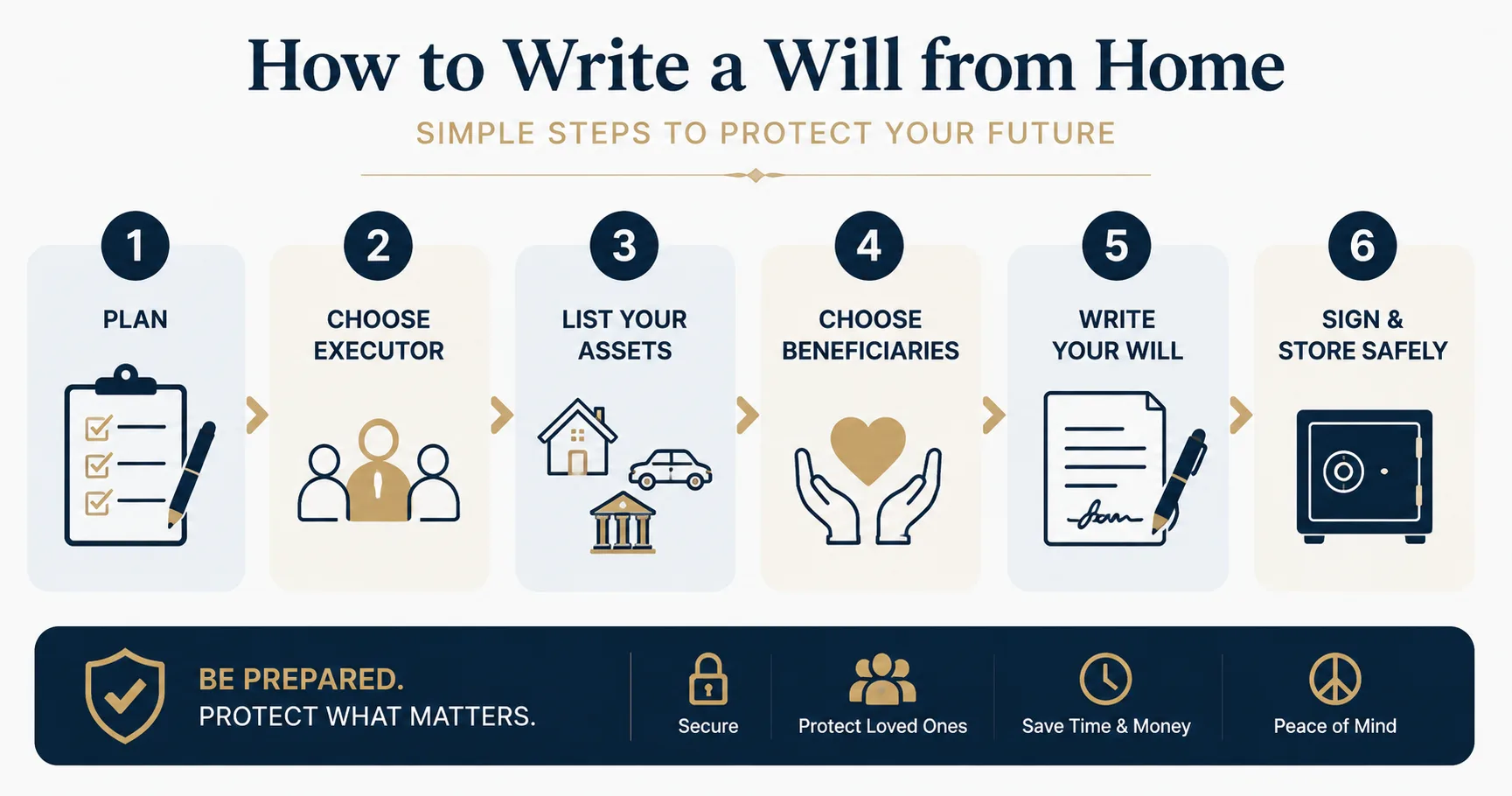
You don't need to set foot in a solicitor's office to write a valid will in England and Wales. The whole drafting process can happen from your kitchen table - and for a standard estate, the result is just as legally binding as one drafted in a high-street firm. The only thing that can't happen entirely from your laptop is the signing, which still requires two adult witnesses physically present at the same time under the Wills Act 1837 section 9.
This is a step-by-step guide to writing your will from home: what to gather, how to draft it, how to sign it, and how to store it.
Step 1: Gather what you'll need before you start
Before opening any will builder, spend ten minutes pulling together a rough picture of your estate. You don't need exact numbers, just a list:
- Property - your home (and whether you own it solely, as joint tenants, or as tenants in common with someone else), any other property.
- Savings and investments - bank accounts, ISAs, premium bonds, shares.
- Pensions - workplace and private pensions (note: most pensions pass via a separate nomination form, not your will).
- Life insurance - similarly, often paid out via nomination, not via the will.
- Personal items of value - jewellery, vehicles, art, anything you might want to leave to a specific person.
- Debts - mortgage balance, credit cards, loans.
You'll also want a list of:
- Beneficiaries - the people (and any charities) you want to inherit, with full names and addresses.
- Possible executors - two ideally, with full names. They should be over 18, willing, and likely to outlive you.
- Possible guardians - if you have children under 18.
Having this in front of you means the will-writing process is data entry, not decision-making.
Step 2: Choose how you'll draft the will
You have three realistic at-home options:
- A guided online will builder like Trusted Hands. You answer questions on a screen, the software adapts to your situation, and the finished document is produced as a printable PDF. Typical cost £40-£100. Time: 15-30 minutes.
- A DIY paper kit from a stationer. Cheap (£10-£25) but error-prone - small mistakes invalidate the will or void specific gifts.
- An online solicitor consultation - some firms offer remote video consultations with a follow-up will sent by post. Usually £200-£400.
For most estates, option 1 hits the right balance of cost, control, and safety. We've covered the comparison of online vs traditional wills in detail elsewhere if you want a fuller picture.
If you'd rather just begin, our guided will builder is free to start - you only pay when you download the document.
Step 3: Work through the will questions
Whatever route you choose, expect to be asked about:
- Personal details - your full name, address, and any previous names.
- Marital status - currently married/civil-partnered, divorced, separated, single. (Marriage revokes a previous will unless it explicitly says it was made in expectation of that marriage.)
- Children - biological, adopted, and any stepchildren you want to provide for explicitly. Stepchildren are not inherited automatically.
- Beneficiaries - who inherits, and in what shares or specific gifts.
- Residual estate - the catch-all for anything not specifically named. Most disputes arise here, so make it explicit.
- Executors - who carries out your wishes. We have a guide to choosing executors.
- Guardians - for children under 18.
- Funeral wishes - optional but appreciated by family.
Take your time. You can usually pause and return.
Step 4: Read the draft carefully
A good online builder shows you the draft as you go, so by the time you finish you've already read your will. Read it once more end-to-end before printing. Look for:
- Names spelt correctly.
- Shares adding up to 100%.
- A residual clause covering anything not specifically gifted.
- Substitute beneficiaries in case someone dies before you.
- Substitute executors and guardians.
If anything is unclear, change it. The point of writing from home is that you're in no hurry.
Step 5: Print the will on plain white paper
Use plain white A4 and a regular printer. Don't bind, staple, or hole-punch the printed pages until after signing - any extra holes or marks on a will can raise questions about whether something was attached or removed.
Keep the pages together as a clean, ordered set.
Step 6: Sign and witness it correctly
This is the only step you can't do at your laptop. The will must be signed in the physical presence of two adult witnesses, both present at the same time. Each witness then signs in your presence.
Witnesses must be:
- 18 or over.
- Not beneficiaries of the will.
- Not married to or in a civil partnership with a beneficiary.
Common safe choices: neighbours, work colleagues, friends who aren't named in the will. Avoid anyone who might inherit anything, even a small specific gift.
If a beneficiary witnesses the will, the gift to them fails - the rest of the will normally still stands, but it's an avoidable disaster. See our common will mistakes guide for the other classic errors.
Want to skip straight to the drafting? Trusted Hands turns this whole process into a 15-30 minute guided flow. Start free - you only pay when you're ready to download.
Step 7: Store the original somewhere safe
The signed paper original is the legal document. Photocopies and scans don't count for probate. Sensible storage:
- A fireproof home safe.
- The Probate Service's wills storage facility (a small one-off government fee).
- A specialist storage provider.
Tell your executors where the original is. A perfect will that no one can find is no use.
Step 8: Plan when you'll review it
Set a reminder to review the will every three to five years, or sooner if you have a major life event - marriage, divorce, new child, house move, death of a named person, significant change in finances.
Some online services (Trusted Hands included) offer an annual updates option that lets you regenerate your will whenever circumstances change for a small annual fee, which avoids the "I'll get round to it" problem.
For complex estates, we recommend you seek assistance from a Trusted Hands Advisor or your own legal advice.
Frequently asked questions
Can I really write a legally valid will from home?
Yes. The legal requirement is about how the will is signed and witnessed, not where it was drafted. A will drafted at your kitchen table and signed correctly is just as binding as one drafted in a solicitor's office.
Do my witnesses need to know the contents of the will?
No. Witnesses are confirming that they saw you sign the document - not approving its contents. They don't need to read it. They just need to see you sign and then sign themselves.
Can I sign a will electronically?
Not in England and Wales as of 2026. The Wills Act still requires a wet-ink signature on paper, witnessed in person. Law reform is being consulted on but not yet enacted.
What if I make a mistake after signing?
Don't write on the will or amend it by hand. Either write a separate codicil (a formal amendment, signed and witnessed the same way) or, more commonly, write a fresh new will that explicitly revokes the old one. Most modern online services make re-issuing easier than codicils.
How quickly can I get the will done?
Most people complete the drafting in 15-30 minutes. Then you need to print, organise two witnesses, and sign - usually another 30 minutes once you've found witnesses available at the same time. So allow an hour total of focused effort.
Ready to write your will?
Trusted Hands is a guided, plain-English will builder. You answer simple questions, see your draft as you go, and only pay when you're ready to download.
- Free to start - no card details to begin
- Smart Will Engine - only asks what's relevant to your situation
- Fixed price - no hourly bills, no surprises
- Annual updates option - keep your will editable as life changes