
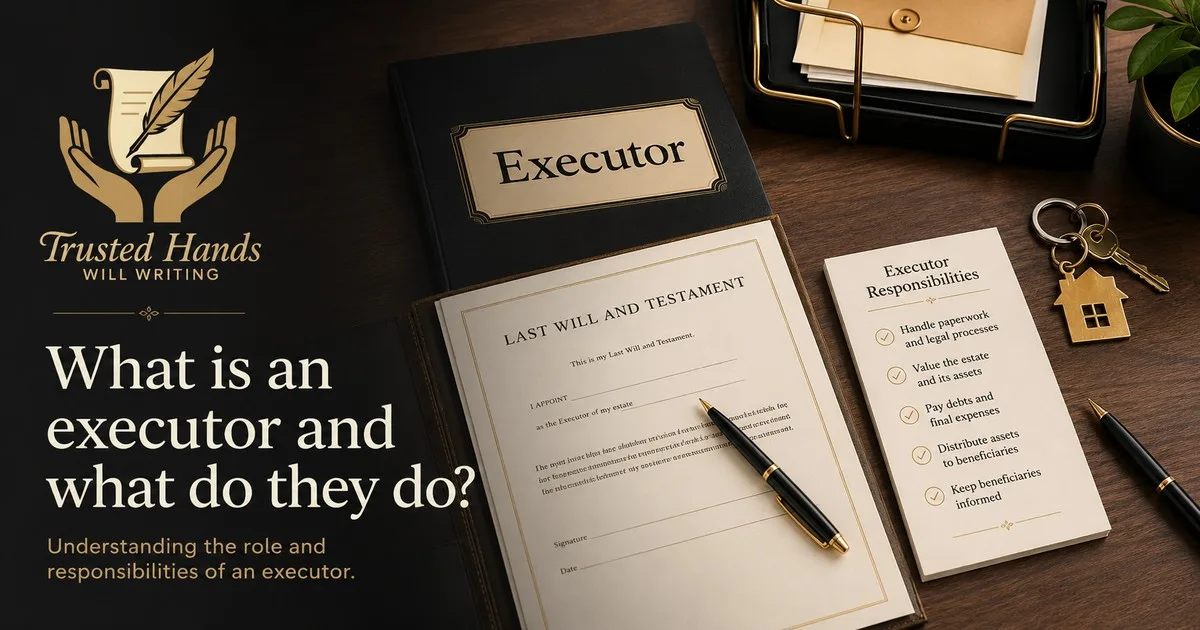
An executor is the person you name in your will to carry out your wishes after you die. They are the legal representative of your estate - the one who gathers everything you owned, settles what you owed, applies for probate where it's needed, and finally pays out what's left to the people you've chosen to inherit.
It's a role that sounds simple on paper but turns out to be a real job. Most executors describe it as somewhere between a few months of admin and a full part-time role for a year. Choosing the right person, and knowing what you're asking of them, matters a lot more than most people realise when they sit down to write a will.
What an executor actually does
The job has four broad phases. Each one can take weeks - sometimes longer if the estate is complicated or there's a property to sell.
1. Registering the death and securing the estate
In the first days, the executor (often acting alongside family) registers the death, notifies banks, the DWP, HMRC and pension providers, and makes sure assets are safe. This includes things like cancelling direct debits, redirecting post, and locking up an empty property if the deceased lived alone.
2. Valuing the estate
Before probate can be applied for, the executor needs a clear picture of what the estate is worth. That means listing every asset (property, savings, investments, pensions paid into the estate, valuables, vehicles) and every liability (mortgage, credit cards, loans, unpaid tax). The total is what HMRC will use to assess inheritance tax.
3. Applying for probate and paying tax
If the estate is above a certain threshold or contains property to be sold or transferred, the executor applies to the Probate Registry for a "grant of probate". The grant is the legal document that proves they have the authority to deal with the estate. Inheritance tax (where due) usually has to be paid before the grant is issued - which can mean borrowing against the estate or using the deceased's bank account under HMRC's direct payment scheme.
Our probate timeline guide walks through how long each stage typically takes.
4. Distributing the estate
Once probate is granted and tax is paid, the executor closes accounts, sells or transfers assets, and pays out what's left to the beneficiaries named in the will. They also keep accounts of everything they've done - beneficiaries are entitled to see them.
Who can be an executor?
Almost any adult can be an executor. The legal requirements are short:
- They must be 18 or over when probate is applied for (you can name a younger person, but they can't act until they turn 18).
- They must have mental capacity to make decisions.
- They must not be bankrupt at the point of acting (a bankrupt person can be appointed but a court will usually pass over them).
Beyond that, it's about who you trust to do the job carefully. Most people pick a spouse, an adult child, a sibling, or a close friend. You can also appoint a professional - a solicitor, accountant or specialist probate firm - though they will charge for their time.
How many executors should you appoint?
You can appoint up to four executors to act at the same time. We'd suggest two, or one with a substitute.
- Two executors can share the workload and check each other's decisions. If one becomes unwilling or unable to act, the other carries on.
- One executor with a substitute is fine for simpler estates. The substitute steps in only if the first choice can't act.
A single executor with no backup is a small but real risk - if they die, lose capacity or simply refuse, your estate has no one in the saddle and your beneficiaries face delay and cost.
If you'd rather just get on with it, our guided will builder walks you through the executor decision in plain English, including how to set up a substitute.
Can a beneficiary also be an executor?
Yes - and it's extremely common. A spouse or adult child is often both an executor and a main beneficiary, and that's perfectly legal. The conflict-of-interest concerns that crop up in some legal contexts don't really bite here, because the executor is administering a process you've designed.
There's a separate question about whether a beneficiary can also be a witness - the answer is no, and we cover that below. But being an executor and a beneficiary at the same time is fine. Our executor-as-beneficiary guide goes into the practicalities in more depth.
What makes a good executor?
A good executor is someone who:
- Is organised and patient. There's a lot of paperwork and waiting.
- Lives in the UK. Probate involves UK courts and UK banks - an executor abroad can act, but it adds friction (and sometimes the need to appoint a UK-based attorney to act on their behalf).
- Will outlive you, ideally. Picking someone the same age as you is fine, but a substitute who's a generation younger is sensible.
- Is trusted by your beneficiaries. If your children are inheriting and one of them resents your executor, you've baked in a dispute.
- Will actually do the job. Some people are flattered to be asked but disappear when the work starts. Always have the conversation first.
Ready to put this into your own will? Trusted Hands turns the executor decision (and everything else) into a 15-30 minute guided builder. Start free → - only pay when you download.
Can an executor refuse to act?
Yes. Being named in a will doesn't oblige you to do the job - you can renounce the role before you've taken any steps to administer the estate. We have a dedicated guide on what happens when an executor refuses, but the short version: your substitute steps up, or if there's no substitute, the beneficiaries can apply for "letters of administration with will annexed" and effectively take over.
Do executors get paid?
Not usually. Lay executors (family or friends) work unpaid, though they can claim out-of-pocket expenses from the estate - travel, postage, valuation fees, professional advice. Some wills include a small "legacy" to the executor as a thank-you, which is a nice touch but not required.
Professional executors (a solicitor, bank or specialist firm) charge for their time. Banks have historically charged a percentage of the estate - typically 1-4% - which can add up to a great deal of money for a large estate. Most modern advice is to avoid percentage-based professional executors unless you have a specific reason to want one. For complex estates, we recommend you seek assistance from a Trusted Hands Advisor or your own legal advice.
Frequently asked questions
Can I appoint a friend who lives abroad as my executor?
You can, but it's harder for them to act. UK probate forms, UK bank visits and certified document checks all assume the executor is here. Most foreign-based executors end up appointing a UK-based attorney to act on their behalf, which adds cost. A local executor is almost always simpler.
What if my chosen executor dies before me?
If you've appointed two, the other one carries on alone. If you've appointed one with a substitute, the substitute steps in. If you've named only a single executor with no substitute and they die first, the beneficiaries can apply for letters of administration - but it's a slower process. Always name a backup.
Do my executors need to know I've named them?
Legally no, but practically yes. Tell them. Tell them where the original will is stored. Tell them roughly what's in the estate. An executor who learns of their role at the same time as the death is starting from zero in the worst possible week.
Can my executor also be a witness to my will?
No - and this is important. If your executor is also a beneficiary and they witness the will, the gift to them fails under section 15 of the Wills Act 1837. If they're an executor only and not a beneficiary, they can witness, but it's much cleaner to use neutral witnesses.
What if all my executors refuse or can't act?
The beneficiaries (in priority order under the rules) can apply to be administrators of the estate "with the will annexed". The will is still valid; it's just that someone else handles the admin. Naming a substitute in your will avoids this entirely.
Ready to write your will?
Trusted Hands is a guided, plain-English will builder. You answer simple questions, see your draft as you go, and only pay when you're ready to download.
- Free to start - no card details to begin
- Smart Will Engine - only asks what's relevant to your situation
- Fixed price - no hourly bills, no surprises
- Annual updates option - keep your will editable as life changes