
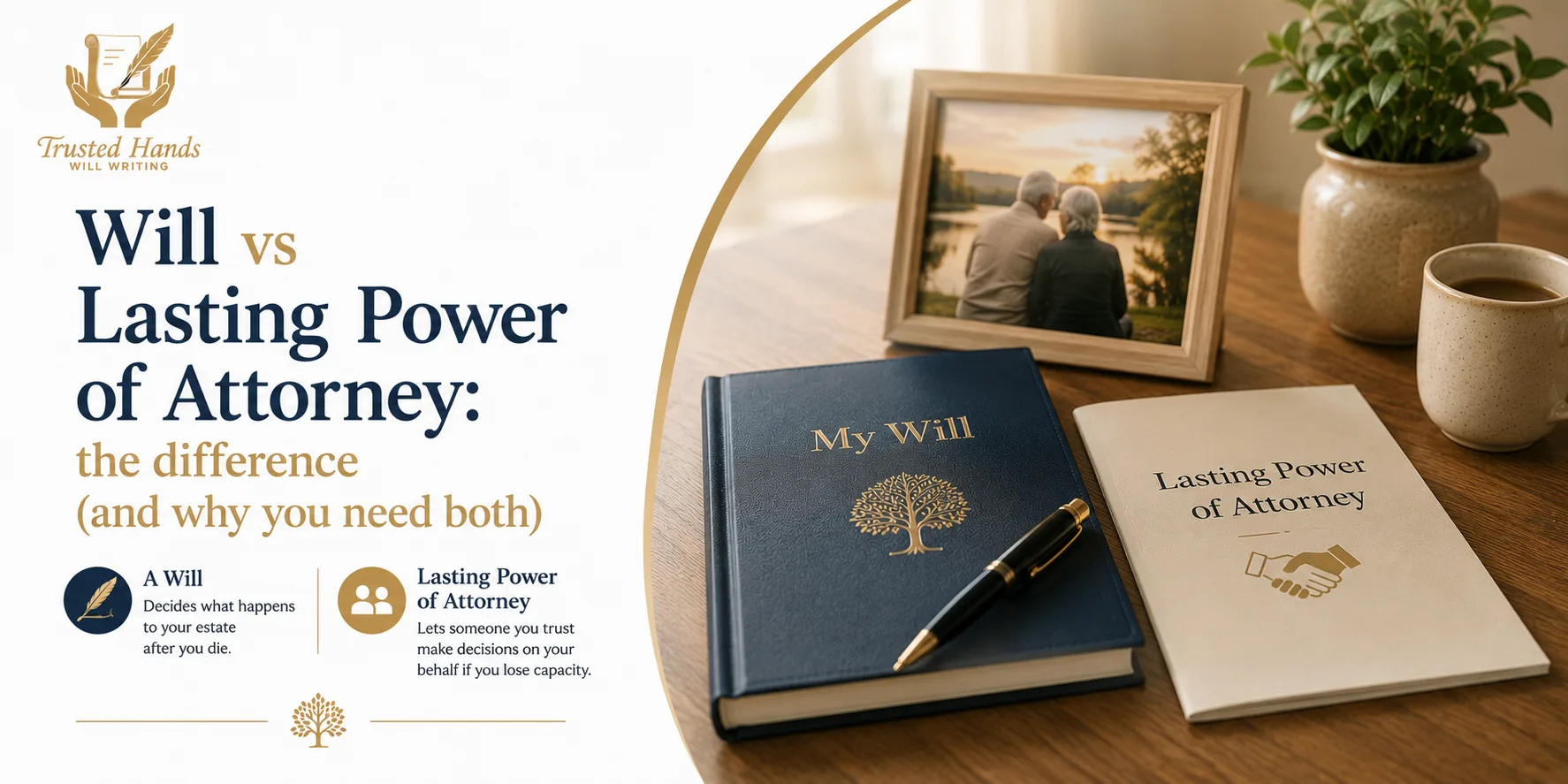
A will and a Lasting Power of Attorney (LPA) are the two most important legal documents most adults will ever sign — and they are routinely confused. They cover entirely different situations: a will controls what happens to your money and property after you die; an LPA controls what happens while you are alive but unable to make decisions for yourself. Both are essential, both are separate, and you usually need both.
This guide explains the difference, when each one matters, and why having one without the other leaves a serious gap in your planning.
Key takeaways:
- A will takes effect when you die. It says who inherits your estate, who acts as executor, and who looks after any children under 18.
- A Lasting Power of Attorney (LPA) takes effect while you are alive but have lost mental capacity. It says who can make decisions on your behalf.
- LPAs end on death; wills only apply on death. There is zero overlap — they cover different periods of your life.
- Most adults need both: a will, and both types of LPA (Property & Financial Affairs, and Health & Welfare).
- Without an LPA, your family must apply to the Court of Protection for a deputyship order if you lose capacity — slow, expensive and intrusive.
What each document actually covers
| | Will | Lasting Power of Attorney |
|---|---|---|
| When it takes effect | On your death | When you have capacity but choose to let attorneys act, or when you lose capacity |
| What it controls | Who inherits your estate; executors; guardians for children | Day-to-day decisions about money, property, health, care |
| Who acts | Executors (named in will) | Attorneys (named in LPA) |
| Where to register | Not registered during your lifetime | Must be registered with the Office of the Public Guardian (OPG) |
| Cost (2026) | From £49 for a single will | £82 OPG fee per LPA + preparation cost |
| Legal framework | Wills Act 1837 | Mental Capacity Act 2005 |
| Can it be changed? | Yes, by writing a new will or codicil | Yes, while you have capacity. After capacity loss, only the Court of Protection can change it. |
| What happens if you don't have one? | Intestacy rules decide who inherits | Family must apply to Court of Protection for deputyship |
Why you need both
Imagine you have a stroke at 65 and survive but lose the ability to manage your own affairs. Your will is irrelevant — you're still alive. Your bank freezes joint accounts the moment they're told. Your bills go unpaid. Care decisions need someone to make them. Without an LPA, your family has no legal authority to step in. They must apply to the Court of Protection for a deputyship — a process that takes 6-12 months and costs £1,000-£3,000.
Now imagine you recover, live another 10 years, and then die. Your LPA ended the moment you died. Your executors now need a will to follow. Without a will, your estate passes under intestacy rules — which may not match your wishes at all.
The two documents protect you in entirely different scenarios. Having one without the other is like buying car insurance but no home insurance, or vice versa. Each covers a different risk.
Common misconceptions
"I have a will, so I'm covered." Not for incapacity. Your will is dormant until you die.
"My spouse can just take over if something happens to me." Only if you're married and only for limited things. Banks won't accept verbal authorisation. The DWP won't release benefits. The local authority won't take instructions about your care. Marriage gives surprisingly little automatic authority over a partner's affairs.
"I'll just sort it out if it happens." You can only make an LPA while you have mental capacity. The moment capacity is lost, the option is gone permanently. By the time your family realises you need one, it may be too late.
"My LPA covers what happens after I die." No. LPAs end on death. Your attorneys' authority ends the second your death is confirmed. From that point, your executors named in your will take over.
"I only need one — the other is a nice-to-have." Both serve different purposes. Skipping one leaves a big gap.
What an LPA actually covers (a closer look)
There are two types of LPA in England and Wales:
### Property and Financial Affairs LPA
- Paying bills
- Collecting income, benefits, pensions
- Managing bank accounts and investments
- Selling or buying property
- Dealing with HMRC
- Running a business
This LPA can be used as soon as it's registered if you choose, or only when you've lost capacity.
### Health and Welfare LPA
- Day-to-day care and routine
- Where you live
- Medical treatment decisions
- Care home choices
- (If you specifically agree) life-sustaining treatment decisions
This LPA can only be used after you've lost capacity to make the decision yourself.
See our LPA explained guide for the full mechanics.
What a will actually covers (a closer look)
A will deals with everything in your estate after you die:
- Who inherits each part
- Who acts as executor (collecting in your assets, paying debts, distributing what's left)
- Who looks after any children under 18 (guardians)
- Specific gifts of money, items or property
- Charitable bequests
- Funeral wishes (though see our funeral instructions guide — a letter of wishes is usually better)
Without a will, the intestacy rules in the Administration of Estates Act 1925 decide. The rules don't know about unmarried partners, stepchildren, chosen charities or which of your children needs the most support.
Trusted Hands bundles will + both LPAs at a 25% discount. Build everything in one guided journey, save your draft as you go, and only pay when you're ready. Start your will + LPAs →
Order in which to do them
If you can only do one right now, do the will first if you have any property, dependants or specific wishes. Do the LPAs first if you're older or have any health concerns that make capacity loss a near-term risk. Ideally do all three within the same calendar year.
Frequently asked questions
Do my LPAs need to match my will?
Not legally, but for sanity they should align. If your will leaves everything to your spouse but your LPA names your sister as attorney, it works — but the people involved should at least know about each other.
Can my will appoint my attorneys?
You can name the same people, yes — many people do. The roles are different (attorneys act while you're alive but incapacitated; executors act after you die), but appointing the same trusted family members for both is common.
Are LPAs only for the elderly?
No. LPAs cover any loss of capacity at any age — stroke, accident, sudden illness, mental health crisis, dementia. The young and healthy are less likely to need them, but accidents and acute illness can happen to anyone.
Can I write my own LPA?
The forms must be the official OPG forms, but you can fill them in yourself, or use a guided service like Trusted Hands. You do not need a solicitor.
What if I have an LPA but no will?
If you die, the LPA ends and your estate passes under intestacy rules. Your former attorneys have no continuing role.
What if I have a will but no LPA?
If you lose capacity, the will is irrelevant. Your family must apply for a deputyship from the Court of Protection. The will only takes effect when you eventually die.
Are LPAs and "power of attorney" the same thing?
In modern UK practice yes. The older Enduring Power of Attorney (EPA) was replaced by LPAs in 2007. EPAs signed before October 2007 are still valid but only cover property and finance, not health and welfare.
Trusted Hands is a UK will-writing and LPA preparation service, not a firm of solicitors. The information above is general; for complex estates (large IHT exposure, business interests, trust planning, contested capacity) take regulated advice.
Get both sorted in one go
Trusted Hands offers a will + both LPAs bundle at 25% off:
- Will from £49, both LPAs from £179
- Bundle discount: 25% off the combined total
- Build everything in one guided online session
- Free Executor Pack with every will
- Annual Subscription with Family Vault for ongoing updates