
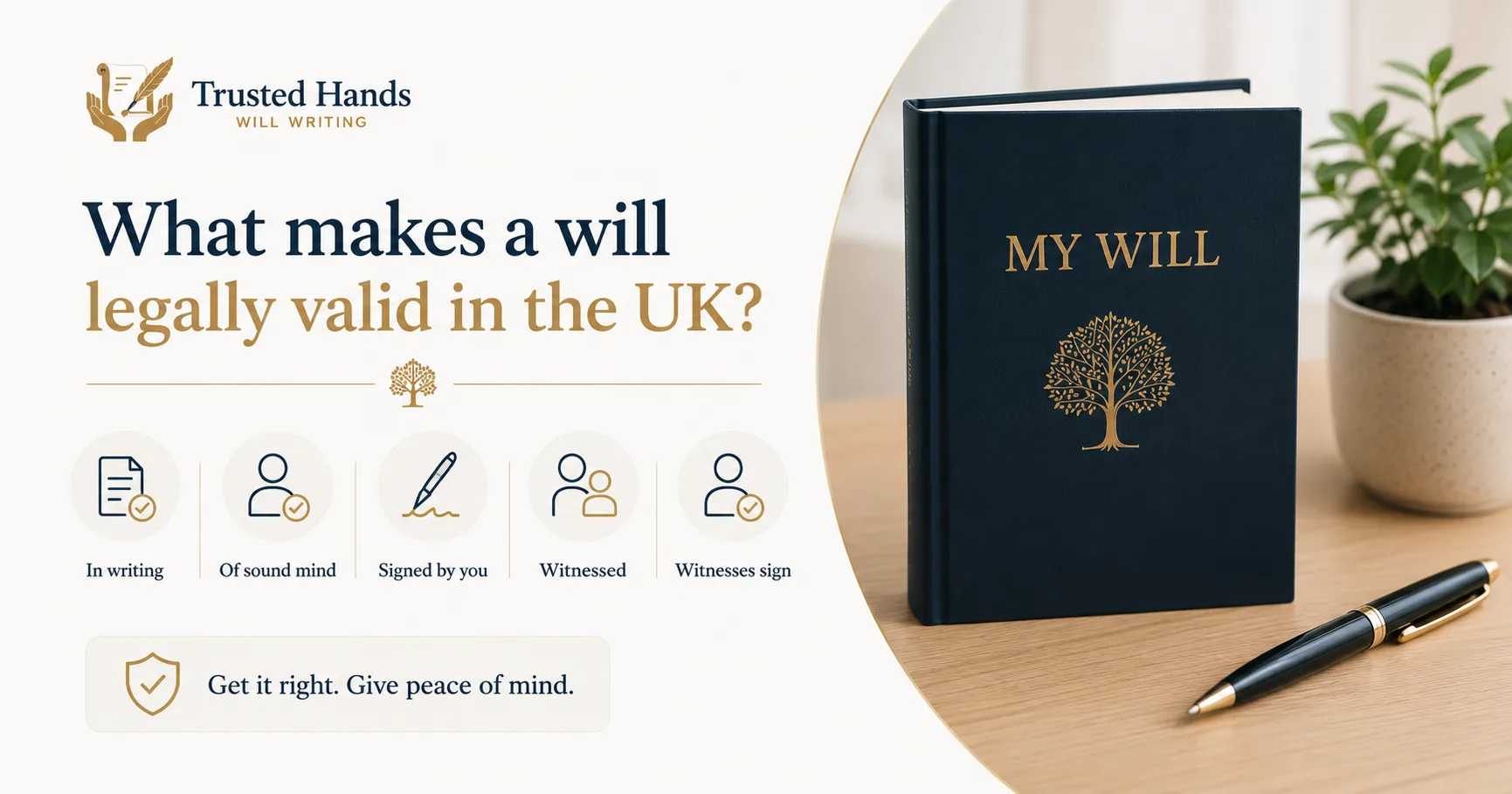
A will is only useful if it is legally valid - and the rules for validity in England and Wales are surprisingly specific. Most challenged wills don't fail because of bad drafting; they fail because someone got the formalities wrong. This guide covers exactly what makes a will legally valid in the UK, what can quietly invalidate one, and how to make sure yours stands up at probate.
The legal test in one section of one Act
Validity is governed by the Wills Act 1837 section 9. The test is short:
A will is valid if:
- It is in writing.
- It is signed by the testator (you), or by someone else in your presence and at your direction.
- The testator intends the signature to give effect to the will.
- The signature is made or acknowledged in the simultaneous presence of two witnesses, both adults.
- Each witness then signs the will, or acknowledges their signature, in the presence of the testator.
That is the entire core test. Everything else flows from it.
We explain section 9 in plain English in our Wills Act 1837 guide, but for now the practical question is: how do you make sure each requirement is satisfied?
Requirement 1 - in writing
The will must be a written document. Handwritten, typed, printed - all fine. Audio recordings, video messages, voice notes and emails are not valid wills in England and Wales, no matter how clear the intent.
The signed original on paper is the legal document. Photocopies and scans are useful as backups but they are not the will itself.
Requirement 2 - capacity and intent
Two related requirements sit alongside the formalities:
Mental capacity. You must have what the law calls testamentary capacity at the time of signing. The classic test (from Banks v Goodfellow) is that you must understand:
- The nature of making a will.
- The extent of your property.
- The people who might reasonably expect to inherit.
- That none of those people's claims should be improperly influenced.
Capacity is presumed unless something raises a doubt. If there is doubt - dementia, illness, medication - it can help to have a doctor's note from the day of signing.
Knowledge and approval. You must know what is in the will and approve it. This is why "blind signing" a document put in front of you is risky.
We cover capacity issues in more depth in losing mental capacity.
Requirement 3 - the testator's signature
You must sign the will. The signature can be your usual signature, your initials, a mark (an X), or even something less formal - but it must be intended to authenticate the will.
If you're physically unable to sign, the law allows another person to sign on your behalf, but they must do so:
- In your presence.
- At your direction.
- With clear evidence that this is what is happening.
Sign at the end of the will, after all dispositive clauses, ideally with the witnesses' signatures immediately below. Don't sign on a separate sheet that could be detached.
Requirement 4 - two witnesses, simultaneously present
This is where most invalid wills go wrong. The two witnesses must be:
- Both physically present at the same time when you sign or acknowledge your signature.
- Aged 18 or over.
- Of sound mind.
- Not beneficiaries of the will.
- Not married to or in a civil partnership with a beneficiary.
If a beneficiary witnesses the will - even a small gift - the gift to that beneficiary fails. The rest of the will normally still stands. It's an entirely avoidable disaster, and it happens regularly.
Witnesses don't need to read the will or know what's in it. They are witnessing your signature, not the contents. But they must see you sign (or you must acknowledge to them that the signature on the document is yours).
We explain the witnessing rules in detail in how many witnesses does a will need.
Requirement 5 - witnesses sign in your presence
After you sign, both witnesses must sign in your presence. If you've stepped out of the room and they sign while you're not there, the will is technically invalid. In practice, the safest approach is the whole sequence happening in one continuous sitting:
- You sign.
- Witness 1 signs.
- Witness 2 signs.
- Everyone is in the same room throughout.
Want a service that catches the witnessing pitfalls? Trusted Hands gives you clear step-by-step witnessing instructions and a 15-30 minute guided builder. Start free → - only pay when you download.
Other things that can invalidate a will
Beyond the section 9 formalities, several events can invalidate or partially invalidate a will:
Marriage. Marriage or civil partnership automatically revokes any earlier will, unless the will was specifically made in expectation of that marriage and says so. People who remarry without realising this often die intestate by accident.
Divorce. Divorce doesn't revoke the whole will, but it treats your ex-spouse as having predeceased you for the purposes of any gifts or appointments. Any gift to them lapses; if they were named as executor, they can no longer act.
A new will. A new will revokes all earlier ones, provided the new one says so (which any properly drafted one will).
Physical destruction. Tearing up, burning, or otherwise destroying a will - with the intention to revoke it - revokes the will. Accidental destruction does not.
Undue influence. If a court finds the testator was forced or pressured into making the will, it can be set aside. This is rare and hard to prove, but real.
Fraud. Forged signatures, swapped pages, fake codicils - all invalidate the will (and the people responsible commit serious offences).
What does not invalidate a will
Some common worries are unfounded:
- A typo or small error in the body of the will. Doesn't invalidate it. The court can interpret unclear language; obvious typos are usually ignored.
- Pages not initialled. Not a legal requirement, although it's good practice.
- The will being old. A will doesn't expire. A 30-year-old will signed correctly is still valid - though we'd suggest reviewing it.
- An out-of-date address for a beneficiary. Doesn't invalidate the gift. The executors trace the beneficiary at probate.
Practical steps to make sure your will is valid
If you take only one thing from this article: get the witnessing right. That is where the largest single category of failure happens.
A useful checklist:
- Two adult witnesses, present at the same time.
- Neither is a beneficiary; neither is married to a beneficiary.
- Sign and witness in one continuous sitting.
- Use a single black pen for everyone.
- Don't detach pages or staple anything new in afterwards.
- Store the signed original somewhere safe - and tell your executors where.
For complex estates, we recommend you seek assistance from a Trusted Hands Advisor or your own legal advice.
Frequently asked questions
Does a will need to be signed in front of a solicitor?
No. There is no requirement for a solicitor to be present. Two adult non-beneficiary witnesses, present at the same time, is the legal requirement. Most properly signed wills are witnessed by neighbours, colleagues or friends.
Can my children witness my will?
Only if they are not beneficiaries of the will (and not married to one). If a child is a beneficiary - which is usually the case - they cannot witness it. We cover this in who cannot witness a will.
Does a will expire after a number of years?
No. A will doesn't expire by itself. It remains valid until you revoke it (by a new will, by destroying it, or by marriage). That said, reviewing every three to five years is sensible because circumstances change.
What if I find a small mistake after signing?
Don't write on the will itself - that can cause problems. The proper fix is either a codicil (a separate signed and witnessed amendment) or a fresh new will. For anything more than a tiny correction, a fresh will is cleaner.
Can a digital or electronic signature work?
Not currently in England and Wales. The law still requires a wet-ink signature on paper. There have been discussions about reforming this, but as of 2026 the requirement stands.
Ready to write your will?
Trusted Hands is a guided, plain-English will builder. You answer simple questions, see your draft as you go, and only pay when you're ready to download.
- Free to start - no card details to begin
- Smart Will Engine - only asks what's relevant to your situation
- Fixed price - no hourly bills, no surprises
- Annual updates option - keep your will editable as life changes