
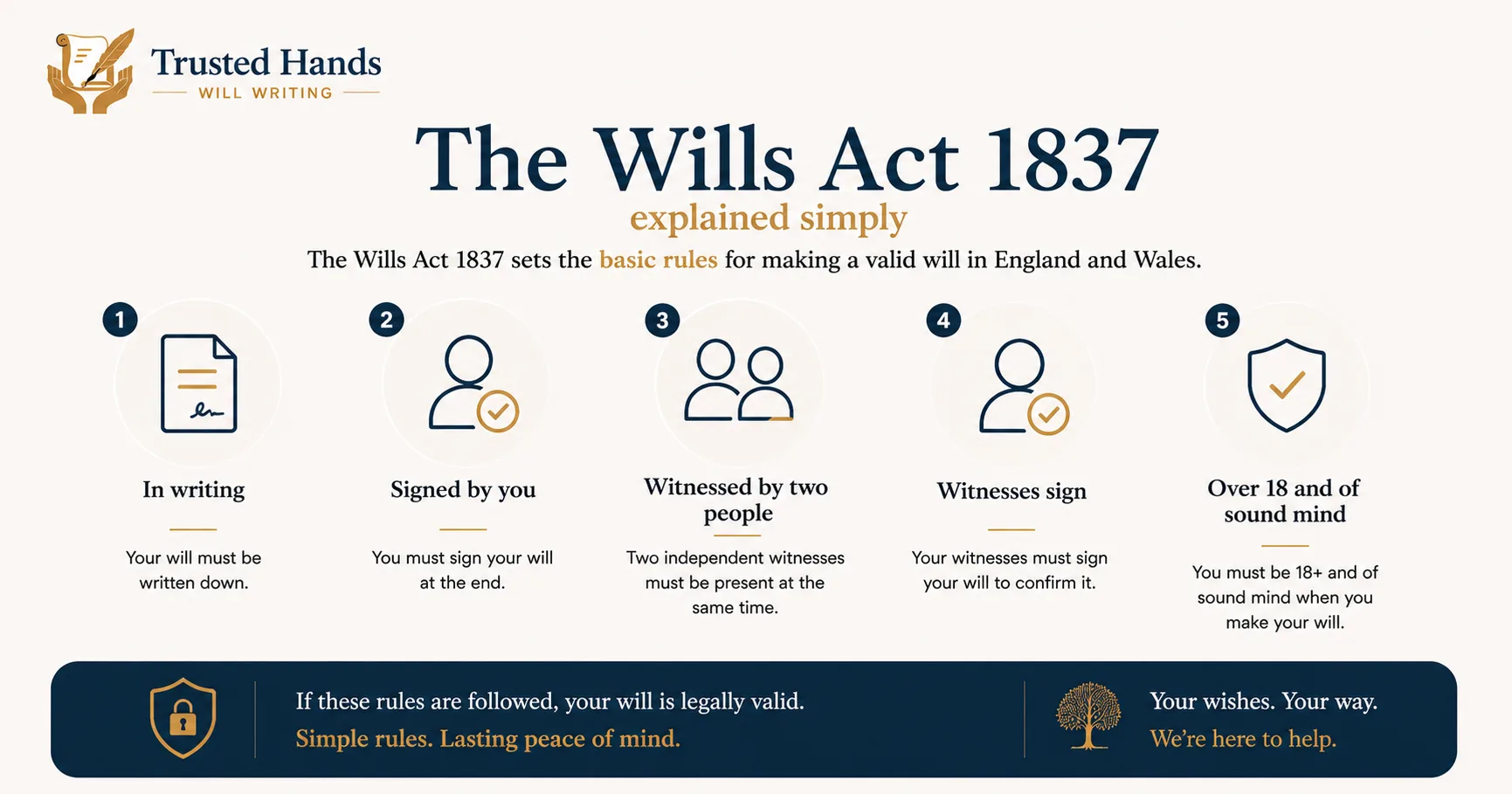
The Wills Act 1837 is the cornerstone of will-making in England and Wales. It is also nearly 200 years old, written in Victorian English, and almost never read by the people whose lives depend on it. This guide explains what the Act actually says, how it works in practice in 2026, and the small number of provisions everyone making a will needs to know.
Why an Act from 1837 still matters
Until 1837, English wills were a chaotic mix of overlapping rules - one set for personal property, another for real estate, different rules in different courts. The Wills Act swept that all away and created a single, uniform legal framework. The core formalities for making a will haven't substantially changed since.
Most of the day-to-day legal requirements you'll hear about - "two witnesses present at the same time," "must be in writing," "marriage revokes a will" - come directly or indirectly from this Act.
There have been amendments over the years (notably by the Administration of Justice Act 1982 and the Mental Capacity Act 2005), but the bones of the framework are still 1837.
Section 9 - the validity test (everyone's most important section)
If there is one section of the Wills Act you should know, it is section 9. It sets out the formalities for a valid will. As amended, it requires:
A will is valid only if:
- It is in writing.
- It is signed by the testator, or by some other person in their presence and at their direction.
- It appears the testator intended their signature to give effect to the will.
- The signature is made or acknowledged by the testator in the presence of two or more witnesses present at the same time.
- Each witness either attests and signs the will or acknowledges their signature in the presence of the testator (but not necessarily in the presence of any other witness).
In plain English: write it down, sign it, with two adults watching at the same time, and then both of them sign while you watch.
That is the foundation of every valid will in England and Wales. We unpack the practical detail in our legally valid will guide.
Section 7 - age requirement
Section 7 sets the minimum age for making a will at 18. Below that age, a will is not valid - with one narrow exception under section 11 for "privileged wills" made by people on active military service or seafarers at sea, who can make a valid will at any age and without the section 9 formalities. This is rare in modern practice.
Section 15 - the beneficiary witness rule
This is the section that catches people out most often. Section 15 says that if a witness (or their spouse or civil partner) is a beneficiary of the will, the gift to that beneficiary fails. The rest of the will is unaffected.
This means: never ask a beneficiary, or someone married to a beneficiary, to witness your will. Ask neighbours, colleagues, or friends instead. We explain the witnessing rules in who cannot witness a will.
The reason for this rule is to prevent witnesses from having a personal interest in the document they are vouching for. The Act preserves the will (so administration can still proceed) while taking away the gift that created the conflict.
Section 18 - marriage revokes a will
This is one of the more surprising provisions of the Act. Under section 18, marriage automatically revokes any earlier will, unless the will was made in expectation of the marriage and says so.
The same rule applies to civil partnerships under section 18B (added by the Civil Partnership Act 2004).
In practical terms: if you have a will from 2018 and you marry in 2026 without making a new will, your 2018 will is revoked the day you marry. You die intestate from then until you make a new will. This catches a lot of people, particularly second marriages.
If you write a will in expectation of a specific marriage, the will should say so explicitly - then it survives the wedding.
Section 18A - divorce treats former spouse as predeceased
Section 18A (added by the Administration of Justice Act 1982 and amended by the Law Reform (Succession) Act 1995) covers what happens after divorce.
After your decree absolute, any gift in your existing will to your former spouse, and any appointment of them as executor, takes effect as if they had died on the date the decree absolute was granted. The gift lapses; the appointment fails. The rest of the will stands.
The will is not automatically revoked. So a divorced person who hasn't updated their will isn't intestate - but they may have a will with significant lapsed gifts and a missing executor. Updating after divorce is strongly recommended. We cover this in will after divorce.
Section 20 - revocation by a new will or destruction
Section 20 sets out how a will can be revoked. There are essentially three ways:
- A new will that revokes earlier ones (any properly drafted will starts with a revocation clause).
- A signed and witnessed declaration of revocation, made with the same formalities as a will.
- Physical destruction of the will by the testator, with the intention of revoking it.
Important: accidental destruction does not revoke a will. If your will burns in a house fire, it is not revoked - though obviously it is much harder to prove its contents at probate.
Section 21 - changes after signing
Once a will has been signed and witnessed, you can't simply scribble changes onto it. Section 21 says any alteration or addition to a will after execution is invalid unless the alteration itself is signed and witnessed in the same way as the original will.
This is why crossing out a beneficiary in pen years later does nothing - it's not a witnessed amendment. The proper fix is either a codicil (a separate signed and witnessed amendment) or a fresh new will. For anything more than a typo, a new will is cleaner.
Want a builder that handles the formalities for you? Trusted Hands turns the Wills Act requirements into a clear 15-30 minute walkthrough. Start free → - only pay when you download.
Sections 24-27 - construction rules
The Act also contains a set of "construction" rules - default rules about how to interpret a will. Examples:
- Section 24: a will speaks from death (so "my car" means whatever car you owned at death, not when you signed).
- Section 25: a residual gift catches anything that fails for any reason.
- Section 27: a general gift of "all my property" does what it says.
These rules fill in gaps in the drafting. They're useful but they're no substitute for clear wording in the first place.
What the Act doesn't cover
The Wills Act 1837 governs the formalities and revocation of wills. It doesn't cover:
- Inheritance tax. That's the Inheritance Tax Act 1984.
- Intestacy. That's the Administration of Estates Act 1925.
- Family provision claims. That's the Inheritance (Provision for Family and Dependants) Act 1975.
- Mental capacity. That's the Mental Capacity Act 2005 (and case law like Banks v Goodfellow).
- Probate procedure. That's the Senior Courts Act 1981 and the Non-Contentious Probate Rules 1987.
A modern will sits within all of these. For complex estates, we recommend you seek assistance from a Trusted Hands Advisor or your own legal advice.
Frequently asked questions
Is the Wills Act 1837 still in force?
Yes, fully. It has been amended a number of times - most significantly in 1982 and 2004 - but the core framework is still the 1837 Act. Every valid will in England and Wales today is a section 9 will.
Does the Act apply in Scotland and Northern Ireland?
Scotland has a separate framework under the Succession (Scotland) Act 1964 and the Wills Act 1963. Northern Ireland has its own statutory framework. The Wills Act 1837 applies in England and Wales.
Can the formalities ever be relaxed?
Only in very narrow cases - section 11 privileged wills for armed forces and seafarers. Otherwise the section 9 formalities are strict. There are occasional reform proposals to allow electronic wills or to give courts power to validate wills with minor formal defects, but as of 2026 the strict rule still applies.
What happens if a will doesn't comply with section 9?
It is invalid. The estate is treated as intestate, unless there is an earlier valid will, in which case that earlier will applies. We cover the consequences in dying without a will.
Why do witnesses still have to be physically present?
Because section 9 requires it - "in the presence of two or more witnesses present at the same time." Remote video witnessing was temporarily allowed during the COVID-19 pandemic but is no longer in force as of 2026. Two adult witnesses, in the same room, at the same time, remains the rule.
Ready to write your will?
Trusted Hands is a guided, plain-English will builder. You answer simple questions, see your draft as you go, and only pay when you're ready to download.
- Free to start - no card details to begin
- Smart Will Engine - only asks what's relevant to your situation
- Fixed price - no hourly bills, no surprises
- Annual updates option - keep your will editable as life changes