
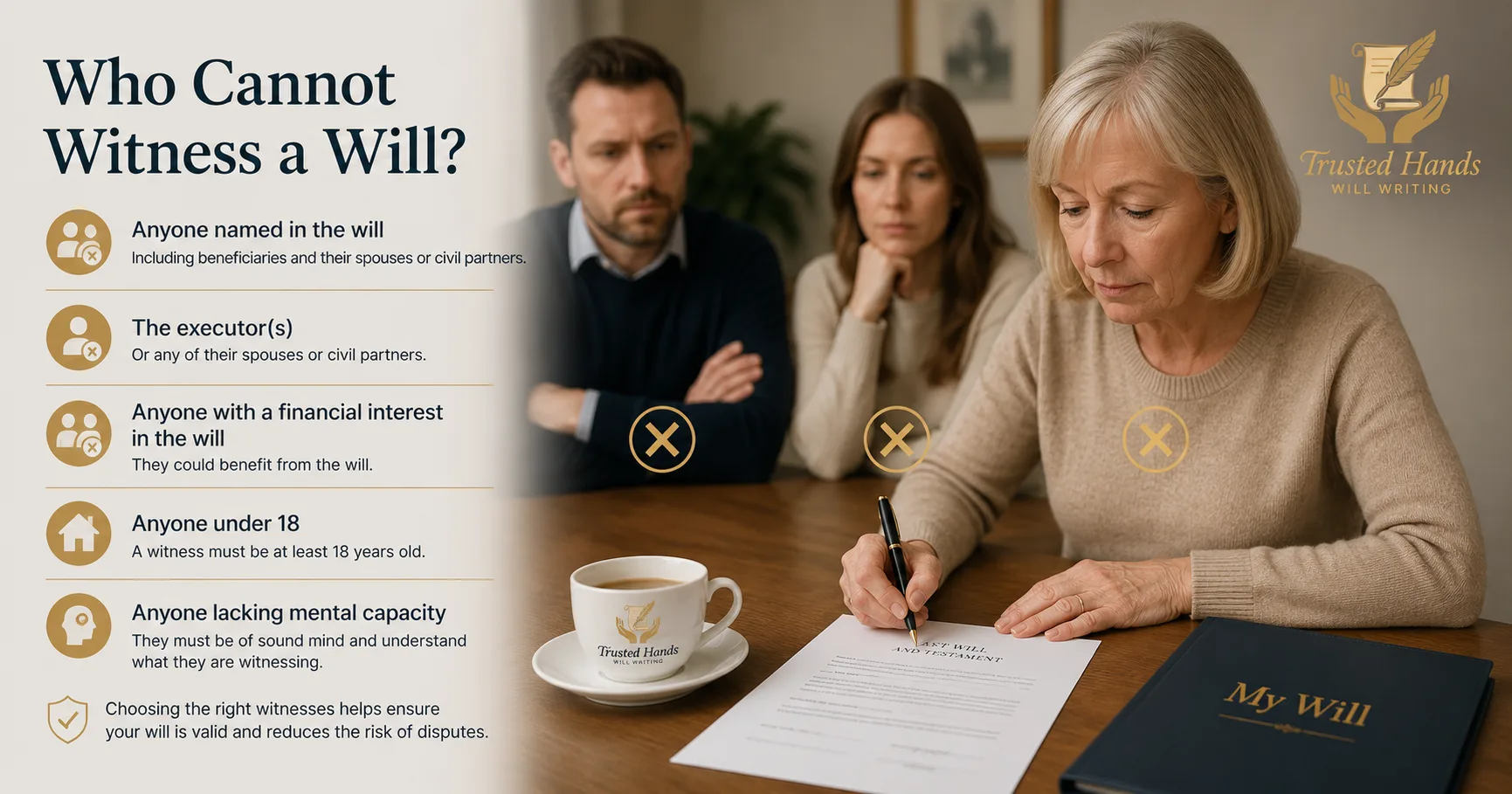
The list of people who cannot witness your will in England and Wales is shorter than the list who can - but the consequences of getting it wrong are big. A wrongly-witnessed will isn't necessarily invalid, but specific gifts can quietly fail, and the people you most wanted to provide for can end up with nothing.
This guide walks through every category of disqualified witness under English law, why each one is excluded, and what to do instead.
The two rules in one sentence
Under the Wills Act 1837, a witness must be 18 or over and of sound mind, and under section 15 of the same Act, a witness who is also a beneficiary - or married to or in a civil partnership with a beneficiary - cannot benefit from the will. The will itself usually stays valid; it's the gift to that person that fails.
That's it. There is no list of "approved" professions; there's no requirement that the witness be a UK citizen, or a homeowner, or a friend. Just: adult, capable, not a beneficiary or beneficiary's spouse, and able to see you sign.
1. Anyone under 18
A 17-year-old cannot validly witness a will, no matter how mature. The age-18 rule is hard - even if probate is granted years later, the witnessing has to have been valid on the day. This catches out families who ask a teenage child to act as a witness, especially in informal home-drafted wills.
The fix is obvious: use an adult.
2. Anyone who lacks mental capacity
A witness must understand that they are witnessing your signature on a legal document. Someone with severe dementia, advanced learning disability, or who is heavily intoxicated at the time of signing, cannot lawfully act as a witness. The threshold is not high - it's not the same as the capacity required to make the will yourself - but it is real.
In practice this is rare, because most people picking witnesses pick people they spend time with and would notice if there were a problem. But it matters in care home and hospital settings. Don't ask a fellow resident with significant cognitive impairment to sign.
3. Anyone who is blind, in the legal sense, at the moment of signing
This is a technical point and an uncomfortable one to put plainly. A witness must actually see you sign the will. Section 9 has been read by the courts to mean that someone who is registered blind cannot attest to seeing a signature, so cannot validly act as a witness in the traditional way.
It is not about disability in general - hearing impairment, mobility limitation, or anything else that doesn't affect being able to see the signature is fine. It's specifically about being able to see the act of signing.
4. Beneficiaries of the will
This is the big one - and the rule that most often goes wrong. Section 15 of the Wills Act 1837 says that if a beneficiary witnesses the will, the gift to that beneficiary is void. The rest of the will is unaffected; the witness's signature still counts; but their inheritance is gone.
So if your will leaves £20,000 to your son and your son signs as a witness, that £20,000 is treated as if it were never there. It falls back into the residuary estate and is divided up among everyone else.
There is one narrow exception: if the will would have been validly executed without the beneficiary's signature - because there were already two other valid witnesses - the gift can survive. But this is a fragile defence and not something to rely on. Pick neutral witnesses from the start.
5. The spouse or civil partner of a beneficiary
Section 15 extends the same rule to the spouse and civil partner of a beneficiary at the time of witnessing. So if you leave £20,000 to your daughter, and your son-in-law witnesses the will, the £20,000 to your daughter still fails.
Note: this only applies if the marriage or civil partnership existed at the time of witnessing. If your daughter married her husband five years after he witnessed the will, the gift survives. But you can't engineer that, so the practical rule remains: don't use beneficiaries' spouses as witnesses.
6. Anyone signing on your behalf (if they would benefit)
If you are physically unable to sign and you direct someone to sign on your behalf, that person is in a similar position to a witness. They should not be a beneficiary either, for the same reasons. This is rare in practice but worth flagging.
(If that's prompted you to want to clean this up, our online will builder walks you through witness selection and gives you a one-page witness guide to print and follow.)
Who CAN witness, then?
Anyone who is:
- 18 or over
- Mentally capable
- Able to see the signing
- Not a beneficiary
- Not married to or in a civil partnership with a beneficiary
In practice, the safe choices are:
- Neighbours you don't owe money or favours to
- Colleagues (provided they aren't named in the will)
- Friends from outside the immediate family
- Bank or building society staff - some branches will witness on request, though check first
- Notaries or solicitors - reliable, neutral, but they may charge
Avoid family members unless you're certain none of them are beneficiaries (and that no spouse of any beneficiary is involved).
What about the executor?
Your executor can witness the will, provided they are not also a beneficiary. Many wills name an executor who isn't getting anything (a professional friend, a solicitor, a paid professional executor) and they can witness perfectly well. A spouse or adult child who is both your executor and a major beneficiary - very common - cannot.
We have a fuller treatment of this in our executor-as-beneficiary guide and our piece on how to choose your executors.
What happens if you've already used the wrong witness?
Don't panic - and don't try to amend the existing will yourself with a pen. The fix is to make a new will that revokes the old one. This is straightforward: a fresh will, properly witnessed, with a revocation clause at the top, replaces the previous one entirely. The old, broken will becomes irrelevant.
If the testator has already died and you are the executor or family discovering the problem, you may need to take legal advice about whether the gift can be saved or what the practical effect is. For complex estates, we recommend you seek assistance from a Trusted Hands Advisor or your own legal advice.
Need to redo a wonky will? Trusted Hands lets you write a fresh, properly witnessed replacement in 15-30 minutes. Start free → - only pay when you download.
A simple checklist for the signing day
Before you sign:
- Have you printed the final version of the will (no hand-edits)?
- Are both witnesses 18 or over and mentally capable?
- Is either witness a beneficiary, executor-and-beneficiary, or married/civil-partnered to a beneficiary? If yes, find a different witness.
- Are you all going to be in the same room throughout?
- Do the witnesses have a pen and know to write name, signature, address and occupation?
If you can answer those five questions cleanly, you're ready to sign.
Frequently asked questions
Can my children witness my will?
If they are beneficiaries (which they almost always are), no. Their gift would fail. Use friends or neighbours instead.
Can my solicitor be a witness?
Yes, if they are not a beneficiary. Many solicitors will arrange witnessing as part of their will service. Some online builders, including Trusted Hands, leave you to organise your own neutral witnesses, which is normally faster and cheaper.
What if I find out later that one of my witnesses was a beneficiary's spouse?
The gift to that beneficiary may have failed under section 15. The simple fix is to make a new will, properly witnessed, that re-leaves the gift. The new will revokes the old one and the gift is restored.
Are doctors or nurses good witnesses for someone in hospital?
They can be excellent witnesses provided they are not beneficiaries. In hospitals and care homes, staff witnessing is common - just make sure none of them are mentioned in the will.
Can I witness someone else's will if I'm 17 turning 18 next week?
Not until you've actually turned 18. Wait the week.
Ready to write your will?
Trusted Hands is a guided, plain-English will builder. You answer simple questions, see your draft as you go, and only pay when you're ready to download.
- Free to start - no card details to begin
- Smart Will Engine - only asks what's relevant to your situation
- Fixed price - no hourly bills, no surprises
- Annual updates option - keep your will editable as life changes