
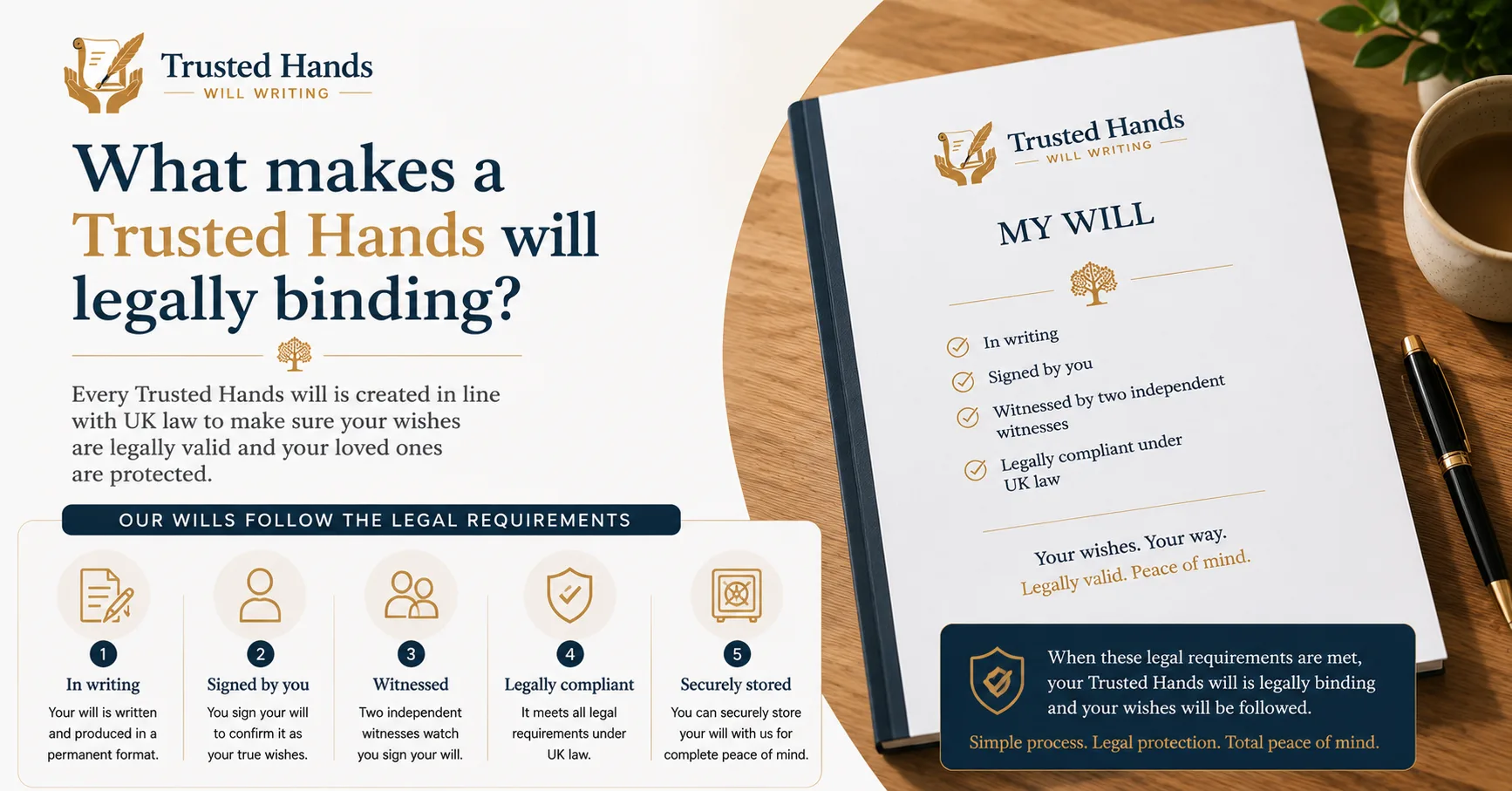
"Is an online will actually legal?" is one of the questions we hear most often, and it's a fair one. The answer in England and Wales is yes - provided the will meets the requirements of the Wills Act 1837. Those requirements aren't about who drafted the document; they're about how it's signed and witnessed. This guide walks through what makes a will legally binding in England and Wales, and where Trusted Hands fits into that picture.
The four legal requirements (England and Wales)
A will is legally binding in England and Wales when section 9 of the Wills Act 1837 is satisfied. The four requirements are:
- The will is in writing. Handwritten, typed or printed - all are fine. The Trusted Hands builder produces a printed document.
- The person making the will (the testator) signs it, or someone signs it in their presence and at their direction.
- The testator intends by their signature to give effect to the will.
- Two witnesses are present at the same time as the testator signs (or acknowledges their signature), and each witness signs the will or acknowledges their signature in the presence of the testator.
That's it. There's no need for a notary, no need to register the will anywhere, and no need for a solicitor to be involved. What matters is that those four conditions are met properly. Get them right, and the will is binding. Get any one of them wrong, and the will may be invalid - which is why so many home-made wills fail at the witnessing step.
You can read about the broader legal framework in our Wills Act 1837 explained guide.
Where the Trusted Hands process fits
A guided online builder can do two things to make sure those legal requirements are met. First, it can produce a properly drafted document. Second, it can guide you through the signing and witnessing so you don't fall at the last hurdle. Trusted Hands does both.
Drafting
The Smart Will Engine drafts your will in plain English, structured to meet the requirements of section 9. It includes:
- A clear identification of you as the testator (full legal name and address).
- A revocation clause that revokes earlier wills.
- Appointment of executors (and substitutes).
- Appointment of guardians, if you have children under 18.
- Specific gifts, residuary gifts, and any other dispositions.
- An attestation clause confirming that the signing and witnessing met the Wills Act requirements.
- A signature block for you and for two witnesses, with space for printed names, addresses and the date.
The attestation clause matters. If a will is later contested, the attestation clause is the first thing the probate registry looks at to confirm the will was properly executed. Our standard attestation wording follows the form recognised by the courts.
(If you'd like to see how the document is structured, start your will online - the draft preview shows you the layout from the first question.)
The witness guide
Most invalid wills fail at the witnessing step, not the drafting. That's why Trusted Hands includes a witness guide that walks through the signing in plain English. The guide covers:
Who can witness
Any adult of sound mind can witness, with one critical exception: a witness or their spouse cannot benefit from the will. If a beneficiary witnesses the will, the will itself is still valid but the gift to that witness fails. This is the single most common cause of partially-failed wills, and it's avoidable.
A handy rule: don't ask anyone in the will (or their spouse) to witness it. Pick neutral adults - neighbours, colleagues, friends who aren't beneficiaries.
We've written a longer piece on this in who cannot witness a will.
How the signing works
Both witnesses must be present at the same time when you sign. They must see you sign (or acknowledge a signature you've already made). They must then each sign in your presence. The phrase "in the presence of" means physically present and able to see - not in another room, not on a video call.
The witness guide shows you exactly where each person signs, what to write, and what to date.
What to do if a mistake is made
If anyone signs in the wrong place, or a date is wrong, the safest course is to start a fresh print of the document and sign that one. Crossing out and initialling on the original can work but creates needless ambiguity if the will is ever contested. Our guide explains both routes.
The complexity flagging system
The Wills Act requirements are about execution, not about the content of the will. A will can be properly executed and still be a poor fit for the estate it covers. That's where the complexity flagging system comes in.
As you answer the builder's questions, the engine watches for patterns that suggest your situation needs more than a standard will:
- A second marriage with children from a previous relationship.
- A trading business that needs to keep operating.
- A beneficiary with a disability who depends on means-tested benefits.
- Foreign property or assets held overseas.
- A beneficiary you can't locate.
In these situations the builder flags it clearly and offers you the option to switch to assisted mode. For complex estates, we recommend you seek assistance from a Trusted Hands Advisor or your own legal advice. The flag is about making sure the document fits the estate, not just the law.
What can invalidate a will
Even a properly drafted will can be invalidated. The main grounds are:
- Improper execution - failure to meet the four section 9 requirements (most common).
- Lack of testamentary capacity - the testator didn't understand what they were doing at the time of signing.
- Undue influence - the testator was pressured into the will's terms.
- Forgery or fraud - rare but does happen.
- Subsequent revocation - a later will revokes the earlier one, or marriage automatically revokes a will (unless the will was made in contemplation of that marriage).
Our will mistakes UK guide goes through the practical mistakes that lead to challenges. Our guide on contesting a will UK covers what happens when one is challenged.
Want a will that holds up in probate? Trusted Hands handles the drafting and walks you through the signing. Start free → - only pay when you download.
After signing - storage and retrieval
A signed will is only useful if your executors can find it. The Trusted Hands digital vault stores a digital copy of the signed will plus the recorded location of the physical original. You tell your executors where the original lives (a fireproof box, a bank deposit, a filing cabinet) and the digital copy is there as a back-up record.
The vault doesn't replace the original. The original signed and witnessed paper is the legally operative document. The digital copy is for reference, executor handover, and your own peace of mind.
Keeping the will valid over time
A will doesn't expire, but circumstances change. Marriage automatically revokes a will in England and Wales unless the will is made "in contemplation of" that marriage. Divorce removes a former spouse's entitlements and their appointment as executor, but does not revoke the rest of the will.
If you'd like to update your will to reflect a new circumstance, the annual updates subscription keeps your will editable in the builder. You log in, change what's changed, re-render the document, and re-sign and re-witness it. The new will revokes the old one.
For more on when an update is needed, see updating your will online.
Frequently asked questions
Is a Trusted Hands will valid in Scotland or Northern Ireland?
No. The Wills Act 1837 applies in England and Wales. Scotland and Northern Ireland have their own succession law - if you live in either, you'll need a will drafted under that jurisdiction.
Do I need to register the will anywhere?
No. England and Wales has no compulsory will register. You can choose to register a will privately for an extra fee (the National Will Register is one option), but it's not required for the will to be binding.
Can a witness be a relative?
Yes - a relative can witness, provided they are not a beneficiary and are not married to a beneficiary. Adult children who aren't named in the will can witness it; an adult child who is a beneficiary cannot, or their gift will fail.
What if my circumstances are complex?
The complexity flagging system surfaces it as you go. For complex estates, we recommend you seek assistance from a Trusted Hands Advisor or your own legal advice.
Is a digital signature acceptable?
No. Section 9 of the Wills Act 1837 requires a wet signature - ink on paper, in person, in the presence of two witnesses. There have been temporary exceptions (during the pandemic, video witnessing was allowed under specific rules), but the current law is wet signatures.
Ready to write your will?
Trusted Hands is a guided, plain-English will builder. You answer simple questions, see your draft as you go, and only pay when you're ready to download.
- Free to start - no card details to begin
- Smart Will Engine - only asks what's relevant to your situation
- Fixed price - no hourly bills, no surprises
- Annual updates option - keep your will editable as life changes